

Strategic Plan 2025-2030
The JCQ strategic plan 2025-2030 is our commitment to the schools, colleges, and students who rely on us. By continuing to work together, we will ensure the UK’s qualifications system remains robust, equitable, and fit for the future.
This document can be viewed using the interactive browser on this page, or downloaded as PDF using the following link.
A Message from the Chairperson
Collaboration, Integrity, and Progress
For over 25 years, JCQ has been central to providing consistency in assessment delivery across the UK, uniting awarding organisations to reduce complexity for schools, colleges, and students. As Chair of the Board, I am proud to present a strategy that builds on this legacy while addressing the unprecedented challenges of today’s educational landscape.
The UK’s qualifications system stands at a pivotal moment. Ongoing reforms in qualifications and education, coupled with rapid technological advancements and evolving expectations of students and employers, require a responsive and forward-thinking approach. This strategy reflects JCQ’s core purpose as a Community Interest Company: to act for the benefit of the education community, ensuring fairness, transparency, and operational parity across both general (GQ) and vocational and technical qualifications (VTQs).
Central to our approach is collaboration. Our eight-member awarding organisations—AQA, CCEA, City & Guilds, NCFE, OCR, Pearson, SQA, and WJEC/Eduqas, bring unparalleled expertise to the table. Together, we have navigated sector-wide challenges, from pandemic recovery to managing qualification reforms, by fostering unity and shared purpose. This strategy builds on that collaborative foundation, ensuring JCQ remains a trusted partner for all stakeholders.
This document represents more than just a strategy, it is a commitment to the schools, colleges, and students who rely on us. By continuing to work together, we will ensure the UK’s qualifications system remains robust, equitable, and fit for the future.
Jill Duffy
Chair, JCQ Board
Chief Executive Officer’s Introduction
Charting Our Path: JCQ’s Strategic Vision 2025–2030
At JCQ, our mission is clear: working alongside our members, we aim to reduce bureaucracy for schools and colleges across the UK, by providing consistent assessment administration guidance covering our members’ general, vocational and technical qualifications.
This strategy, rooted in feedback from our members and stakeholders, sets out how we, as an awarding organisation membership body, will continue to bring members together to deliver our mission between 2025 and 2030.
Key to our success will be our five strategic objectives:
- Simplifying Assessment Administration: Streamlining processes and guidance to reduce bureaucracy for centres.
- Enhancing Support for VTQs: Advancing clarity and best practice in the administration of vocational and technical qualifications.
- Building Strategic Alliances: Strengthening partnerships across the education sector.
- Engaging a Dynamic Membership Community: Supporting and connecting our members to drive excellence.
- Driving Operational Excellence: Investing in our people, technology, and governance to ensure resilience and efficiency.
The past decade has tested the resilience of the education sector from the pandemic to the growing range of VTQ pathways. Today, we build on that foundation through a commitment to our members, to develop our shared services, deepen sector partnerships, and enhance our guidance for schools and colleges. JCQ remains ready to support our members in responding to new challenges, unexpected disruptions, and ongoing qualification reform.
I am confident that, guided by this strategy, JCQ will continue to support the integrity of assessment administration across the UK, while enabling the innovation needed to meet tomorrow’s demands.
Margaret Farragher
Chief Executive, JCQ
JCQ Strategic Plan 2025-2030
BACKGROUND
The Joint Council for Qualifications (JCQ) is a membership organisation representing the eight leading awarding organisations in the UK: AQA, CCEA, City & Guilds, NCFE, OCR, Pearson, SQA, and WJEC/Eduqas. JCQ’s member awarding organisations deliver high-stakes vocational and general qualifications that feature in performance tables and other lists of publicly funded qualifications published by the UK Government and the devolved administrations in Scotland, Wales, and Northern Ireland. These qualifications are regulated and contribute to national accountability measures, supporting progression to further study and employment across all four nations of the UK.
KEY FACT
JCQ member organisations collectively offer more than 3,600 subject qualifications.
Although JCQ works closely with UK qualifications regulators and government departments which are responsible for regulation and policy, it is not a regulator, does not set policy, and cannot direct awarding organisations. JCQ’s role is to bring members together to agree common administrative arrangements and guidance, supporting consistency for schools, colleges, and other educational establishments, and helping members meet regulatory requirements.
As a Community Interest Company, JCQ’s purpose is to benefit the education community by establishing and maintaining consistent administrative arrangements for assessments, and by supporting our members and centres across the United Kingdom to respond effectively to policy and regulatory developments.
”Having consistent processes across JCQ awarding organisations reduces our admin burden and helps us focus on supporting students”
EXAMS OFFICER
In accordance with JCQ’s Articles of Association, our aims are realised through coordinated action, enabling us to ensure that schools, colleges, other educational establishments and the wider education community are supported by robust and effective systems for the delivery of qualifications.
JCQ’s aims are to
- Reduce bureaucracy for schools and colleges by facilitating and delivering common administrative arrangements for examinations.
- Provide a forum for strategic debate, information exchange, and expression of common interest amongst awarding organisations.
- Enable founding member awarding organisations to jointly express views and collectively respond to national issues.
- Provide a channel for collective discussion with key stakeholders including the HE sector, teachers, and their representative organisations.
These are achieved through collaboration among our eight-member awarding organisations:
 |  |  |  |
 |  |  |  |
History of JCQ
JCQ was set up in 1998. It was formed by five UK awarding organisations—AQA, CCEA, OCR, Pearson and WJEC—who established the Joint Council for General Qualifications (JCGQ) as an unincorporated association.
1998-2000 – FORMATION AND CREATION OF ICE
Between 1998 and 2000, the JCGQ created the Instructions for Conducting Examinations (ICE), which remains an essential document for all UK schools, colleges and, other educational establishments.
2003 – EXPANSION AND STRUCTURAL REFORM
City & Guilds (C&G) and the Scottish Qualifications Authority (SQA) became members, prompting a rebrand to the Joint Council for Qualifications (JCQ) to reflect its broader remit.
2004 – EXPANSION AND STRUCTURAL REFORM
JCQ established the Centre Inspection Service to ensure consistent standards in exam delivery across England, Wales, and Northern Ireland and compliance with the newly formed JCQ regulations and instructions.
2007 – EXPANSION AND STRUCTURAL REFORM
JCQ developed the first General Regulations for Approved Centres, a document that sets out the standards and requirements that schools, colleges and other educational establishments must meet to deliver the examinations and assessments of its member awarding organisations.
2011 – DIGITAL INNOVATION
Following the transfer of responsibility from the Qualifications and Curriculum Development Agency (QCDA), JCQ launched its Access Arrangements Online (AAO) platform, allowing centres to submit applications for examination access arrangements (e.g., extra time, modified papers). This replaced some paper-based processes and multiple awarding organisation systems, reducing administrative duplication for centres.
KEY FACT
JCQ member organisations collectively issue over 8.9 million awards across all qualification types, annually.
2018 – SYSTEM ENHANCEMENTS AND MEMBERSHIP GROWTH
NCFE joined JCQ, further diversifying its expertise and reinforcing its role as a unified voice for both general and vocational qualifications.
The AAO system expanded to include applications for alternative exam arrangements, such as overnight supervision, transferred candidates, and late arrivals.
This streamlined compliance for centres managing complex logistical challenges.
2019 – ADDRESSING MODERN CHALLENGES
JCQ commissioned the Independent Commission on Examination Malpractice, chaired by Sir John Dunford, to address emerging challenges within the sector. Its recommendations shaped guidelines for present day malpractice management, exam security and centre accountability.
2020-2021 – THE PANDEMIC AND INCREASED VTQ FOCUS
This period marked an increased focus as JCQ built on its ongoing support for VTQs, working to streamline assessment arrangements, reduce bureaucracy for schools, colleges and other educational establishments, and offer students greater clarity.
During the COVID-19 pandemic, JCQ provided standardised guidance to schools and colleges, on evidence-based assessments, aligned with taught content, alongside quality assurance processes. This framework enabled students to progress in their education through unprecedented disruption.
2025 – ASSOCIATE MEMBERSHIP
JCQ introduced its new Associate Membership scheme, welcoming OCNNI as the first associate member. This milestone broadens JCQ’s collaboration with awarding organisations of all sizes and builds stronger links across the UK.
Mission and impact
Throughout its history, JCQ has focused on reducing bureaucracy while safeguarding the integrity of UK qualifications.
By harmonising processes across our members, which now span general, vocational, and technical qualifications, it ensures fairness for students and consistency in the delivery of assessments.
JCQ Shared Services
Centre Admin Portal (CAP) and Access Arrangements Online (AAO):
CAP is used by JCQ-registered centres in England, Wales, and Northern Ireland, to process access arrangements applications, modified papers, and other administrative tasks. Integrated with Access Arrangements Online (AAO), CAP enables centres to process applications efficiently, in line with JCQ regulations. CAP facilitates once-only applications across all member awarding organisations, streamlining processes by centralising arrangements such as consortium approvals, transferred candidates, and very late arrivals.
Data Transport Application:
The Data Transport Application provides a secure and automated method for transferring entry, amendment, and results file data between centres, awarding organisations, and MIS providers. This system ensures encrypted data transmission, protecting sensitive information from unauthorised access or breaches during transfer. By streamlining data exchange processes, the Transport application supports efficient communication between stakeholders while maintaining compliance with data standards.
KEY FACT
JCQ’s Access Arrangements Online System processes over 230,000 applications each year.
Centre Inspection Service (CIS):
The CIS operates across England, Wales, Northern Ireland, and some international centres, inspecting every centre listed in the National Centre Number (NCN) standard register to ensure compliance with JCQ regulations for assessment conduct and delivery. CIS plays a vital role in safeguarding the integrity of the examination system by supporting member awarding organisations in meeting requirements such as the General Conditions of Recognition. Feedback from inspections informs updates to key JCQ guidance documents such as the Instructions for Conducting Examinations (ICE) and malpractice guidelines. CIS also identifies centres requiring additional support or guidance in exam delivery, ensuring a proactive approach to maintaining high standards across all schools, colleges, and other educational establishments.
JCQ’s guidance is always clear and accessible — having everything in one place makes a real difference during busy exam periods.”
EXAMS OFFICER
National Centre Number Register (NCNR):
The NCNR maintains essential contact information for centres across the UK and conducts thorough annual updates to ensure accuracy and compliance. Divided into two sections, the standard register for schools and colleges administering general qualifications and vocational and technical qualifications with timetabled components/units, and the higher register for centres approved to conduct vocational and technical qualifications, the NCNR supports various JCQ shared services such as CAP/AAO and CIS. By providing accurate data, the NCNR ensures awarding organisations can operate confidently while contributing to the overall integrity of the examination system.
Guidance for Schools, Colleges and Other Educational Establishments – Helping To Uphold the Integrity of the UK Examinations System
JCQ committees and working groups play a key role in developing and reviewing high-quality guidance documentation that supports centres in delivering assessments effectively. These resources are created by industry experts and reviewed for legal compliance. The guidance streamlines administrative processes for schools and colleges while maintaining the integrity of assessments. Guidance produced by JCQ includes the following:
- A guide to the awarding bodies’ appeals processes
- A guide to the special consideration process
- Access arrangements and reasonable adjustments
- General regulations for approved centres
- Instructions for conducting coursework
- Instructions for conducting examinations (ICE)
- Instructions for conducting non-examination assessments – GCSE and GCE qualifications
- Instructions for conducting non-examination assessments – vocational and technical qualifications
- Key dates in the examination cycle
- Post-Results Services – information and guidance to centres
- Suspected Malpractice – policies and procedures
KEY FACT
Over 7,000 centre inspections are carried out annually by JCQ across England, Wales, and Northern Ireland.
Communications and Stakeholder Engagement
JCQ is committed to keeping schools and colleges informed and supported throughout the academic year. Schools, colleges and other educational establishments receive a monthly newsletter with timely information about guidance, resources, and sector updates. In addition, JCQ produces tailored bulletins for senior leaders and dedicated newsletters on current topics such as artificial intelligence and cyber security. Engagement with the sector is further strengthened through regular meetings with teacher associations, providing an opportunity to listen to concerns and share updates on JCQ activities. Throughout the year, JCQ also liaises with these associations to seek feedback on specific issues, ensuring that the needs and perspectives of centres are reflected in ongoing developments.
The JCQ Exams Officers briefing was one of the best exam related webinars I have ever attended. Even as an experienced and long-standing Exams Officer it felt really relevant, useful and informative and great as a refresher ahead of the summer exam series.”
EXAMS OFFICER
Support for Private Candidates
JCQ recognises the important role that private candidates, such as home-educated students, adult learners, and those studying independently or through distance learning, play in the UK qualifications system. To support these students, JCQ provides clear guidance for centres and private candidates, ensuring access to information about entry requirements and assessment arrangements. JCQ maintains an online tool to help private candidates identify centres that may be willing to accept their entries.
JCQ Common Timetable Group
The JCQ Common Timetable Group develops, consults and publishes common timetables for major examination series, including the GCSE November series and the GCSE and GCE June series. The group aims to ensure, as far as possible, that examination dates are aligned across all member awarding organisations, for the benefit of centres and students. The group’s recent work has focused on reducing timetable clashes between GQ and VTQ in the summer exam period to further minimise disruption for students.
Whenever there’s a new challenge—like changes to access arrangements or technology—the JCQ updates and webinars keep us ahead of the curve.”
EXAMS OFFICER
Cyber, Information and Security Group:
In an increasingly digital world, JCQ’s Cyber, Information and Security Group is at the forefront of protecting sensitive qualifications data from emerging threats. This group brings together cyber experts from member awarding organisations and relevant stakeholders to ensure robust security measures are in place across the sector. By promoting good cyber hygiene practices and promptly sharing information on vulnerabilities, JCQ helps safeguard assessments while enhancing cyber maturity within centres.
Vocational and Technical Qualifications Programme Board:
This board focuses on simplifying and standardising VTQ delivery across member awarding organisations where possible. By embedding principles of simplicity, consistency, clarity, and quality into VTQ provision, the board ensures centres and students benefit from streamlined processes, where these are achievable, while providers can navigate complex requirements more effectively.
UCAS Data Sharing Agreement:
JCQ, through a Data Sharing Agreement with UCAS, establishes the framework for its member to share student outcomes securely and on time. This coordinated approach supports members in meeting publication day deadlines and contributes to the efficient and reliable administration of university admissions.
KEY FACT
JCQ member organisations collectively manage over 26 million scripts and pieces of coursework.
Access to Plagiarism Detection Software:
JCQ provides our members access to plagiarism detection software via an annual group license managed by its Malpractice Committee. This tool supports awarding organisations in investigating suspected cases of malpractice while upholding academic integrity across assessments.
Music Publishers Association Agreement:
Through its partnership with the Music Publishers Association, JCQ facilitates access to licensed musical works, enabling our members to include a wide range of music genres in examinations and assessments.
Results Analysis and Insights:
On results days, JCQ provides immediate insights into qualification results across its member awarding organisations and the wider stakeholder group across the UK. This service includes secure data transfer for embargoed results into JCQ for analysis and publication. The insights generated are invaluable for centres, stakeholders, members of the press, and policymakers in understanding trends within the education sector.
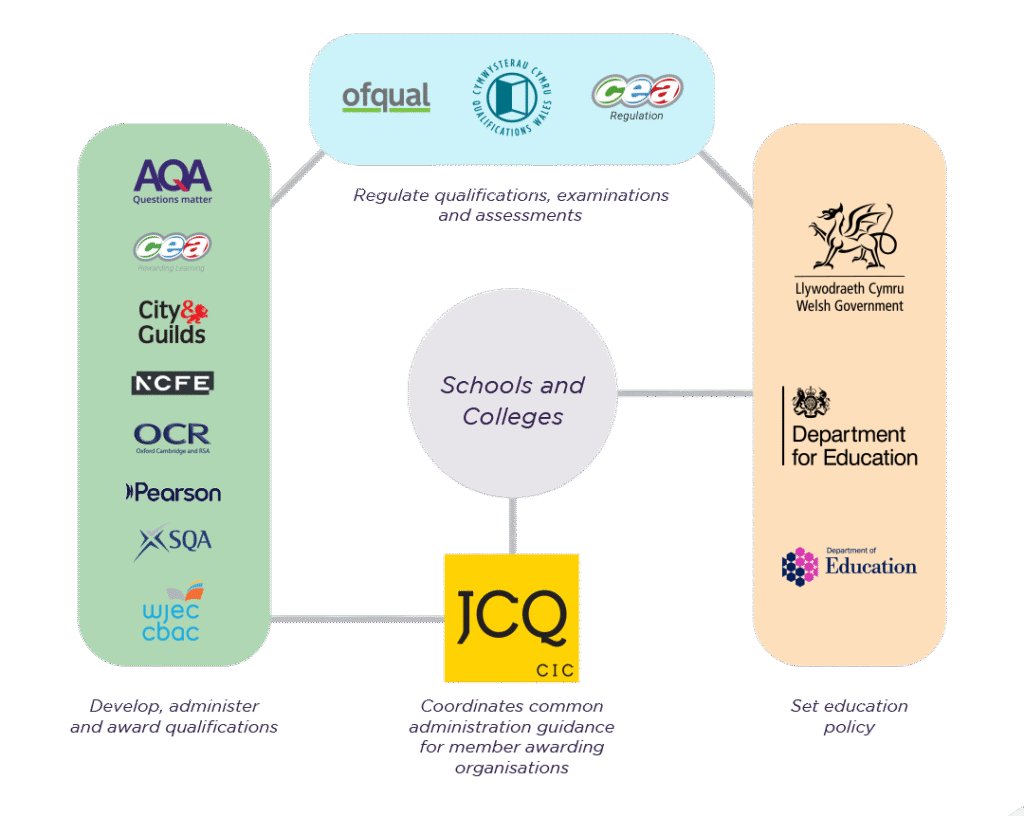
The JCQ Ecosystem
KEY FACT
JCQ member organisations collectively provide assessments in over 6,000 centres across the UK.
JCQ’s Vision and Mission
Vision
To set the benchmark in qualifications administration, making guidance and processes clear, equitable and accessible.
Mission
JCQ’s mission is to provide clear and consistent administration arrangements for qualifications, supporting member awarding organisations and streamlining processes for schools, colleges and other educational establishments. This enables effective and equitable assessment delivery for the benefit of education providers and students across the UK.
KEY FACT
97% of attendees rated JCQ’s “New to Role” Exams Officer Webinars as professional and valuable.
Strategic themes
The JCQ Strategy, 2025-2030 is structured around five strategic themes. These themes define the key areas JCQ will focus on to achieve its vision and guide the organisation’s priorities, ensuring focus, coherence, and alignment across all activities and programmes. The themes are:
1. Supporting Excellence in Assessment Conduct and Administration
2. Enhancing Support for Vocational and Technical Qualifications (VTQs)
3. Building Strategic Alliances
4. Engaging a Dynamic Membership Community
5. Driving Operational Excellence: Enhancing Our Staff, Technology and Data Strategy
KEY FACT
Over the past year, JCQ’s Instructions for Conducting Examinations (ICE) guidance attracted 157,000 webpage views from 54,000 unique users.
“Through JCQ membership, awarding organisations have a valued platform to engage, exchange ideas, and develop common approaches to key challenges.”
JCQ MEMBER
“Having such clear and thorough JCQ guidance across all areas means we can be sure our processes are fair—and that every student is treated equally during assessments.”
EXAMS OFFICER
“The committees create a supportive safe environment where complex issues may be discussed.”
JCQ MEMBER
“JCQ committees provide a valuable function for AOs to interact and agree common principles.”
JCQ MEMBER
“The committee has a depth of knowledge which can be called upon.”
JCQ MEMBER
1. Supporting Excellence in Assessment Conduct and Administration
This theme is central to JCQ’s mission to align assessment administration by facilitating collaboration among its members. Its focus is on making assessment processes more consistent, efficient, and effective throughout the UK education sector.
The main goal is to reduce bureaucracy for schools, colleges and other educational establishments by simplifying exam administration. This is achieved through ongoing review and improvement of guidance, support, and communications, promoting consistency and clarity while also upholding the integrity and security of the UK qualification system.
The theme also emphasises building resilience across JCQ, our members, and the wider education sector. By developing a strong, efficient, and adaptable qualifications system, we aim to prepare for and manage evolving challenges and unexpected disruptions, ensuring the integrity and continuity of assessments.
Our aim is to support schools, colleges, and other educational establishments across the UK by providing clear, consistent communications on JCQ examination arrangements. Through guidance, support, and signposting, we help centres prepare for a range of scenarios, keeping them informed and enabling effective delivery of qualifications. While JCQ works with the UK qualifications regulators and government departments who regulate and set policy, we are not a regulatory body and do not direct awarding organisations. Instead, as a membership body, JCQ brings awarding organisations together to develop common administrative arrangements and guidance, providing consistency for centres and supporting members with compliance to regulatory requirements.
To achieve this strategic objective, JCQ will focus on the following strategic commitments, each designed to improve assessment administration, strengthen support for centres and members, and ensure the qualifications system remains robust and responsive.
OUR STRATEGIC COMMITMENTS. WE WILL:
- Continue to streamline assessment administration processes, across a wide range of GQs and VTQs.
- Develop and maintain high quality guidance, streamlined processes and shared services.
- Align organisational goals with stakeholder expectations.
- Implement continuous improvement methodologies.
- Enhance communication to promote transparency and collaboration.
1. Supporting Excellence in Assessment Conduct and Administration
To deliver on our strategic commitments we will:
1.1 Continue to develop and maintain common timetables and administrative arrangements that support the effective delivery of General and Vocational and Technical Qualifications, through regular consultation with stakeholders and sharing of outcomes.
1.2 Continue to review JCQ’s suite of guidance documentation to reflect regulatory requirements and evolving sector needs.
1.3 Continue to review and refine the centre inspection service, ensuring it remains fit for purpose and flexible for all types of centres.
1.4 Review and enhance the National Centre Number Register to support effective awarding organisation and centre administration.
1.5 Support effective stakeholder engagement by gathering feedback and insights from centres, members, teacher associations and other partners through regular meetings and an annual consultation to inform future communications and service development.
1.6 Facilitate lessons learned exercises and continuous improvement following examination series.
1.7 Enhance support for exams officers and other centre staff by offering targeted webinars, podcasts, and digital resources.
1.8 Strengthen JCQ’s digital presence by improving the website’s accessibility, user experience, and alignment with stakeholder needs.
1.9 Promote transparency and accessibility by publishing qualification results, press notices, and supporting materials on results days evolving in line with the needs of the sector.
2. Enhancing Support for Vocational and Technical Qualifications
JCQ recognises the vital role that VTQs play in equipping students with practical, job-specific skills that meet industry needs and bridge the gap between education and employment. We also understand the challenges centres face in administering VTQs.
To address these challenges, JCQ and its member awarding organisations are committed to streamlining VTQ administration wherever possible. This includes expanding shared services, such as online access arrangements, and developing VTQ guidance and resources to support schools, colleges, and other educational establishments. Through these efforts, we aim to assist centres in maintaining the integrity of the examination system, ensuring VTQ administration is efficient, accessible, and upholds the highest standards of fairness and trust.
JCQ is committed to further supporting VTQ administration by working collaboratively with member awarding organisations to publish key dates and deadlines as part of the biannual common timetable development process. By encouraging greater alignment, where appropriate, of processes such as term-time checks, key dates, and non-examination assessment arrangements, JCQ aims to help members and centres address operational challenges in VTQ delivery, while recognising and respecting the unique requirements of both VTQs and GQs.
To expand our support for VTQs, particularly for colleges and other educational establishments working with a wide range of providers, including smaller awarding organisations, JCQ has introduced a new level of associate membership. This new membership category will enable greater consistency of guidance and administrative arrangements across the sector, fostering a more cohesive and streamlined approach to VTQ administration. In addition, JCQ’s members remain committed to regulatory alignment by maintaining close engagement with regulatory bodies across all UK jurisdictions. As a result, JCQ guidance and processes reflect evolving requirements and the differing policy arrangements of the devolved administrations.
JCQ members recognise that the VTQ reform landscape is continually evolving. We will use our communication channels to provide clear, timely information to centres about VTQ administration, supporting them through changes in qualifications and policies. By broadening JCQ membership to include both full and associate members, we will draw on the expertise of existing and new awarding organisations, further strengthening sector-wide collaboration. These efforts aim to ensure operational parity for VTQs and support the sector in adapting to ongoing developments and opportunities.
OUR STRATEGIC COMMITMENTS. WE WILL:
- Support VTQ administration arrangements.
- Promote common systems and processes.
- Implement associate membership.
- Be responsive to regulatory alignment.
- Foster collaboration and communication on VTQ matters.
2. Enhancing Support for Vocational and Technical Qualifications
To deliver on our strategic commitments we will:
2.1 Work alongside member awarding organisations to develop and promote operational parity, best practice, and the adoption of common systems and processes in VTQ administration, coordinating key initiatives to address sector priorities.
2.2 Continue to review and refine the centre inspection service to ensure it remains fit for purpose, flexible, and responsive to the needs of members in the inspection of VTQ centres.
2.3 Support the growth and engagement of the JCQ membership community, including the integration and evaluation of any new associate members, to enhance collaboration and improve systems and processes offered via JCQ shared services to schools and colleges.
2.4 Provide useful forums for discussion on VTQ technical issues, rules, and delivery, enabling ongoing collaboration and engagement among awarding organisation members, exams officers, and centres.
2.5 Ensure VTQ administration and guidance remain fit for purpose, flexible, and responsive to the needs of members in delivering qualifications to VTQ centres.
2.6 Expand and strengthen the analysis and representation of VTQ results in JCQ briefings and sector communications, supporting a holistic understanding of qualification trends.
2.7 Develop communication strategies to improve understanding of VTQ administration, including key dates, certification, student accessibility, and signposting available VTQ resources.
3. Building Strategic Alliances
Given the complexity of the qualifications market, JCQ and our members work hard to build and maintain relationships across the education sector to ensure JCQ guidance and services help support schools and colleges in the most appropriate way. As a small but well-established Community Interest Company, with over 25 years of experience, JCQ has built strong partnerships with teaching associations, heads of centres, examination officer groups, SENCOs, UCAS, technology providers and other education sector membership bodies. By collaborating with schools, colleges and other educational bodies at local, regional and national levels, we will continue to value the benefits of partnership working to drive excellence across the qualifications sector.
KEY FACT
In a twelve-month period, JCQ’s Access Arrangements and Reasonable Adjustments guidance was viewed 125,000 times by 55,000 individual users.
JCQ’s approach to strategic alliances is flexible and responsive, tailored to the specific needs of each task or objective. Through this focus on collaboration, JCQ seeks to work with stakeholders to deliver effective services and identify practical ways to support the education sector.
Looking ahead, JCQ will remain open to opportunities for building new alliances that benefit our members, schools, colleges and other education establishments. We are committed to engaging with stakeholders both within and beyond our current relationships, carefully considering their feedback to inform and strengthen our partnerships.
By fostering strategic alliances, JCQ aims to support excellence in assessment conduct and administration while remaining adaptable to the evolving needs of the education sector.
OUR STRATEGIC COMMITMENTS. WE WILL:
- Develop strategic alliances with educational stakeholders.
- Align strategic alliances with core JCQ business objectives while preserving independence from policy influence.
- Engage in industry forums and collaborative initiatives.
- Foster partnerships for knowledge exchange.
- Gather, analyse and act upon stakeholder feedback.
3. Building Strategic Alliances
To deliver on our strategic commitments we will:
1.1 Continue to identify, engage, and develop partnerships with key stakeholders – including government departments, regulators, sector bodies, and professional associations, to support JCQ’s strategic objectives, promote shared priorities, and extend the reach and impact of our work.
1.2 Align all strategic alliances with JCQ’s core business objectives and maintain the organisation’s independence from direct policy influence.
1.3 Ensure JCQ’s participation in sector events and conferences, such as teacher association events, consistently adds value, supports the sector, and delivers meaningful engagement, with input regularly reviewed to maximise impact.
1.4 Support cross-sector projects and joint communications initiatives led by qualification regulators, government departments, as appropriate, focused on sharing best practice qualification administration and/or addressing new and emerging challenges.
1.5 Gather feedback from partners and stakeholders to inform the ongoing development and effectiveness of JCQ’s strategic alliances and engagement activities.
The group does a thorough and effective job of comprehensively reviewing the relevant JCQ documentation, ensuring updated documents are issued on time for centres and students.”
JCQ MEMBER
4. Engaging a Dynamic Membership Community
JCQ’s members, AQA, CCEA, City & Guilds, NCFE, OCR, Pearson, SQA, and WJEC/Eduqas are at the core of JCQ.
The JCQ team engages with nearly 300 staff members from our member awarding organisations daily. Committees and working groups, led by members, provide a forum for collaboration, review, and decision-making on a wide range of operational and strategic matters.
Their responsibilities include regularly reviewing and updating JCQ’s guidance and support documentation, such as malpractice guidance, appeals processes and guidance for private candidates, to ensure these resources remain current, compliant, and practical for centres1. Committees also oversee the management and development of key shared services and processes, including the coordination of the common timetable, the evaluation of new initiatives, and the response to emerging challenges in areas such as artificial intelligence, cyber security, and changes in regulations.
In addition, JCQ committees facilitate sector-wide communication by contributing to monthly centre newsletters and producing targeted information for senior leaders. They ensure that feedback from centres, members, and stakeholders is considered in the ongoing development of JCQ’s services and resources. By responding proactively to qualification reforms and sector challenges, such as the introduction of T Levels, changes in assessment arrangements, or issues like COVID-19 and building safety, these committees work to present a unified response and minimise disruption for centres, where possible.
JCQ committees play a vital role in ensuring common approaches by all AOs and provide support and guidance to colleagues across AOs.”
JCQ MEMBER
Through this collaborative and adaptive approach, JCQ’s committees help maintain high standards, support continuous improvement, and ensure that the needs of members and centres remain at the heart of JCQ’s work.
Through coordination of its network of groups and committees, JCQ recognises the need to balance time, resources, and expertise across this community. Central to our approach is fostering a collaborative environment where all members, regardless of the size or type of awarding organisation, respect and value each other’s perspectives and expertise. We are committed to maintaining a shared culture of openness, inclusivity, and mutual respect, where differing views are welcomed and considered, and members work together to reach common ground. By establishing open channels of communication and encouraging active participation, we ensure that our collective efforts create value for both members and the wider education sector.
JCQ’s members are responsible for setting the strategic direction of the organisation and ensuring effective oversight and governance via the JCQ Board. As representatives of the organisations that fund JCQ, Board members oversee legal and regulatory compliance, monitor performance, and uphold JCQ’s vision, mission and values.
As a Community Interest Company, the JCQ Board has a duty to ensure the organisation operates for the benefit of schools, colleges, and the broader education community. This includes maintaining financial sustainability, managing risks effectively, and adding value by developing and promoting consistent administrative arrangements that support centres. The Board is also responsible for ensuring that JCQ remains responsive to changes in education policy, regulatory requirements, and sector-wide challenges, while fostering collaboration among stakeholders and maintaining strong engagement with its community of schools and colleges.
This strategic theme focuses on building a collaborative community where each member actively values the expertise and diverse perspectives each member brings. Inclusive practices will ensure we harness different viewpoints as we focus on our shared goals, like reducing administrative burden and streamlining assessment processes. We are committed to creating a culture where collective progress stems from mutual understanding and respect as we work together to reach common ground.
By bringing members together around shared objectives and fostering structured collaboration, JCQ seeks to strengthen its supportive role and remain responsive to changes in the sector.
OUR STRATEGIC COMMITMENTS. WE WILL:
- Develop services that add value for members and support them in delivering GQs and VTQs across the UK.
- Review member engagement biennially and act on feedback to foster a strong membership community.
- Integrate Environmental, Social and Governance (ESG) principles into our operations and member services.
- Ensure financial sustainability through effective budget management and transparent administration of shared services.
- Run effective and inclusive committee meetings that facilitate informed decision-making, encourage active participation, and make the best use of members’ time and expertise.
4. Engaging a Dynamic Membership Community
To deliver on our strategic commitments we will:
1.1 Continue to develop and refine our services, resources, and support through collaborative engagement, to ensure they meet the evolving needs of members in delivering GQs and VTQs.
1.2 Build upon a culture of inclusiveness, mutual respect, and constructive discussion where all members’ perspectives are valued and collaborative decision-making is supported by regular feedback and engagement.
1.3 Ensure rigorous and effective governance through robust Board oversight, regular reviews and comprehensive induction for new Board and Committee Chairs.
1.4 Continue to embed Environmental, Social, and Governance principles in JCQ’s operations and decision-making.
1.5 Ensure financial sustainability and transparency by effectively managing budgets, cashflow, member contributions, and shared service arrangements, with regular reporting and periodic independent reviews.
1.6 Enhance JCQ’s resilience by maintaining robust risk management, crisis response, and compliance frameworks, including media and communications protocols.
1.7 Coordinate and support the effective operation of all JCQ committees and groups by fostering a shared culture of openness, inclusivity, and collective progress, underpinned by clear annual work programmes, strong collaborative practices, and well-documented actions.
5. Driving Operational Excellence: Enhancing Our Staff, Technology and Data Strategy
In today’s evolving educational landscape, JCQ recognises the importance of digital innovation, robust data management, and staff development.
JCQ is committed to improving our internal digital capabilities and maintaining the efficiency and security of our externally facing central systems. We also aim to support stakeholders in understanding and utilising the results data we publish. Additionally, we are committed to equipping our staff with the confidence to handle challenges while supporting their professional development to foster innovation and adaptability. By focusing on these key areas, we aim to strengthen JCQ’s ability to serve our members and the wider educational community effectively.
We plan to modernise our internal digital infrastructure, where possible, by leveraging appropriate technologies to deliver efficient support and services. Externally, we will work with members to continuously enhance JCQ’s shared services, supporting the delivery of a wide range of member qualifications, while also streamlining processes for centres, where possible.
I find the groups very useful and value the opportunity to meet colleagues from other AOs and the JCQ staff who support those groups.”
JCQ MEMBER
Our focus remains on maintaining and improving key services – including the Centre Administration Portal, Access Arrangements Online, and the Data Transport Application, to ensure they meet modern user interface standards, operational requirements, and cybersecurity challenges.
JCQ facilitates collaboration among members to share intelligence on cybersecurity, best practice, and responsible use of emerging technologies, including artificial intelligence. This collective approach helps the sector address technological opportunities and challenges.
Effective data management is central to JCQ’s role. On behalf of our members, we collate and analyse aggregated qualification results across the UK, providing timely, factual insights on results days and maintaining best practice in data governance, quality, and security. Our commitment to transparency, accountability, and compliance ensures that both general and vocational and technical qualifications results are accurately represented and accessible.
KEY FACT
Within a single year, JCQ’s private candidates’ webpage was accessed 47,000 times by 29,000 unique users.
As qualification reforms continue to shape the sector, we aim to include additional qualifications with our results briefings, to deepen our analysis and modernise the ways we present insights, helping schools, colleges, other educational establishments, and stakeholders interpret and use the data we publish.
JCQ aims to foster a culture of continuous learning, innovation, and inclusion, empowering staff to adapt to changing priorities and drive operational excellence. This approach, tailored for small, high impact teams, allows us to maximise our effectiveness and maintain the agility needed to meet the evolving needs of the organisation and our members.
By focusing on staff development, digital transformation, and data strategy, JCQ aims to strengthen its capacity to serve members and stakeholders, ensuring we remain responsive, resilient, and forward-looking.
Our committee always works well. It is constructive and completes its annual programme of work as well as sharing ideas and good practice.”
JCQ MEMBER
OUR STRATEGIC COMMITMENTS. WE WILL:
- Foster a culture of continuous learning and innovation while championing diversity, equity, and inclusion in the workplace.
- Optimise employee wellbeing and work-life balance.
- Enhance our digital infrastructure and digital skills.
- Improve governance to deliver data quality, security, compliance, privacy and accessibility.
- Advance data analytics, expert analysis and collaborative insights to support a comprehensive understanding of our data.
5. Driving Operational Excellence: Enhancing Our Staff, Technology and Data Strategy
To deliver on our strategic commitments we will:
1.1 Foster a high-performing, collaborative culture within the JCQ team and across our committees and membership, valuing diverse expertise and promoting teamwork to drive operational excellence and innovation.
1.2 Promote employee wellbeing and work-life balance through supportive policies, resources, and a positive working environment.
1.3 Strengthen our digital infrastructure and staff digital skills by providing targeted training and fostering a culture of digital innovation to support operational excellence and continuous improvement.
1.4 Strengthen data management and governance to ensure quality, security, compliance, privacy, and accessibility, in line with OSR and industry standards.
1.5 Enhance the accessibility, usability, and presentation of results data to support stakeholders in interpreting and using JCQ data effectively.
1.6 Ensure rigorous governance, operational resilience, and effective resource management through robust risk management, cyber security, crisis response protocols, transparent Board oversight, statutory compliance, efficient administration of shared services, and independent support where appropriate.
1.7 Advance data analytics and expert analysis, informed by our data strategy, to produce accessible and interactive outputs—such as data releases, reports, blogs, and briefings—support stakeholder understanding, and use data and research to drive continuous improvement of JCQ’s services, support, and guidance.
All quotations presented throughout the document are drawn from JCQ’s 2025 stakeholder surveys. Respondents’ identities have been anonymised.
This publication is protected by copyright. You may use and re-use this information free of charge in any format or medium, provided it is reproduced accurately and not used in a misleading context. When republishing or copying this material, the source must be identified and the copyright status acknowledged.
For permissions beyond this general permission, or for any enquiries regarding this publication please contact info@jcq.org.uk.
Contact
For enquiries about the JCQ Strategy contact:
Joint Council for Qualifications (JCQ)
124 Finchley Road
London, NW3 5JS
Email: info@jcq.org.uk
Phone: 020 7638 4132