

Access Arrangements and Reasonable Adjustments
Adjustments for candidates with disabilities and learning difficulties Valid from 1 September 2025 to 31 August 2026. Updated March 2026
1 September 2025 to 31 August 2026 – Updated March 2026
This document can be viewed using the interactive browser on this page, or downloaded as PDF using the following link.
Key changes for 2025–26
Before contacting the JCQ and/or an awarding body with a query about access arrangements/
reasonable adjustments, the SENCo must ensure that this document or the relevant section
of the JCQ document Instructions for conducting examinations has been checked. The
answers to many queries will be found within these documents.
| Chapter | Section or Paragraph | Summary of change |
|---|---|---|
| Front cover, Chapter 5 | This document now covers Cambridge Advanced Nationals, Essential Skills and NCFE Vocational Technical qualifications, as listed. | |
| Deadlines, Chapter 8 | 8.6 | A signed candidate personal data consent form and Data protection confirmation by the examinations officer or SENCo form are no longer required. |
| Deadlines, Chapter 8 | 8.6 | Candidates must be informed that an application for access arrangements will be processed using Access Arrangements Online, complying with the UK GDPR and the Data Protection Act 2018. |
| 4 | 4.2.11 | Failure to comply with the regulations now includes not providing full and detailed information when referring an online application to an awarding body. |
| 5 | 5.1 | SENCos should note that supervised rest breaks may be more effective and appropriate than 25% extra time for candidates who experience anxiety or attention difficulties. They may better address the needs of many neurodivergent candidates such as those with ADHD, ASD as well as many of those with a medical condition and mental health needs. |
| 5 and 7 | 5.2 7.6.1 | Part 1 of Form 8 must include teacher feedback and evidence of normal way of working. The candidate’s current difficulties in the classroom, timed internal tests and/or mock examinations, teacher feedback and their normal way of working must be recorded within Part 1 of Form 8 prior to the assessment. |
| 5 and 7 | 5.2 7.6.1 | A ‘skeleton’ Part 1 of Form 8 being completed prior to the assessment is no longer acceptable. |
| 5 | 5.2 | Except for GCSE resits, for applications for 25% extra time processed from 1 September 2025 onwards, in addition to the completed form there must be: • a sample of internal school tests/mock exam papers across relevant subjects showing the application of 25% extra time; • comments and observations from teaching staff in relevant subjects as to why the candidate needs 25% extra time and how they use the 25% extra time awarded. |
| 5 and 7 | 5.2 7.6.1 | Comments from parents cannot be recorded within Part 1 of Form 8 or Part 1 of Form 9. |
| 5 | 5.2 | Where a candidate has an impairment other than a learning difficulty the SENCo should consider the option of supervised rest breaks before making an application for 25% extra time. |
| 5 | 5.2, 5.3 and 5.4 | An example of a candidate with a stammer requiring 100% extra time for an MFL Speaking assessment has been provided. |
| 5 | 5.5 | Where candidates only require occasional words or phrases to be read, they may use an examination reading pen. |
| 5 | 5.13 | A Communication Professional has been renamed as a Sign Language Professional. |
| 5 | 5.14 | Before processing an online application for a practical assistant, subject teachers must be consulted to ensure the proposed tasks the practical assistant would perform in an examination or assessment would not invalidate the published assessment objectives. |
| 5 | 5.16 | Where a candidate has persistent and significant concentration difficulties, a blank sheet of paper for doodling is now a centre delegated arrangement. |
| 5 and 8 | 5.17 8.5 | An online application for an exemption should now be processed by selecting ‘Exemption’ and not ‘Other’. |
| 5 | 5.18 | Where a candidate has an approved online application for a bilingual dictionary with 25% extra time, if the three-year period from the candidate’s entry into the United Kingdom falls within an examination series, the candidate will be permitted to complete that series in full using a bilingual dictionary with 25% extra time. |
| 5 | 5.21 | An online application must not be processed until it has been established which of the candidate’s examinations will be subject to a timetable variation. |
| 5 | 5.22 | An online application must not be processed until it has been established which of the candidate’s examinations will be subject to a timetable variation. Full details of all the candidate’s examinations which will be subject to a timetable variation must be recorded. The date and session for each examination must be listed. |
| 6 | 6.5.3 | SENCos must ensure that a question paper on coloured paper is appropriate to the candidate’s needs. Alternative ways of working should be explored, such as the use of a coloured overlay or the candidate wearing coloured glasses. |
Introduction
IMPORTANCE OF THESE REGULATIONS
These regulations reflect a whole centre approach to access arrangements and reasonable adjustments. It is, therefore, the responsibility of the head of centre, members of the senior leadership team, the SENCo, assessor(s)1 and, where relevant, the SEN Governor to familiarise themselves with the entire contents of this document.
The term ‘SENCo’ used throughout this document refers to the person appointed by the head of centre to coordinate the access arrangements process within the centre. This would also include an access arrangements coordinator (AAC), an assistant SENCo or a deputy SENCo.
The head of centre must ensure that the SENCo has sufficient time to both manage the access arrangements process within the centre and familiarise themselves with the JCQ document Access Arrangements and Reasonable Adjustments. They must also ensure that the SENCo and the centre’s appointed assessor undertake regular CPD, such as attending an annual update course on these regulations.
The SENCo, or an equivalent member of staff within an FE college, fully supported by teaching staff and members of the senior leadership team, must lead on the access arrangements/reasonable adjustments process within their centre.
Teaching staff and members of the senior leadership team must support the SENCo in identifying, determining and implementing appropriate and practicable access arrangements and reasonable adjustments.
A centre must make decisions on appropriate access arrangements for their candidates. Although professionals from other organisations may give advice, they cannot make the decision for the centre. They will not have a working knowledge of an individual candidate’s needs and how their difficulties impact in the classroom and/or in timed assessments. It is the responsibility of the SENCo to make appropriate and informed decisions based on the JCQ regulations.
The SENCo must work with teaching staff, support staff (such as learning support assistants and teaching assistants) and exams office personnel to ensure that approved access arrangements/ reasonable adjustments are put in place for internal school/college tests, mock examinations and examinations.
Where appropriate, the SENCo will also need to work with specialist advisory teachers, educational psychologists and medical professionals.
The SENCo must work with the centre’s appointed assessor to ensure a consistent, joined-up process. This will also allow the SENCo to discuss individual candidate cases with the assessor before making final decisions.
The SENCo must work with teaching staff to identify the most appropriate published format of modified papers (see Chapter 6) which will enable the candidate(s) to access their examinations.
These regulations must be used when processing applications using Access arrangements online.
Online applications must only be processed where they are supported by the centre and the candidate meets the published criteria for the arrangement(s) with the full supporting evidence in place.
Failure to comply with the regulations contained in this document has the potential to constitute malpractice, which may impact on the candidate’s result(s).
Examples of failure to comply include:
- putting in place access arrangements/adjustments that are not approved;
- failing to consider putting in place access arrangements (which may be a failure to comply with the duty to make reasonable adjustments);
- permitting access arrangements/adjustments within the centre which are not supported by appropriate evidence; or
- charging a fee for providing reasonable adjustments to disabled candidates.
Whilst this document addresses the duty upon awarding bodies to make reasonable adjustments and avoid unfavourable treatment towards disabled candidates, it cannot cover every scenario. Each case will be determined on its own facts as to what is reasonable.
Chapter 1 – General qualifications – information and guidance for centres
The awarding bodies have a duty not to discriminate against individuals in relation to conferring qualifications in respect of all protected characteristics set out in the Equality Act 2010 (with the exception of the protected characteristics of marriage and civil partnership). They will take steps when developing specifications, identifying the assessment criteria and drafting question papers to ensure that the impact of each of these upon individuals with differing protected characteristics is minimised.
This chapter specifically sets out the duty upon awarding bodies to make reasonable adjustments and avoid unfavourable treatment towards disabled candidates.
1.1 AWARDING BODIES – GENERAL QUALIFICATIONS
Section 96 (1-6) of the Equality Act 2010 states that when assessing candidates and conferring general qualifications, awarding bodies must not discriminate, harass or victimise and have a duty to make reasonable adjustments.
1.2 DUTY TO MAKE A REASONABLE ADJUSTMENT
The duty for an awarding body to make a reasonable adjustment will apply where assessment arrangements would put a disabled candidate at a substantial disadvantage in comparison to a candidate who is not disabled. In such circumstances, the awarding body is required to take reasonable steps to avoid that disadvantage. Awarding bodies are not required to make adjustments to the academic or any other standard being applied when conducting an examination/assessment.
Where a centre is under a duty to make a reasonable adjustment, it must not charge a disabled candidate any additional fee in relation to the adjustment or aid.
1.3 DEFINITION OF DISABILITY
Section 6 of the Equality Act 2010 defines disability as a ‘physical or mental impairment which has a substantial and long-term adverse effect on someone’s ability to carry out normal day-to-day activities’.
1.4 DEFINITION OF SPECIAL EDUCATIONAL NEEDS (SEN)
A candidate has ‘special educational needs’ as defined in the SEND code of practice: 0 to 25 years.
Children have special educational needs if they have a learning difficulty or disability which calls for special educational provision to be made for them.
The Equality Act 2010 definition of disability includes substantial and long-term sensory impairments, such as those affecting sight or hearing, mental health difficulties and long-term health conditions, such as asthma, cancer, diabetes and epilepsy. Children and young people with such conditions do not necessarily have SEN, but there is a significant overlap between disabled children and young people and those with SEN.
1.5 THE POWER OF THE REGULATOR
Section 96 (7-8) states that the duty to make reasonable adjustments to general qualifications does not apply where the regulator specifies provisions, criteria or practices in relation to which the awarding body:
- is not subject to a duty to make reasonable adjustments;
- is subject to a duty to make reasonable adjustments, but in relation to which such adjustments, as the regulator specifies, should not be made.
It should be noted that the regulators’ powers under section 96 of the Equality Act 2010 are ‘negative’ rather than ‘permissive’. That is, section 96 allows the regulators to specify where awarding bodies are not under a duty to make reasonable adjustments, rather than saying precisely what adjustments should be made. For example, the regulators have specified that a reader cannot be used as a reasonable adjustment where a candidate’s reading ability is being assessed.
1.6 WHICH QUALIFICATIONS ARE COVERED BY SECTION 96 OF THE EQUALITY ACT 2010 IN ENGLAND AND WALES?
- Advanced Extension Awards
- Entry Level Certificate qualifications
- Essential Skills (Wales)
- Free Standing Mathematics Qualifications
- General Certificate of Education (Advanced and Advanced Subsidiary levels)
- General Certificate of Secondary Education
- Project qualifications (Extended, Foundation and Higher Projects)
- Welsh Baccalaureate Qualification, Core Certificate.
1.7 HOW CAN CENTRES APPLY FOR REASONABLE ADJUSTMENTS FOR CANDIDATES DEFINED AS DISABLED UNDER THE TERMS OF THE EQUALITY ACT 2010?
Reasonable adjustments
A reasonable adjustment required by a candidate who is disabled within the meaning of the Equality Act 2010 will usually be an access arrangement for the assessment in question, as listed in Chapters 5 and 6 of this document.
The arrangements set out in Chapters 5 and 6 of this document are the most common ones that are put in place. They will be sufficient to enable candidates who experience persistent and significant difficulties (whether those are a result of a disability within the meaning of the Equality Act or otherwise) to access assessments.
Examples of reasonable adjustments for disabled candidates
- A candidate with Dyslexia needs to use a word processor and requires 25% extra time. The use of a word processor is a reasonable adjustment since it is his normal means of producing written work within the centre and is appropriate to his needs.
The candidate has been assessed by the centre’s appointed assessor using current nationally standardised tests. The assessment shows that the candidate has a substantial and long-term impairment, as his working memory and speed of reading are in the below average range. The candidate has standardised scores of 79 and 81. Prior to the candidate being assessed, the SENCo completed Part 1 of Form 8. The application of 25% extra time is a reasonable adjustment and the SENCo processes an online application using Access arrangements online. - A candidate with ADHD (Attention Deficit Hyperactivity Disorder) has persistent difficulty concentrating and poor working memory. Supervised rest breaks and the use of a prompter, who may need to physically show her where on a page she had been working in order to restart her work, would be reasonable adjustments.
- A candidate has ASD which is formally confirmed by a letter from a consultant paediatrician. He has persistent and significant difficulties with his handwriting, which is poor but not illegible. He is unable to complete mock English Language, English Literature, Geography and Religious Studies papers within the time allowed. In other subjects he finishes the mock papers before the end of the test. The SENCo processes an online application for 25% extra time on account of his impairment, which is having a substantial and adverse effect in those GCSE subjects with extended writing. Without the application of 25% extra time in those subjects the candidate would be at a substantial disadvantage.
- A candidate with a severe vision impairment requires 50% extra time to effectively access the modified enlarged papers ordered for her. In examinations involving complex layout and diagrams she also requires the use of a practical assistant and a reader to work under her instruction to locate relevant information. The awarding bodies approve the use of a practical assistant, a reader and 50% extra time, as the candidate has a substantial and long-term impairment.
A candidate who is deaf uses BSL as his normal way of working within the centre. The candidate will be provided with modified language papers (where the paper has not been modified at source), a live speaker for pre-recorded components and a Sign Language Professional. These are reasonable adjustments for the candidate. The SENCo orders modified language papers, where available, using Access arrangements online. - A candidate with profound Speech, Language and Communication Needs (SLCN) is allocated a reader. An online application for a reader is approved. The candidate has a substantial and long-term impairment and the use of a reader reflects her normal way of working within the centre. The candidate, in light of her substantial difficulties, is presented with several prompt cards – “please repeat the instructions”, “please read that again”, “please read back my answers”. The use of a reader and prompt cards (placed on the candidate’s desk and open to scrutiny by a JCQ Centre Inspector) would be reasonable adjustments for this candidate.
The candidate also has persistent and significant difficulty with memory of spoken language and needs repetition. 25% extra time is required, as the process of reading will be substantially slower. Without the application of 25% extra time the candidate would be at a substantial disadvantage. The SENCo decides to apply for 25% extra time and processes an online application. - A candidate with total colour blindness will be sitting A level Geography examinations. In timed internal school tests and mock examinations a member of staff has annotated the test papers with the names of the colours.
Due to the impact of his colour blindness the SENCo does not feel colour naming by the invigilator would be an appropriate adjustment. The constant raising of the candidate’s hand to request that an invigilator names colours for him would be very distracting for other candidates in the exam room. Additionally, the candidate would lose time working in this way.
The SENCo submits an online application for ‘Other’ using Access arrangements online. The online application is automatically not approved. The SENCo refers the application online to the relevant awarding body requesting an invigilator annotates the question paper with the names of the colours before the start of the examination.
The awarding body will consider the application in light of the candidate’s needs and the requirement to maintain the integrity and security of the examination.
1.7.1 Identifying adjustments at the start of a course for a disabled candidate with very substantial and complex needs
It is possible that where a disabled candidate has very substantial and complex needs these may not be accommodated by the range of published arrangements. For example, a candidate with a brain injury who may need access to eye gaze technology or a candidate who cannot use a pen and must use a pencil due to sensory processing difficulties. The list of arrangements is not exhaustive.
Centres must discuss these cases with the relevant awarding body/bodies prior to processing an online application for ‘Other’.
Whilst any proposed arrangement(s) should support a disabled candidate in being able to demonstrate their knowledge and understanding of the subject, the qualification must remain a reliable indication of their knowledge, skills and understanding. In most cases, it would not be reasonable for adjustments to be made to subject content or the assessment objectives within a qualification. To do so would undermine the effectiveness of the qualification in providing a reliable indication of the candidate’s knowledge, skills and understanding.
The awarding body/bodies will be able to advise the centre as to the evidence required to support an online application for ‘Other’. More compelling evidence of need may be required to ensure that the candidate is not unfairly advantaged. If the centre cannot provide evidence, it may not be possible for the awarding body to approve the adjustment(s) being sought.
The requirement for evidence of need is important to maintain the rigour and standard of the examination system and to ensure that those receiving and using examination certificates can continue to have confidence in the awarding of qualification grades.
1.7.2 A significant change in a candidate’s condition where previously approved arrangements may no longer be sufficient
A candidate who has very substantial and complex needs must be kept under review by their centre.
If the candidate’s disability is now such that previously approved adjustments are no longer sufficient to meet their needs, i.e. difficulties over and above those that previously approved adjustments would have alleviated, the centre must contact the relevant awarding body/bodies to discuss further adjustments.
The awarding body/bodies will always explore additional reasonable adjustments with the centre to ensure that, where possible, the candidate can sit their examinations. Any revised arrangements, such as additional reasonable adjustments, must be approved by the awarding body/bodies prior to the candidate’s examinations.
1.7.3 Rare and exceptional circumstances where no other reasonable adjustments will allow a disabled candidate to sit their examinations
In rare and exceptional circumstances where the centre cannot identify additional reasonable adjustments which would allow the candidate to sit their examinations, the relevant awarding body/bodies must be contacted.
The awarding body/bodies will determine each case on an individual basis. They will want to understand the candidate’s individual circumstances and, wherever possible, to put in place appropriate adjustments which will allow examinations to be sat. Only the awarding body/bodies will determine whether it is appropriate to consider alternative arrangements for the candidate.
An awarding body may be able to determine grades using suitable alternative assessment evidence. However, this will only be possible as a reasonable adjustment where a candidate is disabled within the meaning of the Equality Act 2010†. The centre must have medical evidence which confirms the candidate’s disability.
For an awarding body to determine grades using alternative assessment evidence, the candidate must have undertaken a course of study which has allowed the demonstration of the knowledge, skills and understanding, as required by the awarding body’s specification. All suitable reasonable adjustments must have been considered and exhausted by the centre. There must be no other reasonable adjustments which would allow the candidate to sit their examinations.
The centre must have securely retained suitable alternative assessment evidence which is a sufficient representation of the requirements of the awarding body’s specification and can be compared to the resulting national standard to allow the awarding body to determine a grade. The centre will be required to confirm to the awarding body that the alternative assessment evidence submitted is the candidate’s own unaided work. The awarding body, not the candidate’s teacher, will determine a grade that aligns with the national standard set for examinations and other formal assessments.
For centres in Northern Ireland the definition of disability is defined in:
- The Disability Discrimination Act 1995 (as amended) (“the 1995 Act”)
- The Special Educational Needs and Disability (Northern Ireland) Order 2005 (“the 2005 Order”)
- The Special Educational Needs and Disability (General Qualifications Bodies) (Relevant Qualifications, Reasonable Steps and Physical Features) Regulations (Northern Ireland) 2008 (“the 2008 Order”)
Case studies of disabled candidates being awarded a range of adjustments have been produced to help SENCos with exceptional cases. These may be found at:
jcq.org.uk/exams-office/access-arrangements-and-special-consideration
1.8 ARRANGEMENTS IN NORTHERN IRELAND
Separate legislation is in place in Northern Ireland. However, the definitions and procedures in this document relating to access arrangements and reasonable adjustments will apply.
The definition of disability is set out in the Disability Discrimination Act 1995 (as amended). The provisions that make discrimination in the arrangements for awarding general qualifications by awarding bodies unlawful are contained in Part 3, Chapter 3 of the Special Educational Needs and Disability (Northern Ireland) Order 2005 (SENDO 2005).
Current qualifications covered by SENDO 2005 are set out in the Schedule to The Special Educational Needs and Disability (General Qualifications Bodies) (Relevant Qualifications, Reasonable Steps and Physical Features) Regulations (Northern Ireland) 2008 (‘the 2008 Regulations’). These are as follows:
- Certificate of Personal Effectiveness (CoPE)
- Entry Level qualifications
- Essential Skills qualifications
- General Certificate of Education (Advanced and Advanced Subsidiary levels)
- General Certificate of Secondary Education
- Vocational Technical Qualifications.
Guidance issued by the Equality Commission for Northern Ireland (Draft Guide to Disability Discrimination Law that relates to General Qualifications Bodies) describes the duties placed on general qualification bodies that offer qualifications in Northern Ireland. Pages 6 to 7 of this guidance also detail the qualifications that the 2008 Regulations deem to be relevant to general qualifications.
A copy of the guidance can be found on the Equality Commission’s website: equalityni.org/ECNI/media/ECNI/Publications/Employers%20and%20Service%20Providers/DraftguidetodiscrimlawGeneralQualificationsbodies2010.pdf?ext=pdf
Chapter 2 – Vocational Technical Qualifications – information and guidance for centres
2.1 WHICH QUALIFICATIONS ARE COVERED?
This chapter relates specifically to Vocational Technical Qualifications as defined in section 54 of the Equality Act 2010.
2.2 AWARDING BODIES – VOCATIONAL TECHNICAL QUALIFICATIONS
Section 53 of the Equality Act 2010 states that when assessing candidates and conferring Vocational Technical Qualifications, awarding bodies must not discriminate, harass or victimise and have a duty to make reasonable adjustments.
2.3 WHAT ARE THE DUTIES OF AWARDING BODIES?
The duty for an awarding body to make a reasonable adjustment will apply where an assessment arrangement would put a disabled person at a substantial disadvantage in comparison to someone who is not disabled. In such circumstances, the awarding body is required to take reasonable steps to avoid that disadvantage. Awarding bodies are not required to make adjustments to the academic or any other competence standard being applied when conducting an examination/assessment.
2.4 APPLICATION OF COMPETENCE STANDARDS
Awarding bodies offering Vocational Technical Qualifications are allowed to apply competence standards to a disabled person. (This equally applies to general qualifications.)
A competence standard is defined as an academic, medical or other standard applied for the purpose of determining whether or not a person has a particular level of competence or ability.
The application by an awarding body of a competence standard to a disabled person does not constitute disability discrimination, unless it amounts to indirect discrimination under section 19 of the Equality Act 2010.
2.5 TAKING ADVICE FROM THE AWARDING BODY ABOUT COMPETENCE STANDARDS
There are subject-specific issues relating to Vocational Technical Qualifications where the centre may need to seek advice from the awarding body issuing the qualification.
In many Vocational Technical Qualifications a wide range of reasonable adjustments will be available. The arrangements listed in Chapters 5 and 6 may be relevant for some candidates entering for Vocational Technical Qualifications.
However, there are some important exceptions where the competence standards would be invalidated if an adjustment was made. Reasonable adjustments to Vocational Technical Qualifications that carry a ‘licence to practise’ need to be carefully considered so as not to invalidate ‘the licence’.
2.6 RECRUITING LEARNERS WITH INTEGRITY
Centres must recruit with integrity for Vocational Technical Qualifications. Centres must ensure that learners have the correct information and advice on their selected qualification(s) and that the qualification(s) will meet their needs. The recruitment process must include the centre assessing each potential learner. The centre must make justifiable and professional judgements about the learner’s potential to successfully complete the assessment and achieve the qualification. Such an assessment must identify, where appropriate, the support that will be made available to the learner to facilitate access to the qualification(s).
Where the recruitment process identifies that the learner may not be able to demonstrate attainment, and thus gain achievement in all assessments for the selected qualification, this must be communicated clearly to the learner. A learner may still decide to proceed with a qualification and not be entered for all or some of the assessments.
Centres must ensure that learners are aware of:
- the range of options available, including any reasonable adjustments that may be necessary, to enable the demonstration of attainment across all the required assessments; and
- any restrictions on progression routes to the learner because of not achieving certain outcomes.
2.7 GUIDANCE ON REASONABLE ADJUSTMENTS
Awarding bodies aim to ensure open access to Vocational Technical Qualifications for learners who are eligible for reasonable adjustments in assessments, without compromising the assessment of the skills, knowledge, understanding or competence being measured.
A reasonable adjustment is agreed at the pre-assessment planning stage and is any action that helps to reduce the effect of a disability or difficulty which places the learner at a substantial disadvantage.
An adjustment will not be reasonable if it affects the reliability or validity of assessment outcomes or it gives the learner an unfair (i.e. not reasonable) assessment advantage over other learners undertaking the same or similar assessments.
The head of centre must ensure that an adjustment implemented by the centre on behalf of the learner is based on firm evidence of a barrier to assessment and is in line with this guidance. Failure to do so may result in advice or action for the centre through to the implementation of steps to manage centre malpractice. This could ultimately lead to the recall of certificates, removal of qualification approval or removal of centre approval.
2.8 REASONABLE ADJUSTMENTS WITHIN VOCATIONAL TECHNICAL QUALIFICATIONS
Vocational Technical Qualifications accredit competence against qualification specifications and assessment criteria and/or National Standards and an approved assessment strategy. Any reasonable adjustment must reflect the learner’s normal way of working, either in the centre or within the occupational area.
Learners may, however, use mechanical, electronic and other aids to demonstrate competence. The aids must either be generally commercially available, or available from specialist suppliers, and be feasible to use in the centre or an employer’s premises.
The following adaptations are examples of what may be considered as facilitating access if they do not impact on any competence standards being tested:
- adaptation of assessment materials;
- adaptation of the physical environment for access purposes;
- adaptation to equipment;
- assessment material in an enlarged format or Braille;
- assessment material on coloured paper or in audio format;
- British Sign Language (BSL);
- changing or adapting the assessment method;
- changing usual assessment arrangements;
- extra time, e.g. assignment extensions;
- modified language assessment material;
- practical assistant;
- prompter;
- providing assistance during an assessment;
- reader;
- scribe;
- use of assistive software/technology;
- use of coloured overlays, low vision aids;
- use of a different assessment location;
- use of ICT/responses using electronic devices.
It is important to note that not all the adjustments (as above) will be reasonable, permissible or practical in some situations. The learner may not need, nor be allowed, the same adjustment for all assessments.
Learners should be fully involved in any decisions about adjustments/adaptations. This will ensure that individual needs can be met, whilst still bearing in mind the specified assessment criteria for a qualification.
As the needs and circumstances of each learner are different, centres must consider any request for a reasonable adjustment on a case-by-case basis. Evidence of need will be required.
2.9 APPLYING REASONABLE ADJUSTMENTS TO INTERNAL ASSESSMENTS
For qualifications which are internally assessed, centres do not need to apply to the awarding body. However, centres must make reasonable adjustments that are in line with the awarding body’s policies.
Where the centre is unsure if the reasonable adjustment proposed is in line with this guidance, the relevant awarding body must be contacted for advice.
2.10 REASONABLE ADJUSTMENTS FOR EXTERNAL ASSESSMENTS
Centres that wish to apply for a reasonable adjustment in a vocational qualification must make an application to the relevant awarding body no later than six weeks before the date of the assessment.
Each application will be considered individually. The response will relate primarily to the effect the requested adjustment might have on the competence and ability being tested in the qualification, as well as the reliability and validity of the assessment.
Some adjustments may not be considered reasonable if they:
- do not meet the published criteria;
- involve unreasonable costs to the awarding body;
- involve unreasonable timeframes; or
- affect the security and integrity of the qualification itself.
For example, Braille papers cannot be produced at short notice. Adjustments must not put in jeopardy the health and well-being of the candidate or any other person.
The centre must ensure that approved adjustments can be delivered to candidates.
2.11 MODIFIED PAPERS
To apply for Braille papers, modified enlarged papers, modified language papers or papers adapted for the purpose of using a recording, orders must be made no later than ten weeks before the date of the assessment.
Where it reflects the learner’s normal way of working, centres may provide an A3 enlargement of non-secure materials without requesting the permission of the awarding body.
The language of non-secure materials must not be changed without the prior permission of the awarding body.
Secure question papers must not be opened early without the prior permission of the awarding body.
Chapter – 3 Candidates with disabilities and learning difficulties, and the application of assessment objectives
3.1 GENERAL QUALIFICATIONS
Centres must recruit with integrity for general qualifications. Centres must ensure that learners have, in an accessible format, the correct information and advice on their selected qualifications and that the qualifications will meet their needs.
The centre must assess each prospective learner and make justifiable, professional judgements about their potential to successfully complete and achieve the qualifications. Such an assessment must, where appropriate, identify the support that will be provided to the learner to facilitate access to the qualifications.
3.2 ASSESSMENT OBJECTIVES AND GRADE BOUNDARIES
- In general qualifications (see Chapter 1, sections 1.6 and 1.8), the candidate must demonstrate attainment in a number of assessment objectives.
The assessment objectives define the competencies being tested by the specification. These test knowledge, understanding, skills and their application. The assessment objectives are set out in the awarding bodies’ specifications for each subject.
The marks gained when these skills are measured are multiplied by an aggregation factor to maintain the appropriate weightings.
The total mark is matched against the agreed number of marks (the grade boundary) required for each grade at which the qualification can be issued.
- The academic standard or level which must be reached by each candidate to achieve a particular grade is identified by the grade boundary. The grade boundaries are applied equally to all candidates. To be awarded a grade, the candidate must be able to demonstrate the level of competence or ability against the assessment objectives.
- Some types of disability may affect the candidate’s ability to demonstrate one or more of the assessment objectives. An alternative route may be available in the specification and advice must be sought from the awarding body. In some cases, a disabled candidate may have to be exempted from a component (see Chapter 5, section 5.17) if that is the only adjustment available to enable them to overcome a substantial disadvantage in accessing the specification.
Sometimes, however, alternatives cannot be found because the impairment relates to a fundamental part of the assessment. As a result, the candidate may not score enough marks to justify entering for the qualification.
The centre may include a candidate on a course in the full knowledge that they may not be able to fulfil all the assessment requirements. The candidate and their parents/carers must be made fully aware of the extent to which it is advisable to enter the candidate for the qualification. It is not always possible to arrange equal access for a candidate whose impairment affects a competence which is being tested and who may be unable to demonstrate the assessment objectives.
Centres should take steps to ensure that their assessors (see Chapter 7, section 7.3) have access to the assessment objectives for the relevant specification(s).
- The examples below show how adjustments can be made to enable candidates to gain access to qualifications and to demonstrate what they know and can do. The examples show cases where an adjustment will not be permitted and where it is not advisable to enter the candidate for the qualification (unless it is felt that the impairment will not affect a significant proportion of the qualification).
- In most cases it will not be reasonable for adjustments to be made to assessment objectives within a qualification. To do so would likely undermine the effectiveness of the qualification in providing a reliable indication of the candidate’s knowledge, skills and understanding. There is no duty to make adjustments which the qualifications regulators have specified should not be made.
Examples of how assessment objectives would impact on the availability of access arrangements/reasonable adjustments
- A candidate with cerebral palsy enjoys her GCSE Design and Technology course but cannot use her hands. She cannot design or make any realisation independently, even with the aid of CAD/CAM. As this part of the assessment is a large proportion of the qualification, she decides not to enter for this subject. The assessment objectives are designing and making, so no adjustment can be made.
- A candidate with dyslexia wants to take GCSE English Language and GCSE Spanish but cannot read or write adequately. He cannot have an adjustment in the form of a reader in the Reading section of the GCSE English Language paper or the GCSE Spanish Reading paper but may use a computer reader. He cannot have a scribe for GCSE Spanish examinations unless he is able to dictate each foreign word letter by letter. It may be appropriate to enter the candidate for GCSE Spanish if, with extra time of up to 50% or the use of a word processor with the spelling and grammar check switched off, he can access the examinations independently. He can, however, have a scribe in the Reading and Writing sections of the GCSE English Language paper. (In an examination assessing the quality of written communication or spelling, punctuation and grammar, where a scribe is used, marks can only be awarded if the candidate can demonstrate that they have carried out the skills being assessed.)
- A candidate with no hands wishes to take GCE A level Fine Art. It is suggested that mouth or foot painting will be acceptable. The candidate cannot do either and wants another person to paint at her instruction. This is not permitted, as the assessment includes the skill of painting.
SECTION B: Adjustments for disabled candidates and candidates with learning difficulties
Chapter 4 – Managing the needs of candidates – principles for centres
4.1 MANAGING THE NEEDS OF DISABLED CANDIDATES AND CANDIDATES WITH LEARNING DIFFICULTIES
Disabled candidates and candidates with learning difficulties, as set out below, may require access arrangements/reasonable adjustments.
Some disabled candidates and candidates with learning difficulties may have multiple overlapping needs and will require a range of adjustments, as set out in Chapters 5 and 6.
Each adjustment must be based on the candidate’s individual profile and the impact their needs have on their ability to access examinations/assessments. The aim is to remove barriers to assessment without giving an unfair advantage to any particular candidate group, ensuring all candidates have a fair opportunity to demonstrate their knowledge, skills and understanding.
4.1.1 Cognition and learning needs2
E.g. Learning difficulties or specific learning difficulties (such as Dyscalculia and Dyslexia)
4.1.2 Communication and interaction needs2
E.g. Autistic Spectrum Disorder (ASD), Speech, Language and Communication Needs (SLCN)
4.1.3 Sensory and physical needs
E.g. Deaf, Vision Impairment (VI), Multi-Sensory Impairment (MSI), Physical Disability (PD)
4.1.4 Social, emotional and mental health needs2
E.g. Attention Deficit Hyperactivity Disorder (ADHD), Mental Health Conditions
4.2 PRINCIPLES FOR CENTRES
The purpose of an access arrangement/reasonable adjustment is to ensure, where possible, that barriers to assessment are removed for a disabled candidate, preventing them from being placed at a substantial disadvantage due to persistent and significant difficulties. The integrity of the assessment is maintained, whilst at the same time providing access to assessments for a disabled candidate.
The SENCo, or an equivalent member of staff within an FE college, must ensure that the proposed access arrangement/reasonable adjustment does not unfairly disadvantage or advantage the candidate.
A centre must make decisions on appropriate access arrangements for their candidates. Although professionals from other organisations may give advice, they cannot make the decision for the centre. They will not have a working knowledge of an individual candidate’s needs and how their difficulties impact in the classroom and/or in timed assessments. It is the responsibility of the SENCo to make appropriate and informed decisions based on the JCQ regulations.
4.2.2 Although access arrangements/adjustments are intended to allow access to assessments, they cannot be granted where they will compromise the assessment objectives of the specification in question (see Chapter 3). For example, the use of a practical assistant will not normally be allowed when practical skills are being tested.
4.2.3 Candidates may not require the same access arrangements/reasonable adjustments in each specification. Subjects and their methods of assessment may vary, leading to different demands of the candidate. SENCos must consider the need for access arrangements/reasonable adjustments on a subject-by-subject basis. (See the second example below.)
Examples
A GCE AS candidate will use a word processor in English Literature, History and Sociology examinations but not in Further Mathematics examinations. The use of a word processor in English Literature, History and Sociology AS examinations is appropriate to his needs and reflects his normal way of working within the centre.
A GCSE candidate is awarded 25% extra time in examinations with extended writing – English Language, English Literature, Geography and History – because her impairment substantially impacts only upon her ability to compose continuous text. These difficulties are not so extensive in short answer French and Spanish examinations, Science and Mathematics examinations. Therefore, 25% extra time is not awarded.
A GCSE candidate is awarded 25% extra time in all his examinations because his impairment substantially impacts upon his reading, writing and processing skills.
4.2.4 Schools should be able to process applications at the start of or during the first year of a two-year GCSE course having firmly established a picture of need and normal way of working during Years 7 to 9.
However, in the event of a temporary injury or impairment, or a diagnosis of a disability or manifestation of an impairment relating to an existing disability arising after the start of the course, access arrangements/reasonable adjustments should be applied for as soon as is practicable. Centres must process applications, as detailed in Chapter 8, section 8.3, using Access arrangements online where required.
Arrangements must always be approved before an examination or assessment.
4.2.5 The arrangement(s) put in place must reflect the support given to the candidate in the centre5, for example:
- in the classroom (where appropriate);
- working in small groups for reading and/or writing;
- support lessons;
- intervention strategies;
- in internal tests/examinations;
- mock examinations.
This is commonly referred to as ‘normal way of working’. For candidates with learning difficulties, this is typically the background information recorded within Part 1 of Form 8 by the SENCo or the assessor working within the centre.
SENCos and assessors must refer to Chapter 7, paragraph 7.6.1 for information on how to confirm ‘normal way of working’.
4.2.6 As subjects vary, leading to different demands of the candidate, support may be needed in just one or two subjects; another candidate may need support in all their subjects. The key principle is that the SENCo, or the assessor working within the centre, can show a history of support and provision. The arrangement is not suddenly being granted to the candidate at the time of their examinations.
4.2.7 The SENCo and/or the assessor must work with teaching staff, support staff and exams office personnel to ensure that approved access arrangements are put in place for internal school tests, mock examinations and examinations.
The candidate must have had appropriate opportunities to practise using the access arrangement(s)/reasonable adjustment(s) before their first examination. This is particularly the case where a computer reader, modified enlarged papers, a scribe, speech recognition technology or a word processor will be used in examinations.
4.2.8 If a candidate has never made use of the arrangement granted to them, e.g. 25% extra time or supervised rest breaks, then it is not their normal way of working. The SENCo may consider withdrawing the arrangement, provided the candidate will not be placed at a substantial disadvantage. (The SENCo would have monitored the use of the arrangement in internal school tests and mock examinations.)
4.2.9 Where non-examination assessment is marked by teachers, credit must only be given for skills demonstrated by the candidate working independently. Access arrangements/adjustments must not compromise assessment requirements.
4.2.10 Where a person is appointed to facilitate an access arrangement/reasonable adjustment, i.e.
- a Language Modifier
- a practical assistant
- a prompter
- a reader
- a scribe
- a Sign Language Professional
they are responsible to the exams officer and must be acceptable to the head of centre. The person appointed must not normally be the candidate’s own subject teacher, Learning Support Assistant or teaching assistant. However, where the candidate’s own subject teacher, Learning Support Assistant or teaching assistant is used, a separate invigilator must always be present. The person appointed must not be a relative, friend or peer of the candidate. A private tutor cannot facilitate an access arrangement.
The head of centre must ensure that the person appointed is an appropriate and responsible adult, is thoroughly trained and fully understands the rules of the access arrangement(s)/reasonable adjustment(s), as detailed in this document.
It is not acceptable for a centre to use a current student to facilitate an access arrangement/reasonable adjustment.
4.2.11 Failure to comply with the regulations contained in this document has the potential to constitute malpractice, which may impact on the candidate’s result(s).
Examples of failure to comply include:
- failing to provide full and detailed information when referring an online application to an awarding body;
- putting in place access arrangements/adjustments that are not approved;
- failing to consider putting in place access arrangements (which may be a failure to comply with the duty to make reasonable adjustments);
- permitting access arrangements/adjustments within the centre which are not supported by appropriate evidence; or
- charging a fee for providing reasonable adjustments to a disabled candidate.
4.2.12 The JCQ and the awarding bodies can only discuss access arrangements/reasonable adjustments with centres and not with parents/carers.
4.2.13 When an access arrangement/reasonable adjustment has been processed online and approved using Access arrangements online, the evidence of need (where required) must be made available by the SENCo to a JCQ Centre Inspector upon request. An awarding body may also request evidence of need when considered necessary. This can either be in hard copy paper format or electronically.
Where the SENCo is storing documentation electronically they must create an e-folder for each individual candidate. The candidate’s e-folder must hold each of the required documents for inspection.
All centres on the National Centre Number Standard Register will be inspected by a JCQ Centre Inspector. The Inspector will expect to see appropriate documentation to substantiate an approved online application for an access arrangement/reasonable adjustment.
If a JCQ centre inspection reveals deficient performance by a centre in respect of its role in requesting and/or implementing access arrangements/reasonable adjustments, an awarding body will take decisive action. Ultimately, an awarding body might have to withdraw approval for a centre. This would be where a centre has clearly failed to comply with its obligations in respect of identifying the need for, requesting and implementing access arrangements/ reasonable adjustments.
4.2.14 The documentation must be presented to the JCQ Centre Inspector by the SENCo.
If the SENCo is not available when the Inspector calls, the relevant member of the senior leadership team must meet with the Inspector and address any queries or questions they may raise.
Examples – evidence for inspection purposes
The evidence may be stored by the SENCo electronically or in hard copy paper format.
A GCSE candidate with autism, which has a substantial and long-term adverse effect, is awarded a reader and a scribe. The SENCo presents for inspection:
- Form 9 which is supplemented by a written statement from a Speech and Language Therapist; (The signed and dated Form 9, completed by the SENCo, is produced in line with these regulations.)
- the approval sheet from AAO.
A GCE A level candidate with specific learning difficulties is awarded 25% extra time. She has two low average standardised scores (85-89) relating to two different areas of speed of working. The SENCo presents for inspection:
- Form 8, with an electronic signature and dated, with Parts 1, 2 and 3 completed and evidence of the assessor’s post-graduate qualification in individual specialist assessment at or equivalent to Level 7;
- a sample of internal test and mock exam papers across relevant subjects showing the application of 25% extra time;
- comments and observations from teaching staff in relevant subjects as to why the candidate needs 25% extra time and how they use the 25% extra time awarded;
- approval from the awarding bodies.
A GCSE candidate with a significant vision impairment which has a substantial and long-term adverse effect is awarded a computer reader. The SENCo presents for inspection:
- Form 9, as detailed in paragraph 5.5.5;
- the approval sheet from AAO.
The candidates would have been informed that an application for access arrangements would have been processed using Access arrangements online complying with the UK GDPR and the Data Protection Act 2018.
A signed candidate personal data consent form and Data protection confirmation by the examinations officer or SENCo form are no longer required.
Chapter 5 – Access arrangements and adjustments
The access arrangements/reasonable adjustments listed within this chapter apply to the following qualifications:
- AQA Applied General qualifications
- AQA Level 2 Certificate in Further Maths
- AQA Level 3 Certificate in Mathematical Studies
- BTEC Firsts
- BTEC Level 2 Technicals
- BTEC Nationals
- BTEC Tech Awards
- Cambridge Advanced Nationals
- Cambridge Nationals
- Cambridge Technicals
- City & Guilds Level 2 and Level 3 Technical qualifications
- Entry Level Certificate qualifications (ELC)
- Essential Skills
- Free Standing Mathematics Qualifications (FSMQ)
- Functional Skills
- GCE (AS and A level)
- GCSE
- NCFE V-Cert Level 1/2 Technical Awards
- NCFE CACHE Level 1/2 Technical Awards
- NCFE CACHE Level 3 Applied General Awards, Certificates, Diplomas and Extended Diplomas
- NCFE CACHE Level 3 Technical Diplomas and Technical Extended Diplomas
- NCFE Level 3 Alternative Academic Qualifications
- OCR Level 3 Certificates
- T Levels
- Welsh Baccalaureate Qualification (WBQ)
- WJEC Level 1 and Level 2 General qualifications
- WJEC Level 1 and Level 2 Vocational qualifications
- WJEC Level 1 and Level 2 Vocational Awards (Technical Awards)
- WJEC Level 3 Applied Certificates, Diplomas and Extended Diplomas (including Alternative Academic Qualifications).
(where permitted by the specification).
The principle will be the same across all qualification types: access arrangements and adjustments must not be allowed to interfere with the integrity of the assessment or to give credit for skills, knowledge and understanding which cannot be demonstrated by the candidate.
Centres should bear in mind that they will have duties towards disabled candidates, including a duty to make reasonable adjustments to the service they provide to candidates. Where the centre is under a duty to make a reasonable adjustment, it must not charge a disabled candidate any additional fee in relation to the adjustment or aid.
The SENCo must undertake the necessary and appropriate steps to gather an appropriate picture of need and demonstrate normal way of working for a private candidate. This includes distance learners and home educated students. The centre, where required, must lead on the assessment process. The candidate must be assessed by the centre’s appointed assessor. In some instances, depending on their needs, the candidate may have to be assessed away from the centre, for example, at home. The centre must comply with the obligation to identify the need for, request and implement access arrangements/reasonable adjustments.
For those centres that accept entries from private candidates, the SENCo must also refer to the JCQ document An overview of the access arrangements and reasonable adjustments process for centres accepting private candidates:
http://www.jcq.org.uk/exams-office/access-arrangements-and-special-consideration
NB Where reference is made to an assessment ‘no earlier than the start of Year 9’, for candidates in Northern Ireland this would be Year 10.
In Wales, a current Individual Development Plan (IDP) which confirms the candidate’s disability has the same status as a current Education, Health and Care Plan (England) or a current Statement of special educational needs (Northern Ireland).
Where reference is made to ‘standardised scores’, these are standard scores which use a mean of 100 and a standard deviation of 15.
5.1 SUPERVISED REST BREAKS
There is not a requirement to process an application for supervised rest breaks using Access arrangements online. However, for GCSE and GCE AS and A level qualifications, the SENCo must complete the statement within either Part 1 of Form 8 or Part 1 of Form 9, confirming the need for supervised rest breaks.
Part 1 of Form 8 will be used to confirm the need for supervised rest breaks for those candidates with learning difficulties who also require 25% extra time and/or a scribe.
The SENCo must confirm the nature of the candidate’s impairment and that supervised rest breaks reflect their normal way of working within the centre. A JCQ Centre Inspector may ask to see the completed Form 8 or Form 9 supporting the awarding of supervised rest breaks.
Specialist evidence is not required for inspection purposes.
Where a candidate has an impairment other than a learning difficulty, the SENCo should consider the option of supervised rest breaks before making an application for 25% extra time.
Supervised rest breaks may be more effective and appropriate than 25% extra time for candidates who experience anxiety or attention difficulties. They may better address the needs of many neurodivergent candidates, such as those with ADHD or ASD, as well as many of those with a medical condition and mental health needs. For a candidate who tires easily or struggles to concentrate over an extended period, supervised rest breaks will be more appropriate than 25% extra time.
Some candidates may additionally require 25% extra time.
5.1.1 The SENCo is allowed to provide a supervised rest break to a candidate where it is their normal way of working within the centre.
The SENCo must be satisfied that:
- the candidate has an impairment which has a substantial and long-term adverse effect, giving rise to persistent and significant difficulties (the candidate is disabled within the meaning of the Equality Act); and
- there is a genuine need for the arrangement.
Supervised rest breaks will be awarded on account of:
- cognition and learning needs;
- communication and interaction needs;
- a medical condition;
- sensory and physical needs;
- social, emotional and mental health needs.
In addition, the candidate’s difficulties must be established within the centre and known to a Form Tutor, a Head of Year, the SENCo and/or a senior member of staff with pastoral responsibilities.
5.1.2 The timing of the examination should be paused and restarted when the candidate is ready to continue.
During the supervised rest break, the candidate must not have access to the question paper/answer booklet. The purpose of a supervised rest break is to provide a break from the examination and must not be used as ‘thinking time’.
A single supervised rest break should normally be no more than 30 minutes in duration. A supervised rest break will often be shorter than this. Candidates cannot be given as many supervised rest breaks as they like for as long as they like. A supervised rest break will not normally be required within the first 10 minutes of an examination but may be thereafter.
The duration of the supervised rest break must be determined by the SENCo based on their knowledge of the candidate’s needs and the candidate’s normal way of working when placed under timed conditions. It may be helpful to consider in advance of the examination(s) how many breaks a candidate might need and the approximate duration of each supervised rest break. This will allow sufficient staff to be available to facilitate each rest break.
If the candidate needs to leave the examination room, an invigilator must accompany them.
- There will be some constraints on timing if the candidate has more than one examination to take each day.
Where a candidate requires supervised rest breaks and extra time, the supervised rest break(s) may be taken at any point during the examination.
In cases of serious illness, centres must seek medical advice on whether the candidate is fit to take the examination.
5.2 25% EXTRA TIME
(Extra time must not be confused with supervised rest breaks – see section 5.1.)
Where a candidate will be working with a scribe for the entire duration of the examination and requires 25% extra time, centres must refer to paragraph 5.7.10.
5.2.1 Processing applications
For those qualifications listed within the Deadlines section, an application for 25% extra time must be processed using Access arrangements online.
Where candidates have complex needs other than learning difficulties, please see paragraph 5.2.3.
Extra time will not be allowed if a candidate’s literacy difficulties are primarily caused by English, Irish or Welsh not being their first language.
5.2.2 Candidates with learning difficulties – core evidence required
To award 25% extra time the SENCo must determine the needs of the candidate based on one of the following:
- a current Education, Health and Care Plan (England), a current Statement of special educational needs (Northern Ireland) or a current Individual Development Plan (Wales) which confirms the candidate’s disability (supplemented by the required centre-based evidence – see paragraph 5.2.3); or
- a fully completed Form 8, with an assessment (Part 2 of Form 8) carried out no earlier than the start of Year 9 by an assessor, confirming a learning difficulty relating to secondary/further education. Form 8 must be supplemented by samples of evidence – see below.
5.2.2.1 Substantial impairment
So as not to give an unfair advantage, Part 2 of Form 8 must confirm that the candidate has at least:
- two below average standardised scores of 84 or less; or
- one below average standardised score of 84 or less and one low average standardised score (85-89).
In either scenario, the two standardised scores must relate to two different areas of speed of working, as below:
- speed of reading and speed of writing; or
- speed of reading and cognitive processing/fluency; or
- speed of writing and cognitive processing/fluency; or
- two different areas of cognitive processing/fluency which have a substantial and long-term adverse effect on speed of working.
An assessment of mathematical fluency must only be used as one of the two required measures for 25% extra time in Mathematics examinations. The mathematical fluency score must be below average. An assessment of mathematical fluency can only contribute to the evidence for 25% extra time in Mathematics examinations.
See paragraphs 7.5.10 to 7.5.13 for further information on reading skills, writing skills and cognitive processing/fluency.
| When to use a reading speed or writing speed score Where a candidate reads for themselves, a measure of text reading speed can be used as one of the two required scores for 25% extra time. The result will be recorded within Part 2 of Form 8 under ‘Evidence for extra time, Reading speed (continuous text)’. Where the candidate uses a computer reader, a reader or an examination reading pen, a measure of reading speed cannot be used as evidence for 25% extra time. Where a candidate writes by hand, a measure of writing speed can be used as one of the two required scores for 25% extra time. The result will be recorded within Part 2 of Form 8 under ‘Evidence for extra time, Writing speed (continuous text)’. Where the candidate uses a scribe, speech recognition technology or a word processor, a measure of writing speed cannot be used as evidence for 25% extra time. See paragraphs 7.5.10 to 7.5.13 for further information on reading skills, writing skills and cognitive processing. |
5.2.2.2 Exceptional circumstances
Where the assessment confirms that the candidate has at least two low average standardised scores (85-89) which relate to two different areas of speed of working, an online referral to an awarding body using Access arrangements online will be required.
The required evidence must be attached to the referral. The awarding body will expect to see a strong justification for 25% extra time.
Within Part 1 of Form 8, the SENCo must paint a picture of the candidate’s normal way of working, clearly demonstrating the need for 25% extra time. The arrangement must not suddenly be granted to the candidate at the time of their examinations.
(A definition of normal way of working is provided within paragraph 4.2.5.)
The SENCo must have completed Part 1 of Form 8 before the candidate is assessed. As a minimum, Part 1 of Form 8 must include teacher feedback and evidence of normal way of working.
‘Skeleton’ information within Part 1 of Form 8 prior to the assessment is no longer sufficient.
Education, Health and Care Plans, Statements of special educational needs or Individual Development Plans
Where a candidate has a current Education, Health and Care Plan (England), a current Statement of special educational needs (Northern Ireland), or a current Individual Development Plan (Wales), the SENCo must substantiate the documentation with a picture of need. This must be completed using Form 9. (Form 8 is not required and must not be used.)
Where a candidate with an existing Form 8 progresses from GCSE to GCE AS, A level and/or other Level 3 qualifications
When a candidate with an existing Form 8 progresses from GCSE to GCE AS, A level and/or other Level 3 qualifications, a new online application for 25% extra time must be processed.
An assessment conducted no earlier than the start of Year 9 (Part 2 of Form 8) recommending 25% extra time for GCSE examinations will be valid for GCE AS, A level and/or other Level 3 qualifications.
A fully completed Form 8 (Parts 1, 2 and 3), signed and dated, may roll forward from GCSE to GCE AS, A level and/or other Level 3 qualifications where the candidate meets the current published criteria for 25% extra time, i.e. the 2025/26 JCQ regulations6. No further assessment is required.
However, so as not to give an unfair advantage, the SENCo or the assessor working with the centre must have available evidence, which clearly shows that 25% extra time is still needed for GCE AS, A level and/or other Level 3 qualifications. (This updated centre-based evidence must be completed using Form 8RF and must specifically relate to GCE AS, A level and/or other Level 3 qualifications).
The SENCo must detail:
- the candidate’s current difficulties to show how they impact on teaching and learning and performance in examinations, summarising evidence of feedback from teachers and/or support staff;
- the support and adjustments that are in place for the candidate in the classroom, tests and examinations.
In addition to Form 8 and Form 8RF there must be:
- a sample of internal school tests/mock exam papers across relevant subjects showing the application of 25% extra time;
- comments and observations from teaching staff in relevant subjects as to why the candidate needs 25% extra time and how they use the 25% extra time awarded.
Where the candidate changes centre, the original or a PDF of a fully completed Form 8, together with evidence of the assessor’s qualification, must be provided. SENCos must provide this evidence to assist their counterparts in FE and Sixth Form colleges.
The Form 8 should be perceived as a ‘passport to access arrangements’ which travels with the candidate.
The SENCo must thoroughly check the Form 8 before forwarding it to another centre, ensuring it has been fully completed, signed and dated.
The SENCo at the receiving centre must not use an incomplete Form 8. The Form 8 must be checked to ensure that all parts of the form have been completed and that it has been signed and dated.
The form cannot be amended retrospectively. Where an incomplete Form 8 has been provided, the candidate must be reassessed to determine the need for 25% extra time.
The SENCo, or an equivalent member of staff within an FE college, must ensure:
- that 25% extra time remains appropriate, practicable and reasonable;
- the candidate meets the current published criteria for 25% extra time, i.e. the 2025/26 JCQ regulations, before a new online application for 25% extra time is processed.
Evidence requirements for 25% extra time for all candidates requiring a Form 8 due to cognition and learning needs
Part 1 of Form 8 (showing centre-based evidence of need and normal way of working)
Comments from parents cannot be recorded within Part 1 of Form 8.
+
Part 2 of Form 8 showing:
Two or more scores scores of 84 or less relating to two different areas of speed of working;
or
one score of 84 or less and one score between 85–89 relating to two different areas of speed of working;
or
Two or more scores between 85–89 relating to two different areas of speed of working7.
+
Samples of evidence for inspection purposes
- a sample of internal school tests/mock exam papers across relevant subjects showing the application of 25% extra time;
and
- comments and observations from teaching staff in relevant subjects as to why the candidate needs 25% extra time and how they use the 25% extra time awarded.
Evidence requirements when a Form 8 or Form 9 is used for GCSE resits
Where a candidate is entered for GCSE examinations in the November 2025 or June 2026 examination series to improve upon a previous grade, the SENCo may use an existing Form 8 or Form 9. Samples of additional evidence (comments and observations from teaching staff or mock exam papers showing the application of extra time) are not required.
SENCos should refer to the JCQ document Guidance regarding access arrangements/ reasonable adjustments when a candidate changes centre for more information on the evidence required when a candidate resits the same qualification or progresses from Level 2 to Level 3 qualifications, whether within the same centre or a new centre.
The document can be found at:
jcq.org.uk/exams-office/access-arrangements-and-special-consideration
Types of disability or access needs
- Communication and interaction needs (ASD)
- Sensory and/or physical needs (HI, MSI, PD, VI)
- Social, emotional and mental health needs (e.g. ADHD)
- Speech, Language and Communication Needs (SLCN)
Supervised rest breaks should be considered before processing an online application for 25% extra time, since they may be more appropriate for candidates with an impairment other than a learning difficulty. (See Chapter 5, section 5.1 for more detail.)
Some candidates may additionally require supervised rest breaks.
5.2.3 Where a candidate has complex needs, i.e.
- communication and interaction needs; or
- a learning difficulty with a current EHCP (England), or a current Statement of special educational needs (Northern Ireland) or a current Individual Development Plan (Wales); or
- sensory and/or physical needs; or
- social, emotional and mental health needs;
- a medical condition formally diagnosed by a registered specialist;
which have a substantial and long-term adverse effect on their speed of working, appropriate evidence of need (as below) must be available at the centre for inspection. Form 8 is not required and must not be used. Standardised scores are not required.
Substantial impairment – evidence of need
So as not to give an unfair advantage, the SENCo must complete Form 9 to:
- detail the candidate’s current difficulties to show how they impact on teaching and learning and performance in examinations, summarising evidence of feedback from teachers and/or support staff;
- confirm that 25% extra time is the candidate’s normal way of working.
Comments from parents cannot be recorded within Part 1 of Form 9.
Form 9 will be supported by specialist evidence confirming the candidate’s disability:
- a letter/report from CAMHS, an HCPC registered psychologist, a medical consultant, a psychiatrist, a Speech and Language Therapist (SaLT); or
- a Neurodevelopmental Specialist GP or GP with an extended role in ADHD, who must have completed an RCGP framework for developing and maintaining an extended role specifically in ADHD. Evidence must be provided of this; or
- a letter/report from the Local Authority Specialist Service, Local Authority Sensory Support Service or Occupational Health Service8; or
- a current EHCP (England), or a current Statement of special educational needs (Northern Ireland) or a current Individual Development Plan (Wales) which confirms the candidate’s learning difficulty, medical condition, physical disability, sensory or multisensory impairment.
and
- a sample of internal school tests/mock exam papers across relevant subjects showing the application of 25% extra time;
- comments and observations from teaching staff in relevant subjects as to why the candidate needs 25% extra time and how they use the 25% extra time awarded;
Where the candidate has been referred to CAMHS or a local NHS Trust by their centre or GP, is on the list to be screened and/or is likely to receive a formal diagnosis, the SENCo may, in exceptional circumstances use a CAMHS/NHS Trust referral confirmation/acceptance letter agreeing to formally assess. This would be due to the length of CAMHS/NHS Trust waiting lists. However, the SENCo must produce a compelling picture of need within Part 1 of Form 9. There will be a greater reliance on centre-based evidence, such as comments and observations from teaching staff and support staff.
If the CAMHS/NHS Trust referral confirmation/acceptance letter does not state an agreement to formally assess, then the only option would be for the SENCo to complete Form 8.
Specialist evidence must confirm that the candidate has a disability. However, the specialist is not required to recommend 25% extra time in their report. The specialist evidence may relate to any age provided it remains current. The SENCo may accept a medical diagnosis from an appropriate specialist working within either the NHS or a private practice.
Although a specialist, e.g. a medical consultant, may recommend specific access arrangements, it is the SENCo who must determine the arrangements for the candidate’s examinations. It is the SENCo’s professional judgement which is based on their knowledge of the candidate’s disability, the candidate’s normal way of working in timed assessments and comments and observations from teaching staff.
Where a candidate with an existing Form 9 progresses from GCSE to GCE AS, A level and/ or other Level 3 qualifications
When a candidate with an existing Form 9 progresses from GCSE to GCE AS, A level and/or other Level 3 qualifications, a new online application for 25% extra time must be processed.
So as not to give an unfair advantage, the SENCo must have available evidence, which clearly shows that 25% extra time is still needed for GCE AS, A level and/or other Level 3 qualifications. This updated centre-based evidence must be detailed within Part 1 of a new Form 9 and must specifically relate to GCE AS, A level and/or other Level 3 qualifications.
The new Form 9 will be supported by specialist evidence confirming the candidate’s disability
and:
- a sample of internal school tests/mock exam papers across relevant subjects showing the application of 25% extra time;
- comments and observations from teaching staff in relevant subjects as to why the candidate needs 25% extra time and how they use the 25% extra time awarded.
The completion of a new Form 9 applies where the candidate remains within the same centre or moves to a different centre.
Factors the centre must consider
5.2.4 Where 25% extra time is to be made available to a candidate in their examinations, the centre must ensure that appropriate invigilation and timetabling arrangements are in place.
5.2.5 Extra time will not be permitted in examinations testing the time in which a skill is performed, such as a Dance or Drama practical assessment, a musical performance or a sport, where timing is an explicit part of the assessment objective.
25% extra time would be awarded in a timed Art examination where a candidate has a formally diagnosed medical condition, a physical disability or a sensory impairment which has a substantial and adverse effect on their manual dexterity and/or their physical coordination. The candidate is demonstrably slower when, for example, mixing paints, painting and/or sketching.
In rare and exceptional circumstances there may be candidates with substantially slower processing, poor memory skills, difficulties with sequencing and/or visual perceptual weaknesses which are impacting on their ability to perform the skill to their expected level when under timed conditions.
5.2.6 Candidates may not require extra time for every examination/assessment and every subject. As subjects and the methods of assessment vary, so the demands on the candidate will vary.
Extra time may not be appropriate in:
- practical examinations; or
- non-examination assessments where the candidate’s impairment has a minimal effect on the assessment.
Care must be taken within the centre to ensure that candidates (whose normal way of working is to use extra time) are not placed at a disadvantage.
5.2.7 For recorded examinations, the centre must request an extra recording from the awarding body, unless they normally receive enough spares.
Where a candidate has an approved application for 25% extra time, advice should always be sought from the relevant awarding body as to how the extra time is to be applied in a Listening and/or Speaking examination.
Entry Level Certificate (ELC) qualifications
For Entry Level Certificate qualifications, the centre is not required to have each candidate individually assessed.
The SENCo must determine the need for 25% extra time based on how the candidate normally works in the classroom.
5.3 EXTRA TIME OF UP TO 50% (BETWEEN 26% AND 50% EXTRA TIME)
Access arrangements and reasonable adjustments are determined on an individual basis. They are based on the assessment evidence, the candidate’s demonstrated needs within the centre and their normal way of working. If a candidate with processing difficulties can demonstrate their knowledge, understanding and skills with 25% extra time then it would not be appropriate to award more than this. To do so would not create a level playing field. It would advantage the candidate over their peers.
For the overwhelming majority of candidates with cognition and learning needs who require extra time, 25% will be sufficient. There must be a strong justification as to why more than 25% extra time is required, including a substantial body of centre-based evidence.
Processing applications
5.3.1 For those qualifications listed within the Deadlines section, an application for extra time of up to 50% must be processed using Access arrangements online.
Access arrangements online will automatically reject applications for extra time of more than 25%. The centre must then make an online referral to the relevant awarding body/bodies using Access arrangements online. Each application will be considered in light of the candidate’s needs. An awarding body reserves the right to request ‘call-in’ evidence from the centre and will expect to see a strong justification for the arrangement.
5.3.2 An application for extra time of more than 25% and up to 50% must only be processed in the following exceptional circumstances:
a) Learning difficulties (including a candidate who has a learning difficulty as evidenced by a current EHCP (England), a current Statement of special educational needs (Northern Ireland) or a current Individual Development Plan (Wales)): Very substantial impairment – evidence of need
A candidate with a learning difficulty which has a very substantial and long-term adverse effect on speed of working (as comprehensively detailed within Part 1 of Form 8).
Results must be given as standardised scores. So as not to give an unfair advantage, only very substantially below average standardised scores of 69 or less are acceptable.
The candidate must have two very substantially below average standardised scores which relate to two different areas of speed of working, as below:
- speed of reading and speed of writing; or
- speed of reading and cognitive processing/fluency; or
- speed of writing and cognitive processing/fluency; or
- two different areas of cognitive processing/fluency which have a very substantial and long-term adverse effect on speed of working.
The candidate must have been assessed using current editions of nationally standardised tests conducted within 26 months of the final examination (see Chapter 7, section 7.5). This will be in addition to a compelling and substantial picture of need, indicating the candidate’s normal way of working, as evidenced within Part 1 of Form 8.
A Form 8 cannot roll forward from GCSE qualifications to GCE AS, A level and/or other Level 3 qualifications where a candidate will continue to require extra time of more than 25% (26% to 50%). A new Form 8 must be completed and the candidate must be reassessed.
| When to use a reading speed or writing speed score Where a candidate reads for themselves, a measure of text reading speed can be used as one of the two required scores for extra time of up to 50%. The result will be recorded within Part 2 of Form 8 ‘Evidence for extra time, Reading speed (continuous text)’. Where the candidate uses a computer reader, a reader or an examination reading pen, a measure of reading speed cannot be used as evidence for extra time of up to 50%. Where a candidate writes by hand, a measure of writing speed can be used as one of the two required scores for extra time of up to 50%. The result will be recorded within Part 2 of Form 8 under ‘Evidence for extra time, Writing speed (continuous text)’. Where the candidate uses a scribe, speech recognition technology or a word processor, a measure of writing speed cannot be used as evidence for extra time of up to 50%. See paragraphs 7.5.10 to 7.5.13 for further information on reading skills, writing skills and cognitive processing. |
b) A medical condition, a physical disability, a sensory impairment (hearing, vision or multisensory impairment): Very substantial impairment – evidence of need
A candidate who has a formally diagnosed medical condition from a registered specialist, a physical disability, a sensory impairment (hearing, vision or multisensory impairment) that very substantially hinders their speed of working.
Extra time might be needed for various reasons. For example, it could take a candidate with a very substantial multisensory impairment longer to read and process text or to find their way round a modified enlarged paper.
Where a candidate is proficient in reading a Braille paper, 50% extra time will be considered on a case-by-case basis.
Where a candidate is proficient in using a modified enlarged paper, with or without a computer reader/reader and/or a scribe, 50% extra time will be considered on a case-by-case basis.
There must be a compelling and substantial picture of need and confirmation of the candidate’s normal way of working, as evidenced within Part 1 of Form 9.
So as not to give an unfair advantage, the SENCo must complete Form 9 to:
- confirm that the candidate has very persistent and significant difficulties when accessing and processing information and is disabled within the meaning of the Equality Act 2010;
- detail the candidate’s current difficulties to show how they impact on teaching and learning and performance in examinations, summarising evidence of feedback from teachers and/or support staff;
- indicate the maximum amount of extra time required, e.g. 40%;
- indicate whether the candidate will be working independently with Braille or modified enlarged papers;
- indicate whether the candidate will be using a computer reader/reader and/or a scribe and/or a word processor;
- confirm that extra time of up to 50% is the candidate’s normal way of working.
The SENCo’s detailed information, as above, will be supported by specialist evidence confirming the candidate’s disability:
- a letter/report from CAMHS, an HCPC registered psychologist, a medical consultant, a psychiatrist, a Speech and Language Therapist (SaLT); or
- a letter/report from the Local Authority Specialist Service, Local Authority Sensory Support Service or Occupational Health Service9; or
- a current Education, Health and Care Plan (England), a current Statement of special educational needs (Northern Ireland) or a current Individual Development Plan (Wales) which confirms the candidate’s medical condition, physical disability or sensory impairment (hearing, vision or multisensory impairment).
Specialist evidence must confirm that the candidate has a disability. However, the specialist is not required to recommend more than 25% extra time in their report. The specialist evidence may relate to any age provided it remains current. The SENCo may accept a medical diagnosis from an appropriate specialist working within either the NHS or a private practice.
Although a specialist, e.g. a medical consultant, may recommend specific access arrangements, it is the SENCo who must determine the arrangements for the candidate’s examinations. It is the SENCo’s professional judgement which is based on their knowledge of the candidate’s disability, the candidate’s normal way of working in timed assessments and comments and observations from teaching staff.
5.4 EXTRA TIME OF OVER 50%
5.4.1 In very exceptional circumstances, a candidate may require more than 50% extra time to manage a very substantial impairment.
For example, a candidate with a severe vision impairment who is very slow in reading a modified enlarged or Braille paper and cannot access an electronic question paper.
Access arrangements online will automatically reject applications for extra time of over 50%. The centre must then make an online referral to the relevant awarding body/bodies using Access arrangements online. Each application will be considered in light of the candidate’s needs. An awarding body reserves the right to request ‘call-in’ evidence from the centre and will expect to see a strong justification for the arrangement.
Detailed information must be provided to the relevant awarding body, indicating the very substantial nature of the candidate’s impairment and why 50% extra time is insufficient.
The SENCo must complete Form 9 to:
- confirm that the candidate has very persistent and significant difficulties when accessing and processing information and is disabled within the meaning of the Equality Act 2010;
- detail the candidate’s current difficulties to show how they impact on teaching and learning and performance in examinations, summarising evidence of feedback from teachers and/or support staff;
- indicate the maximum amount of extra time required, e.g. 75%;
- indicate whether the candidate will be working independently with Braille or modified enlarged papers;
- indicate whether the candidate will be using a computer reader/reader and/ or a scribe and/or a word processor;
- confirm that extra time of over 50% is the candidate’s normal way of working.
The amount of extra time requested must be both reasonable and appropriate to the candidate’s needs.
SENCos should note that extra time of over 100% is likely to be counter-productive in terms of fatigue. Other access arrangements, particularly supervised rest breaks, should be identified to make this arrangement unnecessary.
Examples – extra time (learning difficulties)
A candidate not awarded extra time
Although there is not a picture of need, 25% extra time is not the candidate’s normal way of working and Part 1 of Form 8 cannot be completed, a Year 11 GCSE student still has an assessment. This identifies that his underlying cognitive abilities fall in the upper range, with a score of 125. His literacy skills are within the average range and his cognitive processing scores are in the range of 94-96. An application for 25% extra time cannot be pursued as he does not meet the published criteria.
A candidate with no previous history of need for GCSE examinations
Following feedback from the candidate’s subject teachers during Year 12, the SENCo decides to trial and monitor 25% extra time and records its impact and use. By the March of Year 13, a picture of need and evidence of normal way of working has been firmly established. The SENCo, having collected data throughout the monitoring period, can complete Part 1 of Form 8. The candidate is then assessed by the centre’s appointed assessor who confirms cognitive processing/fluency scores in the below average range (standardised scores of 80 and 83). The SENCo processes an online application for 25% extra time.
Using evidence of cognitive processing difficulties
A GCSE student has an assessment which confirms the presence of a weak, below average working memory and below average phonological processing speed (standardised scores of 77 and 82). Her teachers have already observed that she is slow at gathering her thoughts and putting them down onto paper, especially under the timed conditions of an examination. They confirm she regularly needs verbal instructions repeated. Class test papers additionally show that the quality and quantity of her written answers improve significantly with the allowance of 25% extra time. The SENCo processes an online application for 25% extra time based on her two below average standardised scores, as recorded within Part 2 of Form 8, as well as the picture of need recorded within Part 1 of Form 8.
Reassessment in Year 12 – two low average standardised scores (85-89)
- An A level student was found to have learning difficulties in Year 9. When reassessed on entry to the Sixth Form, his reading accuracy and comprehension skills are well within the average range. His writing speed has never posed a difficulty, but he has previously received extra time in exams requiring extended reading. The new assessment does not indicate below average speeds of working. They fall into the low average range (i.e. 85-89), with one measure falling just within the average range. His reading speed of continuous text is 89, his word reading fluency is 86, his phonological processing speed is 91 and his score for working memory is 88. The SENCo considers his history of need. He has consistently used his extra time in exams requiring extended reading and extension times are allowed for reading in class. Having saved samples of evidence, the SENCo processes an online application for 25% extra time. The application will need to be referred online using Access arrangements online to the relevant awarding body/bodies.
In examples 2, 3 and 4 (as above) the SENCo would have a sample of internal test and mock exam papers across relevant subjects showing the application of 25% extra time and comments and observations from teaching staff in relevant subjects as to why the candidate needs 25% extra time and how they use the 25% extra time awarded.
A candidate with a vision impairment using Braille papers
- A blind candidate is using Braille papers. There is a great deal of text to read in GCSE History examinations and there are many diagrams and tables in GCSE Science examinations. The candidate’s vision impairment very substantially hinders his speed of working.
- The SENCo processes an application for a practical assistant, a reader (to assist the candidate in examinations involving diagrams, graphs and tables) and 100% extra time. The application is automatically rejected by the online system. The SENCo refers the application online to the relevant awarding bodies.
- The awarding bodies will consider the application in light of the candidate’s needs.
A candidate with a vision impairment using modified enlarged papers
- A candidate with a vision impairment uses a print size larger than the published modified enlarged paper formats. Her normal way of working involves enlarging scanned material on a laptop in order to read it. The SENCo orders A4 modified enlarged 18 point bold papers in a non-interactive electronic (PDF) format which the candidate will enlarge on-screen. The candidate will additionally require 50% extra time, as her vision impairment very substantially hinders her speed of working.
- The SENCo processes an application for 50% extra time which is automatically rejected by the online system. The SENCo refers the application online to the relevant awarding bodies who will consider the application in light of the candidate’s needs.
A candidate with a stammer
- A Year 11 GCSE candidate who stammers cannot answer the questions in his GCSE Spanish Speaking assessment within the time allowed. Taking substantially more time to talk is his normal way of working. He stammers even more when there is a strict time limit for a speaking task or when he is judged on his words. He also stammers more on words he needs to say on demand, such as key exam vocabulary.
- The SENCo completes Form 9 confirming that 100% extra time was applied in his recent mock GCSE Spanish Speaking assessment as well as providing feedback from his Spanish teacher. The SENCo requests 100% extra time to give the candidate the time he needs to work through his GCSE Spanish Speaking assessment, as he will invariably stammer during the assessment.
- An online application for 100% extra time is automatically rejected by the online system. The SENCo refers the application to the relevant awarding body who will consider the application in light of the candidate’s needs.
5.5 COMPUTER READER/READER
Processing applications
5.5.1 For those qualifications listed within the Deadlines section, an application for a computer reader/reader must be processed using Access arrangements online. Appropriate evidence of need must be available at the centre for inspection (see paragraph 5.5.5).
| A candidate for whom English is an additional language may use a computer reader/reader. |
For a candidate with reading difficulties, a computer reader may allow them to demonstrate their attainment more effectively and independently than would be possible with a reader. However, a computer reader must be appropriate to the candidate’s needs. There must be sufficient time and training to ensure the candidate can use a computer reader effectively.
A computer reader
5.5.2 Computer software which accurately reads out text, (including synthetic speech software stored on a memory stick) but does not decode or interpret the paper, may be used as a computer reader.
It is the centre’s responsibility to ensure that the computer used does not contain any software that the candidate can access and which might assist them with the examination. Failure to do so may constitute malpractice.
A computer reader will be allowed in papers (or sections of papers) testing reading.
In cases where a computer reader is unable to recognise and, therefore, read an individual word, a human reader may read the word aloud to the candidate.
Where an application for a computer reader is approved, the centre is permitted to open the question paper packet in the secure room up to 90 minutes before the awarding body’s published starting time for the examination. This is specifically to scan the hard copy question paper into PDF format. Any infringement has the potential to constitute malpractice.
However, where an application for a computer reader is approved, it is strongly recommended that the centre uses a non-interactive electronic question paper (see Chapter 6, section 6.7).
A reader
5.5.3 A reader is an appropriate and responsible adult who reads the instructions of the question paper and the questions to the candidate. This may involve reading the whole paper to the candidate or the candidate may request only some words to be read. (See ‘The rules – the use of a reader’ within this section.)
5.5.4 A reader is not a practical assistant, a prompter, a scribe or a Sign Language Professional. The same person may act as a practical assistant, a prompter, a reader, a scribe and/or a Sign Language Professional if permission has been given for these arrangements (where necessary). The regulations for the use of each arrangement must be strictly adhered to.
Types of disability or access needs
- Cognition and learning needs (learning difficulties)
- Communication and interaction needs (ASD)
- English as an additional language
- Sensory and/or physical needs
- Social, emotional and mental health needs (e.g. ADHD)
- Speech, Language and Communication Needs (SLCN)
Evidence of need for all types of disability/access needs
5.5.5 The SENCo must produce a statement confirming the nature of the candidate’s impairment and that the use of a computer reader/reader reflects their normal and current way of working within the centre.
The SENCo must be satisfied that there is a genuine need for a computer reader/ reader due to the candidate’s poor reading skills. Specialist evidence is not required for inspection purposes.
| Types of disability or access needs | Evidence of need |
|---|---|
| Learning difficulties, where the candidate is not subject to an Education, Health and Care Plan, a Statement of special educational needs (Northern Ireland) or an Individual Development Plan (Wales) and requires a computer reader/reader in addition to extra time and/or a scribe. | Part 1 of Form 8, confirming the candidate’s learning difficulties and that the use of a computer reader/reader reflects their normal and current way of working within the centre. Standardised scores are not required for a computer reader/reader. |
| When a candidate progresses from GCSE to GCE AS, A level and/or other Level 3 qualifications and will continue to require a computer reader/reader in addition to 25% extra time and/or a scribe, the Form 8 may roll forward. The SENCo must complete Form 8RF. | Form 8RF, completed by the SENCo, would be attached to the Form 8 confirming the nature of the candidate’s impairment and that the use of a computer reader/reader continues to reflect their normal and current way of working within the centre. NB Form 8RF must also detail the updated centre-based evidence for 25% extra time and/or a scribe. |
| Learning difficulties, where the candidate requires a computer reader/reader but does not require extra time and/or a scribe or • Communication and interaction needs • English as an additional language • Medical condition (formally diagnosed by a registered specialist) • Sensory and/or physical needs • Social, emotional and mental health needs • Speech, Language and Communication Needs | Form 9, completed by the SENCo, confirming the nature of the candidate’s impairment and that the use of a computer reader/reader reflects their normal and current way of working within the centre. Standardised scores are not required for a computer reader/reader. Where the candidate requires a computer reader/reader but does not require extra time and/or a scribe, specialist evidence, such as an EHCP or a formal diagnosis of a medical condition, is not required for inspection purposes. |
Entry Level Certificate (ELC) qualifications
For Entry Level Certificate qualifications, the SENCo must determine the need for a computer reader/reader based on how the candidate normally works in the classroom.
In Entry Level Certificate English, a reader is not permitted in the Reading component. A computer reader may be used in the Reading component of Entry Level Certificate English where it is the candidate’s normal way of working within the centre.
A candidate who would normally be eligible for a reader, but is not permitted this arrangement, may be granted up to a maximum of 50% extra time.
The need for 25% extra time alongside the use of a computer reader/reader should always be considered. If the candidate requires 25% extra time, then they must meet the published criteria. The required evidence must be in place to support an online application for 25% extra time.
Papers (or sections of papers) testing reading
5.5.6 A computer reader will be allowed in papers (or sections of papers) testing reading.
A computer reader is an acceptable arrangement since it allows the candidate to independently meet the requirements of the reading standards. (See the Permissions table within this section on the use of computer readers/readers in GCSE and GCE AS and A level qualifications.)
5.5.7 A reader will not be allowed to read questions or text in papers (or sections of papers) testing reading.
A candidate who would normally be eligible for a reader but is not permitted this arrangement in a paper (or a section of a paper) testing reading, for example, a deaf candidate who cannot optimally access the audio of a computer reader, may be granted up to a maximum of 50% extra time. (Where a candidate is using a computer reader or an examination reading pen, the SENCo cannot grant up to a maximum of 50% extra time.)
An approved application for a reader will allow the SENCo to grant the candidate up to a maximum of 50% extra time in a paper (or a section of a paper) testing reading. Where reading and writing are being assessed in the same paper, the maximum allowance of 50% extra time must only be allocated to the reading section.
Centres should calculate the total time allocated to reading based on the number of marks allocated to the reading questions and add up to a maximum of 50% to that time. Advice from the relevant awarding body may need to be sought.
In a paper (or a section of a paper) testing reading a reader may read back, upon request, what the candidate has written without any emphasis on errors. Alternatively, the candidate may read aloud their answers.
5.5.8 A reader would bring their own interpretation to a description of a diagram. This could affect a candidate’s response and compromise the reliability of the qualification. A reader should only help a vision impaired candidate retrieve information found in diagrams, graphs, maps and tables in response to a request from the candidate.
Factors the centre must consider
5.5.9 The centre is responsible for ensuring that the candidate and reader cannot be overheard by, or distract, other candidates. (This will also apply if the candidate uses a computer reader.
Where the candidate and reader are accommodated in another room, on a one-to-one basis, the reader cannot additionally act as the invigilator where they are the candidate’s subject teacher, Learning Support Assistant or teaching assistant.
5.5.10 Readers may work with more than one candidate but must not read the paper to a group of candidates at the same time, as this imposes the timing of the paper on the candidates.
Three or four candidates may share one reader. Each candidate will need to put their hand up or use a prompt card when they need help with reading. If the group is accommodated in another room, away from the main examination room, a separate invigilator will be required.
Each candidate in the group must meet the published criteria for a reader with an approved online application in place.
Where candidates only require occasional words or phrases to be read, they may use an examination reading pen (see section 5.6).
The rules – the use of a reader
- may help a vision-impaired candidate retrieve information found in diagrams, graphs, maps and tables so that they have access to the same visual information as a sighted candidate. The candidate must make clear what help they require;
- may read numbers printed in figures as words (e.g. 356 would be read as three hundred and fifty-six, but when reading the number it should also be pointed to on the question paper). An exception would be when the question is asking for a number to be written in words (e.g. write the number 356 in words);
- may decode symbols and unit abbreviations in Maths and Science examinations for candidates who require this arrangement to access the assessment, reflecting their current and normal way of working within the centre;
- may, if requested, give the spelling of a word which appears on the paper but, otherwise, spellings must not be given;
- may read back, when requested, what the candidate has written without any emphasis on any errors;
- must read accurately;
- must have appropriate subject knowledge in order to act effectively as a reader in Maths and Science examinations and to decode symbols and formulae with accuracy;
- must only read the instructions of the question paper and questions, and must not explain or clarify;
- must only repeat the instructions of the question paper or questions when a candidate indicates a specific need for help;
- must only read the instructions/rubric of a paper testing reading, and must not read individual questions or text;
- must abide by the regulations since failure to do so could lead to the disqualification of the candidate;
- must not advise the candidate regarding which questions to do, when to move on to the next question nor the order in which questions should be answered;
- must not decode any symbols in a Music examination.
A suggested memory aid for a reader can be found in Appendix 1.
| Remember For Entry Level Certificate qualifications where a reader is used, Form 13 must be downloaded from the Centre Admin Portal (CAP). CAP can be accessed via any of the awarding bodies’ secure extranet sites. Form 13 must be placed inside the candidate’s script. |
Examples – computer readers and readers
- A candidate on the autistic spectrum with substantial and long-term reading difficulties is granted the use of a reader. She hears the words read out by the reader but cannot understand the question. She asks the reader to explain. The reader reads the question again but cannot offer any explanation. A reader can only read the text and not explain it.
- A candidate with a substantial and long-term vision impairment requests A4 modified 24 point bold papers, which the SENCo orders. As his condition is a deteriorating one, he has been using a tablet with computer reading software (a computer reader). The SENCo processes an application for a computer reader which is approved by Access arrangements online. He is allowed a computer reader in his examinations, including those testing reading.
- A candidate, deaf since birth, has related language delay. This is partly shown by persistent and significant difficulties in understanding complex language. Her reading age has consistently been below that of her hearing peers. She is at a substantial disadvantage. She has regular support with reading in class and teaching resources are modified by a Communication Support Worker. She also has behavioural difficulties at school. She is allowed a reader in all examinations except those testing reading. The use of a reader will remove her substantial disadvantage. (A computer reader is not appropriate to her needs because she relies on lip-reading.) In a paper (or a section of a paper) testing reading, the SENCo will award 50% extra time with the candidate reading aloud.
- A candidate with Speech, Language and Communication Needs has a complex language disorder. He has persistent and significant difficulties with sentence recall. As this will have a substantial and adverse impact on the speed at which he can process spoken information, he is allowed a reader.
- A candidate with ADHD is allowed a laptop with computer reading software (a computer reader) in all subjects, including those testing reading, as this has reflected her normal way of working within the centre since Year 7. The SENCo can produce a statement using Form 9 confirming the nature of the candidate’s impairment and that the use of a computer reader reflects her normal and current way of working within the centre.
- A blind candidate in A level Mathematics and Further Mathematics examinations requires a combination of reasonable adjustments. The centre orders Braille papers and tactile diagrams. An application for a practical assistant, a reader and a scribe is subsequently approved by the awarding body, having been automatically rejected by the online system. The reader will enable the candidate to identify diagrams correctly. The practical assistant will guide the candidate’s hand, under instruction, to the tactile graphs. The scribe will draw a straight line between the points the candidate has plotted independently on the tactile graphs. The same person will act as a reader, a scribe and a practical assistant. The supporting adult should be familiar with the subject being examined and the candidate’s normal way of working.
- A candidate is studying for three A levels (Biology, Chemistry and Physics). She has complex learning needs – ASD, Dyslexia and Dyspraxia. The candidate has a current Education, Health and Care Plan and has received classroom support since Year 7. Her normal way of working is a reader and 25% extra time (since she has persistent and significant difficulties in following the reader because of substantial language and vocabulary difficulties). The SENCo processes an online application for a reader since, without the arrangement, the candidate would be at a substantial disadvantage – removing the reader might cause a severe adverse reaction. The SENCo can produce a picture of need for a reader using Form 9 (see paragraph 5.5.5).
- A candidate with vision impairment asks the reader if an unlabelled shape on a diagram has five sides and is a pentagon. The reader can state how many sides the shape has but cannot confirm that it is a pentagon. A reader can only help retrieve visual information that a sighted candidate has access to.
- A 16-year-old Ukrainian student from eastern Ukraine came to the UK in June 2022 under the UK Ukraine sponsorship scheme. He lives with his mother and sister in the home of a local family. His first language is Ukrainian, his second is Russian, which is the language used for his education when in Ukraine. He studied English at school from the age of 12. The basic spoken English he had when he arrived in the UK has improved considerably, as he speaks English with his host family and with his peers and teachers in school. He has found written English hard, partly due to the move from the Cyrillic to the Latin alphabet. He finds reading in English a challenge and understands much more when he listens to text being read aloud whilst following the printed text on the page. After consultation with teachers, the access arrangements coordinator decides to make an application for him to use a computer reader in his examinations.
PERMISSIONS TABLE FOR THE USE OF READERS AND COMPUTER READERS IN FUNCTIONAL SKILLS ENGLISH, GCSE AND GCE QUALIFICATIONS
| CURRENT POSITION | RATIONALE FOR CURRENT POSITION | ||
| QUALIFICATION | CANDIDATE MUST READ FOR THEMSELVES | READER ALLOWED | |
| A level English Language | No | Yes | For A level English Language, ‘reading’ is essentially a requirement to understand the text. A reader or a computer reader would be permitted to support the candidate in understanding the text. |
| A level English Literature | No | Yes | The candidate’s response to literature and texts is being assessed rather than reading. A reader or a computer reader would be permitted to support the candidate in understanding the text. |
| A level English Language and Literature | No | Yes | The same position holds as for A level English Language or A level English Literature. A reader or a computer reader would be permitted to support the candidate in understanding the text. |
| A level Welsh | No | Yes | A level Welsh is a combination of both Welsh Language and Welsh Literature elements. Although reading is a requirement, by this level (in a first language) learners are assumed to have progressed beyond taking meaning off the page from text. A reader or a computer reader would be permitted. |
| A level Welsh second language | Yes, in components that assess reading | Yes, except in components that assess reading | A level Welsh second language assessment objectives show that learners must actually ‘read’ and demonstrate understanding of the written language. This requires taking meaning off the page from text or Braille. A reader would not be permitted for components that assess reading. NB A candidate may, however, use a computer reader in components that assess reading. A computer reader allows the candidate to independently meet the requirements of the reading standards. |
| A level MFL specifications | Yes, in MFL Reading papers | Yes, except in MFL Reading papers | The assessment objectives show that learners must actually ‘understand and respond, in speech and writing, to written language’ (A02). This requires taking meaning off the page from text or Braille. Using a reader to read the English Language rubric is acceptable. However, using a reader to read the respective Modern Foreign Language would not be permitted, as this would turn the task into a listening one. NB A candidate may, however, use a computer reader in an MFL Reading paper. A computer reader allows the candidate to independently meet the requirements of the reading standards. |
| CURRENT POSITION | RATIONALE FOR CURRENT POSITION | ||
| QUALIFICATION | CANDIDATE MUST READ FOR THEMSELVES | READER ALLOWED | |
| GCSE English Language | Yes, in the section of a paper that assesses reading | Yes, except in the section of a paper that assesses reading | GCSE English Language assessment objectives show that learners must actually ‘read’ and demonstrate understanding of the written language. This requires taking meaning off the page from text or Braille. A reader would not be permitted for components that assess reading. NB A candidate may, however, use a computer reader in the section of the paper that assesses reading. A computer reader allows the candidate to independently meet the requirements of the reading standards. |
| GCSE English Literature | No | Yes | Reading is not being assessed in GCSE English Literature. A reader or a computer reader would be permitted. |
| GCSE Welsh first language | Yes, in components that assess reading | Yes, except in components that assess reading | GCSE Welsh requires learners to read and demonstrate understanding of the written language, taking meaning off the page from text or Braille. A reader would not be permitted for components that assess reading. NB A candidate may, however, use a computer reader in components that assess reading. A computer reader allows the candidate to independently meet the requirements of the reading standards. |
| GCSE Welsh Literature | No | Yes | In GCSE Welsh Literature candidates are required to extract literary meaning. A reader or a computer reader would be permitted. |
| GCSE Welsh second language | Yes, in components that assess reading | Yes, except in components that assess reading | GCSE Welsh second language assessment objectives show that learners must actually ‘read’ and demonstrate understanding of the written language. This requires taking meaning off the page from text or Braille. A reader would not be permitted for components that assess reading. NB A candidate may, however, use a computer reader in components that assess reading. A computer reader allows the candidate to independently meet the requirements of the reading standards. |
| GCSE MFL specifications | Yes, in MFL Reading papers | Yes, except in MFL Reading papers | As for A level Modern Foreign Languages, the assessment objectives require that learners must actually ‘understand written language’. This requires taking meaning off the page from text or Braille. Using a reader would not be permitted, as it would turn this task into a listening task. NB A candidate may, however, use a computer reader in a MFL Reading paper. A computer reader allows the candidate to independently meet the requirements of the reading standards. |
| Essential Skills (NI) Communication (Levels 1 and 2) Reading and Writing paper | Yes, in components that assess reading | Yes, except in components that assess reading | Reading is defined as the independent decoding and understanding of written language. A reader would not be permitted for components that assess reading. NB A candidate may, however, use a computer reader. A computer reader allows the candidate to independently meet the requirements of the reading standards. |
| Essential Skills (Wales) Communication | Yes, in components that assess reading | Yes, except in components that assess reading | Reading is defined as the independent decoding and understanding of written language. A reader would not be permitted for components that assess reading. NB A candidate may, however, use a computer reader. A computer reader allows the candidate to independently meet the requirements of the reading standards. |
| Functional Skills English (all levels) | Yes, in the Reading paper | Yes, except in the Reading paper | ‘Reading’ within Functional Skills English qualifications is defined as the independent understanding of written language in specific contexts. This can be demonstrated through the use of texts on screen or on paper. A reader would not be permitted for components that assess reading. NB A candidate may, however, use a computer reader in the Reading paper. A computer reader allows the candidate to independently meet the requirements of the reading standards. |
5.6 READ ALOUD AND/OR THE USE OF AN EXAMINATION READING PEN
There is not a requirement to process an application for read aloud and/or the use of an examination reading pen using Access arrangements online. No evidence is needed to support the arrangement for inspection purposes.
Read aloud
5.6.1 Reading aloud can make a significant difference to a candidate who persistently struggles to understand what they have read. Where a candidate is reading difficult text, they may work more effectively if they can hear themselves read.
5.6.2 The arrangement must reflect the candidate’s normal way of working in internal school/college tests and mock examinations.
5.6.3 A candidate who reads aloud to themselves must be accommodated in another room, away from the main examination room.
5.6.4 A candidate who would normally be eligible for a reader but is not permitted this arrangement in a paper (or a section of a paper) testing reading may read aloud with up to a maximum of 50% extra time.
Examination reading pen
5.6.5 A permitted examination reading pen must not have an in-built dictionary, thesaurus or data storage facility.
The use of an examination reading pen, provided by the centre, might benefit those candidates who wish to work independently. It may increase the independence of candidates who needed a reader for accuracy rather than comprehension.
The use of an examination reading pen should always be considered for those candidates who only require occasional words or phrases to be read to them.
As an examination reading pen may be used in papers (or sections of papers) testing reading, candidates cannot additionally be granted up to a maximum of 50% extra time in place of the reader.
Example – examination reading pen
A candidate was found to be mildly dyslexic in Year 7. The candidate has always used a reader in internal school tests.
However, the SENCo trials the use of an examination reading pen, which subsequently becomes her normal way of working within the centre. It is an effective arrangement, appropriate to her needs.
5.7 SCRIBE/SPEECH RECOGNITION TECHNOLOGY
Processing applications
5.7.1 For those qualifications listed within the Deadlines section, an application for a scribe or speech recognition technology must be processed using Access arrangements online. Appropriate evidence of need must be available at the centre for inspection.
If a word processor (with the spelling and grammar check switched off) is the candidate’s normal way of working within the centre, then it should be used in examinations to encourage independent working and access to marks awarded for spelling, punctuation and grammar (see section 5.8).
A scribe must only be used where a candidate is not sufficiently competent or confident in using a word processor with the spelling and grammar check or predictive text facility switched off.
Some candidates will be able to use a word processor in most of their subjects but may require a scribe in subjects such as Maths and Science.
A scribe or speech recognition technology will not be allowed if a candidate’s literacy difficulties are primarily caused by English, Irish or Welsh not being their first language.
A scribe
5.7.2 A scribe is an appropriate and responsible adult who, in non-examination assessments and/or in examinations (but not in a Speaking Test), types or writes a candidate’s dictated answers to the questions. (See ‘The rules – the use of a scribe’ within this section.)
If a candidate dictates answers onto a tape, the scribe must type or write the candidate’s dictated answers to the questions. The candidate must be present when the scribe types or writes their dictated answers. (A scribe cover sheet must be completed.)
Candidates must respond in English, Irish or Welsh, as appropriate, to meet the assessment of written communication in English, Irish or Welsh.
5.7.3 A scribe is not a practical assistant, a prompter or a reader. The same person may act as a practical assistant, a prompter, a reader and/or a scribe if permission has been given for these arrangements. The regulations for the use of each arrangement must be strictly adhered to.
Use of speech recognition technology
5.7.4 Where the centre has approval for the use of a scribe and where it reflects the candidate’s normal way of working within the centre, as appropriate to their needs, the candidate may alternatively use:
- speech recognition technology with predictive text when the candidate dictates into a word processor. Software (a screen reader) may be used to read back and correct the candidate’s dictated answers; (NB This arrangement will not be permitted in ELC, GCSE and GCE AS, A level Modern Foreign Language specifications. See paragraph 5.7.7.)
- computer software, producing speech, which is used to dictate to a scribe.
However, the candidate will not have access to marks awarded for spelling, punctuation and/or grammar unless they have independently dictated spelling, punctuation and/or grammar and this has been recorded on the scribe cover sheet.
Use of a word processor with the spelling and grammar check switched on
5.7.5 Where the centre has approval for the use of a scribe and where it reflects the candidate’s normal way of working within the centre, as appropriate to their needs, the candidate may alternatively use:
- a word processor with the spellcheck and/or grammar check and/or predictive text switched on.
Where a candidate with learning difficulties is not subject to a current Education, Health and Care Plan (England), a current Statement of special educational needs (Northern Ireland), or a current Individual Development Plan (Wales), Form 8 must show a below average spelling accuracy standardised score (a standardised score of 84 or less) with unrecognisable spellings.
NB This arrangement will not be permitted in ELC, GCSE and GCE AS, A level Modern Foreign Language specifications. See paragraph 5.7.7.
The candidate will not have access to marks awarded for spelling, punctuation and grammar.
A scribe cover sheet must always be completed.
Types of disability or access needs
- Cognition and learning needs (learning difficulties)
- Communication and interaction needs (ASD)
- Sensory and/or physical needs
- Social, emotional and mental health needs (e.g. ADHD)
- Speech, Language and Communication Needs (SLCN)
So as not to give an unfair advantage, a scribe will only be allowed where:
- an impairment has a substantial and long-term adverse effect on the candidate’s writing; or
- a candidate cannot write, type, or produce Braille independently, or at sufficient speed to record their answers, even with extra time, due to a substantial and long-term impairment.
The use of a scribe must reflect the candidate’s normal way of working within the centre in light of their substantial and long-term impairment.
NB Many candidates who produce inaccurate spellings write legibly, as they make reasonable phonetic approximations of the word in question, which can be read by the examiner. These candidates are unlikely to need a scribe unless they have other substantial and long-term writing difficulties.
Learning difficulties
Where a candidate has learning difficulties and is not subject to a current Education, Health and Care Plan (England), a current Statement of special educational needs (Northern Ireland), or a current Individual Development Plan (Wales), Form 8 must be completed.
An assessment no earlier than the start of Year 9 (Part 2 of Form 8) in relation to the candidate’s writing skills is required. (See Chapter 7, paragraph 7.5.11 for more detail.)
For examination purposes, a substantial impairment will be shown by the candidate having:
- a below average standardised spelling accuracy score (a standardised score of 84 or less) with unrecognisable spelling attempts10; or
- a below average standardised score for writing speed (a standardised score of 84 or less).
In some cases, the candidate’s writing is illegible or grammatically incomprehensible but improves significantly when a scribe is used. If these difficulties are not evidenced by a below average standardised spelling accuracy score or a below average standardised score for writing speed, Access arrangements online will not approve the application. The SENCo may decide to refer the application to the awarding body/bodies. (See paragraph 8.4, Example 2.)
must show a below average spelling accuracy score with unrecognisable spellings.
Communication and interaction needs, sensory and/or physical needs, social, emotional and mental health needs
Where a candidate has complex needs, i.e.
- communication and interaction needs; or
- a learning difficulty with a current EHCP (England), or a current Statement of special educational needs (Northern Ireland), or a current Individual Development Plan (Wales); or
- sensory and/or physical needs; or
- social, emotional and mental health needs;
the candidate’s writing skills do not need to be assessed. Form 8 is not required and must not be used. Standardised scores are not required.
However, the SENCo must complete Form 9 to demonstrate that the candidate has an impairment which has a substantial and long-term adverse effect on their writing.
Substantial impairment – evidence of need
Communication and interaction needs, sensory and/or physical needs, social, emotional and mental health needs
For those qualifications listed within the Deadlines section, appropriate evidence of need must be available at the centre for inspection.
So as not to give an unfair advantage, the SENCo must complete Form 9, addressing the bullet points below:
- detail the candidate’s current difficulties to show how they impact on teaching and learning and performance in examinations, summarising evidence of feedback from teachers and/or support staff;
- confirm that a scribe is the candidate’s normal way of working.
The SENCo’s detailed information, as above, will be supported by specialist evidence confirming the candidate’s disability:
- a letter/report from CAMHS, an HCPC registered psychologist, a medical consultant, a psychiatrist, a Speech and Language Therapist (SaLT); or
- a letter/report from the Local Authority Specialist Service, Local Authority Sensory Support Service or Occupational Health Service11; or
- a current Education, Health and Care Plan (England), a current Statement of special educational needs (Northern Ireland), or a current Individual Development Plan (Wales) which confirms the candidate’s learning difficulty, medical condition, physical disability, sensory impairment (hearing, vision or multisensory impairment).
Specialist evidence must confirm that the candidate has a disability. However, the specialist is not required to recommend a scribe in their report. The specialist evidence may relate to any age provided it remains current. The SENCo may accept a medical diagnosis from an appropriate specialist working within either the NHS or a private practice.
Although a specialist, e.g. a medical consultant, may recommend specific access arrangements, it is the SENCo who must determine the arrangements for the candidate’s examinations. It is the SENCo’s professional judgement which is based on their knowledge of the candidate’s disability, the candidate’s normal way of working in timed assessments and comments and observations from teaching staff.
Where a candidate with an existing Form 8 progresses from GCSE to GCE AS, A level and/or other Level 3 qualifications
When a candidate with an existing Form 8 progresses from GCSE to GCE AS, A level and/or other Level 3 qualifications a new online application for a scribe must be processed.
An assessment conducted no earlier than the start of Year 9 (Part 2 of Form 8) recommending a scribe for GCSE qualifications will be valid for GCE AS, A level and/or other Level 3 qualifications.
A fully completed Form 8 (Parts 1, 2 and 3), signed and dated, may roll forward from GCSE to GCE AS, A level and/or other Level 3 qualifications12. No further assessment is required.
However, so as not to give an unfair advantage, the SENCo or the assessor working with the centre must have available evidence which clearly shows that a scribe is still needed for GCE AS, A level and/or other Level 3 qualifications. (This updated centre-based evidence must be completed using Form 8RF and must specifically relate to GCE AS, A level and/or other Level 3 qualifications.
The SENCo must detail:
- the candidate’s current difficulties to show how they impact on teaching and learning and performance in examinations, summarising evidence of feedback from teachers and/or support staff;
- the support and adjustments that are in place for the candidate in the classroom, tests and examinations.
Where the candidate changes centre, the original or a PDF of a fully completed Form 8, together with evidence of the assessor’s qualification, must be provided. SENCos must provide this evidence to assist their counterparts in FE and Sixth Form colleges.
The Form 8 should be perceived as a ‘passport to access arrangements’ which travels with the candidate.
The SENCo must thoroughly check the Form 8 before forwarding it to another centre, ensuring it has been fully completed, signed and dated.
The SENCo at the receiving centre must not use an incomplete Form 8. The Form 8 must be checked to ensure that all parts of the form have been completed and that it has been signed and dated.
The form cannot be amended retrospectively. Where an incomplete Form 8 has been provided, the candidate must be reassessed to determine the need for a scribe.
The SENCo, or an equivalent member of staff within an FE college, must ensure:
- that a scribe remains appropriate, practicable and reasonable;
- the candidate meets the current published criteria for a scribe, i.e. the 2025/26 JCQ regulations, before a new online application for a scribe is processed.
Where a candidate with an existing Form 9 progresses from GCSE to GCE AS, A level and/or other Level 3 qualifications
When a candidate with an existing Form 9 progresses from GCSE to GCE AS, A level and/or other Level 3 qualifications a new online application for a scribe must be processed.
So as not to give an unfair advantage, the SENCo must have available evidence which clearly shows that a scribe is still needed for GCE AS, A level and/or other Level 3 qualifications. This updated centre-based evidence must be detailed within Part 1 of a new Form 9 and must specifically relate to GCE AS, A level and/or other Level 3 qualifications.
The new Form 9 will be supported by specialist evidence confirming the candidate’s disability.
The completion of a new Form 9 applies where the candidate remains within the same centre or moves to a different centre.
Use of a scribe – Modern Foreign Language examinations
5.7.6 In Modern Foreign Language examinations, candidates must produce their own spellings. Therefore, a scribe can only be permitted if the candidate dictates each word letter by letter. As this process is time-consuming and cannot realistically be completed within the standard time allowance, an approved application for a scribe enables the SENCo to award up to 50% extra time. This additional time is specifically granted to allow the candidate sufficient time to dictate spellings to the scribe letter by letter. In many cases the spelling of a word conveys grammatical information, such as verb tense, which can significantly impact the marking process.
The candidate’s dictation may be recorded. This will help the candidate to get the flow of the respective Modern Foreign Language. When the candidate has finished dictating their response the recording may be re-run, enabling the candidate to give the exact spellings of the words dictated.
If the candidate types, they would be typing the spelling of the words themselves, not dictating the spellings letter by letter for a scribe to type or write, so would not be granted 50% extra time. Additionally, predictive text and spellcheckers are not permitted in Modern Foreign Language examinations.
5.7.7 In Modern Foreign Language Writing examinations, candidates are marked for the quality of their language, which not only covers the range and complexity of the language but also the accuracy of their language and spelling. It is, therefore, essential for the words to be spelled out in such examinations.
In Modern Foreign Language Listening and Reading examinations where answers are required to be given in English or Welsh, a scribe is permitted.
Use of a scribe – in subjects assessing quality of written communication or spelling, punctuation and grammar
5.7.8 In subjects where quality of written communication (QWC) is being assessed or where the candidate’s spelling, punctuation and grammar (SPaG) is being assessed, a scribe will be allowed.
A scribe will be allowed in the written papers of the following subjects:
- GCSE English Language (including the Writing section);
- GCSE English Literature;
- GCSE Geography;
- GCSE History;
- GCSE Religious Studies;
- Functional Skills English (including the Writing paper).
However, where a scribe is used in an examination assessing spelling, punctuation and grammar, marks can only be awarded if the candidate can demonstrate that they have carried out the skills being assessed.
(This also applies where a candidate uses a scribe due to a temporary injury at the time of the examination.)
Although it is not recommended, in exceptional circumstances, where a candidate chooses to dictate their spellings and/or punctuation, up to a maximum of 50% extra time may be awarded. (An approved application for a scribe will allow the SENCo to grant up to a maximum of 50% extra time to the candidate when spelling, punctuation and grammar is being assessed.)
It must be recorded on the scribe cover sheet that the candidate dictated spellings and/or punctuation.
Entry Level Certificate (ELC) qualifications
For Entry Level Certificate qualifications, the centre is not required to have each candidate individually assessed.
The SENCo must determine the need for a scribe or speech recognition technology based on how the candidate normally works in the classroom.
For the AQA Entry Level Certificate (ELC) English qualification, a scribe is not permitted in the writing tasks.
Factors the centre must consider
5.7.9 A scribe will not be permitted to perform tasks which are part of the assessment objectives. For further information please consult the awarding body.
5.7.10 In cases where a candidate will be working with a scribe for the entire duration of the examination, 25% extra time should always be considered. The scribe will often require the candidate to repeat their dictation whilst they catch up and to ensure the candidate’s response has been correctly recorded. There is not a requirement to process a separate application or show slow processing scores to award 25% extra time alongside a scribe. However, the SENCo or the assessor working with the centre must explain the need for 25% extra time when using a scribe, for example, through Part 1 of Form 8. When processing an application for a scribe using Access arrangements online, the question ‘Will the candidate be awarded 25% extra time on account of dictating to a scribe for the entire duration of the examination?’ should be answered with a ‘Yes’.
5.7.11 Where a candidate requires 25% extra time without the use of a scribe, a separate application for 25% extra time is required. The candidate must meet the published criteria for 25% extra time.
- Where a candidate with a temporary injury at the time of the examination needs a scribe, the centre must:
- process the arrangement using Access arrangements online;
- ensure that a typed statement is on file confirming the candidate’s temporary injury and the need for a scribe;
- abide by the rules;
- ensure that the scribe cover sheet is completed.
5.7.12 The centre is responsible for ensuring that the candidate and scribe cannot be overheard by, or distract, other candidates. (This will also apply if the candidate uses speech recognition technology.)
Normally, the candidate and the scribe will be accommodated in another room, away from the main examination room.
Where the candidate and scribe are accommodated in another room on a one-to-one basis, the scribe cannot additionally act as the invigilator where they are the candidate’s subject teacher, Learning Support Assistant or teaching assistant.
The rules – the use of a scribe
An assigned scribe:
- must type or write accurately, and at a reasonable speed, what the candidate has said;
- must draw or add to maps, diagrams and graphs strictly in accordance with the candidate’s instructions. If the candidate is taking a design paper, a scribe will only be permitted to assist with the written parts of the paper;
- must abide by the regulations since failure to do so could lead to the disqualification of the candidate;
- must write or word process a correction on a typescript or Braille sheet if requested to do so by the candidate;
- must immediately refer any problems in communication during the examination to the invigilator or examinations officer;
- must not give factual help to the candidate or indicate when the answer is complete;
- must not advise the candidate on which questions to do, when to move on to the next question or the order in which questions should be answered;
- may, at the candidate’s request, read back what has been recorded.
A suggested memory aid for a scribe can be found in Appendix 2.
| Remember Where an application is processed using Access arrangements online, e.g. GCSE and GCE qualifications, a pre-populated scribe cover sheet must be printed from the system. For Entry Level Certificate qualifications, Form 13 must be downloaded from the Centre Admin Portal (CAP). CAP can be accessed via any of the awarding bodies’ secure extranet sites. The cover sheet must: • indicate whether graphs and diagrams were completed by the candidate or the scribe; • be signed by the scribe and countersigned by the head of centre or the examinations officer; • be placed inside the candidate’s completed script when handwritten. Where the candidate’s completed script has been typed, please refer to the relevant awarding body’s instructions, as different processing arrangements apply. A cover sheet must also be securely attached to any non-examination assessment completed with the aid of a scribe. The work must be sent to the moderator in addition to the sample requested. The cover sheet must be signed by the scribe and countersigned by the head of centre or examinations officer. |
Examples – scribes
- A candidate, who has significant learning difficulties, cannot write legibly. However, he can use a word processor, with the spelling and grammar check facility switched off, to record his answers. The SENCo permits the candidate to use a word processor in his examinations, as it reflects his normal way of working within the centre and will allow him to work independently.
- A candidate with cerebral palsy has no use of his hands. He cannot use speech recognition technology because his speech is indistinct. An approved online application permits the use of a scribe in all subjects except Modern Foreign Language examinations. It will be too difficult for him to spell out each word letter by letter.
- A candidate with dyspraxia cannot use a word processor because she has poor motor skills. She can dictate words in Spanish, her chosen Modern Foreign Language, letter by letter. She is permitted a scribe if she dictates in Spanish Writing papers by spelling out words letter by letter. In other subjects, she is permitted to use speech recognition technology without spelling out the words, unless they are uncommon ones. She will be awarded marks for those skills which she has demonstrated.
- A candidate with substantial learning difficulties is assessed by the centre’s appointed assessor. She achieves a below average standardised spelling score of 73. As many of her incorrect spellings are unrecognisable, the SENCo decides to apply for a scribe, which reflects her normal way of working in internal school tests. The SENCo processes an online application for a scribe, which is approved.
- The SENCo has had concerns over a pupil for some time. He has been diagnosed with an autistic spectrum disorder. The pupil has persistent and significant difficulties when concentrating and is unable to write in any detail. His verbal recall is very good. Teachers have shown concern but, because his handwriting is not illegible or unrecognisable, he has not been awarded a scribe. When taking his last set of mock examinations every teacher showed concern. He can answer multiple choice questions but has a complete block when writing detailed answers. The SENCo arranged for his mock GCSE English Language exams to be conducted again with a scribe to see if it made any difference. He was able to answer questions that he did not attempt before and this appears to have substantially increased his chances of getting a grade in the subject. The SENCo decides to process an online application for a scribe, which is approved.
5.8 WORD PROCESSOR
There is not a requirement to process an application for a word processor using Access arrangements online. No evidence is needed to support the arrangement for inspection purposes. (This also applies where a candidate is using a word processor on a temporary basis because of a temporary injury.)
5.8.1 Centres are allowed to provide a word processor, with the spelling and grammar check facility/predictive text switched off, where it is the candidate’s normal way of working within the centre.
For example, due to the candidate’s problems with planning and organisation when writing by hand, their quality of language significantly improves when using a word processor.
(This also extends to the use of electronic braillers and tablets.)
Centres should refer to paragraph 5.7.5 for the use of a word processor with the spelling and grammar check switched on.
5.8.2 The use of word processors in non-examination assessment components will be considered standard practice unless prohibited by the specification.
5.8.3 A candidate may use a word processor in an examination to type questions requiring extended writing and may handwrite shorter answers.
NB Examinations which have a significant amount of writing, as well as those that place a greater demand on the need to organise thought and plan extended answers, are those where candidates will frequently need to type. Examinations which require more simplistic answers are often easier to handwrite within the answer booklet, as the candidate avoids the difficulty of visually tracking between the question paper and computer screen.
5.8.4 For the regulations on the use of word processors in written examinations, please see the JCQ document Instructions for conducting examinations (commonly known as the JCQ ‘ICE’ document):
jcq.org.uk/exams-office/ice—instructions-for-conducting-examinations
An awarding body may require a word processor cover sheet to be completed.
A word processor cannot simply be granted to a candidate because they now want to type rather than write in examinations or can work faster on a keyboard or because they use a laptop at home.
The use of a word processor must reflect the candidate’s normal way of working within the centre. For example, where the curriculum is delivered electronically and the centre provides word processors to all candidates.
The centre may wish to set out the types of candidates which it considers would benefit from the use of a word processor. For example, a candidate with:
- a learning difficulty which has a substantial and long-term adverse effect on their ability to write legibly;
- a medical condition;
- a physical disability;
- a sensory impairment;
- planning and organisational problems when writing by hand;
- poor handwriting.
This list is not exhaustive.
A member of the centre’s senior leadership team must produce a word processor policy, specific to the centre, which details the criteria the centre uses to award and allocate word processors for examinations and assessments. This policy must be available for inspection.
Examples – Word processor
- A candidate who cannot write legibly because she has significant learning difficulties asks to use a word processor in her examinations. It is her normal means of producing written work within the centre because her teachers cannot read her writing. She is very proficient in using a word processor. The SENCo allows her to use a word processor in her examinations.
- A candidate does not have a learning difficulty but is a ‘messy’ writer. His handwriting is hard to decipher. He requests the use of a word processor. This is granted by the SENCo because it reflects his normal way of working within the centre.
- A candidate wishes to use a word processor in her examinations since this is her normal way of working within the centre. However, the candidate additionally wishes to use the spelling and grammar check facility. Given that she does not meet the published criteria for a scribe, the candidate cannot use the spelling and grammar check facility. The SENCo allows her to use a word processor in line with the regulations set out in the JCQ ‘ICE’ document.
- A candidate, who has significant learning difficulties, has quite legible writing. However, he makes many omissions and cannot order his ideas correctly. His written scripts are legible but covered in crossings-out and omission marks. He requests a word processor and this is granted by the SENCo. The use of a word processor allows him to correct text, sequence his answers and reflects his normal way of working within the centre.
- A blind candidate asks to use a word processor in his examinations. He also requests the use of a screen reader to allow him to ‘read’ back and check the answers he has typed. These arrangements are permitted when using a word processor in his examinations. However, if the candidate also wants to use predictive text and/or the spelling and grammar check facility, he must meet the published criteria for a scribe, with an approved application in place.
Examples – Word processor and 25% extra time
- A candidate has a below average free writing speed when handwriting. However, using a word processor is her normal way of working within the centre. When typing she can produce her written work effectively. The SENCo awards the use of a word processor, as it removes the barrier presented by her slow handwriting. The SENCo will consider whether 25% extra time is required when she writes by hand, such as in GCSE Mathematics and Science examinations. The candidate’s cognitive processing will need to be assessed, as she will require two below average standardised scores or one below average standardised score and one low average standardised score to be awarded 25% extra time.
- A candidate with significant learning difficulties has a below average speed of writing and below average scores in areas of cognitive processing and reading speed. As using a word processor is his normal way of working within the centre, he has been able to improve his typing speed to match the equivalent average writing rate. However, he has persistent and significant difficulties in interpreting questions and formulating his typed answers. He is given 25% extra time and the use of a word processor, as both arrangements are appropriate to his needs.
5.9 BRAILLE TRANSCRIPT
There is not a requirement to process an application for a Braille transcript using Access arrangements online. No evidence is needed to support the arrangement for inspection purposes.
5.9.1 Manual braillers will require transcription into print. Braille scripts must be transcribed by the centre.
5.9.2 For the regulations on the use of a Braille transcript, please see the JCQ document Instructions for conducting examinations:
jcq.org.uk/exams-office/ice—instructions-for-conducting-examinations
5.10 Prompter
There is not a requirement to process an application for a prompter using Access arrangements online. No evidence is needed to support the arrangement for inspection purposes.
5.10.1 A prompter may be permitted where a candidate has a substantial and long-term adverse impairment resulting in persistent distractibility or significant difficulty in concentrating.
For example, the candidate:
- has little or no sense of time (e.g. candidates with ADHD or ASD); or
- persistently loses concentration; or
- is affected by an Obsessive-Compulsive Disorder which leads them to keep revising a question rather than moving on to other questions.
A candidate may be assisted by a prompter who can keep them focused on the need to answer a question and then move on to answering the next question.
5.10.2 For the regulations on the use of a prompter please see the JCQ document Instructions for conducting examinations:
jcq.org.uk/exams-office/ice—instructions-for-conducting-examinations
Examples – prompters
A candidate with ASD has no sense of time. The prompter sees that the candidate is doing nothing. She says, “Jake, focus on the question, there are 15 minutes left.”
A candidate with an Obsessive-Compulsive Disorder goes over the first question again and again. The prompter taps on the desk every quarter of an hour. The candidate knows how many questions must be done in that time and tries to move on.
A candidate with Attention Deficit Hyperactivity Disorder works for a few minutes then looks out of the window. As she is taking her examination in an alternative room, the prompter can call out her name to bring her attention back to the question paper.
5.11 LANGUAGE MODIFIER
5.11.1 Access arrangements online does not include a Language Modifier. However, centres may refer applications to awarding bodies. In the first instance, the centre should select ‘Other’. This will result in an automatic rejection. The centre must then make an online referral to the relevant awarding body who will consider the application in light of the candidate’s needs.
A Language Modifier should be a rare and exceptional arrangement. It must only be considered for those candidates whose disability has a very substantial and long-term adverse effect resulting in very persistent and significant difficulties in accessing and processing information.
A Language Modifier is an adjustment of the last resort. An application should only be made once all other relevant adjustments have been considered and found to be unsuitable or unworkable. There must be a very strong justification as to why a Language Modifier is required.
Substantial impairment – suitability and evidence of need
5.11.2 As part of the supporting evidence to an awarding body, the candidate must have a standardised score of 69 or less (a very substantially below average standardised score) in relation to reading comprehension and/or vocabulary. The candidate will have been assessed using current editions of nationally standardised tests conducted within 26 months of the final examination. (The candidate may be assessed by a Qualified Teacher of Deaf Children and Young People who will record the results of their assessment within Part 2 of Form 8.)
The extensive modification of language must reflect the candidate’s normal way of working within the centre, as evidenced within Part 1 of Form 8.
An awarding body reserves the right to request ‘call-in’ evidence from the centre.
A Language Modifier
5.11.3 A Language Modifier is an appropriate and responsible adult who may clarify the instructions used in the examination paper when requested to do so by a candidate.
The Language Modifier must not explain technical terms or subject-specific terms. The ability to understand these terms is part of the assessment. If such terms are explained to the candidate, then the demands of the question will have been compromised, which may constitute malpractice. (See The rules – the use of a Language Modifier within this section.)
A Language Modifier may also act as a reader (see section 5.5). A separate application for a reader is not required.
Papers (or sections of papers) testing reading
5.11.4 A Language Modifier will not be allowed to read questions or text in a paper (or a section of a paper) testing reading.
A candidate who would normally be eligible for a Language Modifier, but is not permitted this arrangement in a paper (or a section of a paper) testing reading, may be granted up to a maximum of 50% extra time. An approved application for a Language Modifier will allow the SENCo to grant the candidate up to a maximum of 50% extra time in a paper (or a section of a paper) testing reading.
Where a Language Modifier uses sign language interpretation, they can sign the instructions/ rubric, but not the questions, in Modern Foreign Languages, English, Irish and Welsh Language examinations. Text/source material or literacy extracts must not be signed to the candidate.
Factors the centre must consider
5.11.5 The centre must remember that acting as a Language Modifier requires significantly more skills than most other arrangements.
A Language Modifier must have:
- successfully completed accredited training; (A JCQ Centre Inspector will ask to see evidence of successfully completed accredited training.)
- knowledge of the subject being examined in order to recognise subject-specific vocabulary and technical terms;
- a good working knowledge of English Language grammatical structures;
- an understanding of the impact of command words and an examiner’s expectations of a candidate’s answer.
A fully Qualified Teacher of Deaf Children and Young People may act as a Language Modifier without the need to successfully complete accredited training.
5.11.6 The candidate should, wherever possible, be familiar with the Language Modifier. (This will be essential for candidates with autism and deaf and/or hard of hearing candidates who rely on the normal methods of communication used in the classroom.)
Where this is not the case, the candidate must:
- have the opportunity to familiarise themselves with the Language Modifier using a trial presentation; and
- be comfortable with the method of communication.
5.11.7 The candidate and the Language Modifier should be accommodated in another room, away from the main examination room.
5.11.8 A separate Language Modifier and invigilator must be available for each candidate. The invigilator must listen carefully and observe the conduct of the Language Modifier throughout the duration of the examination. The invigilator must countersign the cover sheet, ensuring that it accurately reflects the actions of the Language Modifier during the examination.
5.11.9 Where available, modified language papers must always be ordered for candidates who use a Language Modifier. (Please see Chapter 6, section 6.6.)
5.11.10 An approved application for a Language Modifier will allow the centre to open the question paper packet in the secure room one hour before the awarding body’s published starting time for the examination. A question paper should be provided to the Language Modifier to enable them to:
- identify and highlight technical or subject-specific terms and command words which cannot be modified;
- make notes on the question paper if, for example, potentially problematic language is identified.
The Language Modifier must only modify in an examination if the candidate makes clear that they do not understand the wording of a specific question.
The Language Modifier’s question paper must:
- only be annotated in the examination room and must not be shown to another person except for another Language Modifier working in the same room; and
- be retained by the centre until the closing date for reviews of marking for the respective examination series.
Remember
Aside from ELC qualifications, Form 6A (Language Modifier cover sheet) must be printed from the JCQ website:
jcq.org.uk/exams-office/access-arrangements-and-special-consideration/forms
For ELC qualifications, Form 13 must be downloaded from the Centre Admin Portal (CAP).
CAP can be accessed via any of the awarding bodies’ secure extranet sites. Form 6A or Form 13 must be placed inside the candidate’s completed script.
The rules – the use of a Language Modifier
An assigned Language Modifier:
- may go through the instructions/rubric and read the questions to the candidate; (Where permitted, reading to a candidate is part of the role of a Language Modifier.)
- must only rephrase or explain the instructions/rubric of a question paper when a candidate indicates a specific need for help;
- must not rephrase or explain technical or subject-specific terms, as this could advantage or disadvantage the candidate;
- must not change source material which is testing the ability of the candidate to comprehend the information. Source material is often an extract and may have an acknowledgement of the original source;
- must take great care if modifying ‘command’ words in questions, such as describe, explain and suggest, as changing such words may change the nature of the question and disadvantage the candidate. In most cases command words should not be modified;
- must ensure that the method of communication used reflects normal classroom practice. This may include saying the word or phrase, manually coded English, i.e. finger spelling or Signed Supported English (SSE), the use of Cued Speech, the use of BSL or the use of writing to explain the meaning of a word or phrase;
- must record on the Language Modifier cover sheet any rephrasing or explaining. Where no rephrasing or explaining took place this must also be noted on the cover sheet;
- must underline at the end of the examination any words or phrases on the candidate’s question paper which were rephrased or explained. If the question paper is separate from the answer booklet, it must be attached to the candidate’s answer booklet;
- must ensure that a note of the method of communication used, e.g. spoken, written or BSL, is made on the Language Modifier cover sheet.
A suggested memory aid for a Language Modifier can be found in Appendix 3.
5.12 LIVE SPEAKER FOR PRE-RECORDED EXAMINATION COMPONENTS
There is not a requirement to process an application for a Live Speaker using Access arrangements online. No evidence is needed to support the arrangement for inspection purposes.
5.12.1 The SENCo is allowed to provide a live speaker for pre-recorded examination components, e.g. MFL Listening examinations, where it is the candidate’s normal way of working within the centre. The candidate will have persistent and significant difficulties in following speech at normal speed.
5.12.2 For aural tests, clear amplification may be necessary to improve the candidate’s ability to hear, or a transcript of a listening examination may be read to enable the candidate to also lip/speech-read. (See Chapter 6, paragraph 6.6.5 for further information on ordering transcripts of tests.). The SENCo should consult a specialist teacher when considering arrangements for candidates with a sensory impairment
i.e. a Qualified Teacher of Deaf Children and Young People.
5.12.3 The live speaker will speak, read aloud or cue in the language being assessed, e.g. Cued French, the contents of the CD in a Listening examination.
5.12.4 Where the initial letters of words could be easily confused, e.g. deux fois and neuf fois, the live speaker may:
- hold up a card with the initial letter, i.e. ‘d’ or ‘n’;
- write ‘n’ or ‘d’ on a board;
- finger spell or cue the initial letter of the word.
5.12.5 The live speaker should, wherever possible, be the candidate’s subject or specialist teacher. However, an invigilator must always be present in the examination room.
5.12.6 Ideally, a live speaker should work with one candidate. The centre must always consider the candidates’ abilities as lip/speech readers when requiring them to share a live speaker. There must never be more than six candidates to one live speaker, and candidates should be seated to gain maximum benefit from the live speaker.
5.12.7 Where CDs or transcripts of examinations are used, the live speaker should be allowed access to the CD or the transcript one hour before the awarding body’s published starting time for the examination.
This is to allow time for the live speaker to prepare. It may be necessary to delay the start of the examination for the candidate(s) concerned. The candidate(s) must be placed under centre supervision whilst the live speaker prepares for the examination.
5.12.8 Additional repetition is allowed, if necessary, to take into account persistent loss of concentration or to enable the candidate to process the information more easily.
25% extra time may be needed due to the additional repetition and the candidate’s persistent and significant difficulties in following speech at normal speed. (See Chapter 5, paragraph 5.2.3.)
In very rare and exceptional circumstances the candidate may require up to 50% extra time. (See Chapter 5, section 5.3.)
An application for extra time must always be processed online.
5.12.9 If the recording involves the use of two or more characters, a separate live speaker could be used for each role. However, if it is felt desirable to only use one live speaker for the entire test, the live speaker must make it clear which character is speaking.
5.13 SIGN LANGUAGE PROFESSIONAL
There is not a requirement to process an application using Access arrangements online or to record the use of the arrangement. No evidence is needed to support the arrangement.
5.13.1 The SENCo is allowed to provide a Sign Language Professional where it is the candidate’s normal way of working within the centre.
A Sign Language Professional
5.13.2 The role of a Sign Language Professional is to present the questions in a different language without:
- changing the meaning; and/or
- providing any additional information; or
- providing an explanation as to what the question requires of the candidate.
5.13.3 A Sign Language Professional will work ‘live’ in the presence of the candidate during the examination to allow for the candidate’s regional variations in BSL/ Irish SL signs. Consequently, this cannot be checked by the awarding body for accuracy. Great care must be taken not to disadvantage or advantage the candidate. Centres should video the signing of the Sign Language Professional to demonstrate accuracy.
The rules – the use of a Sign Language Professional
5.13.4 The Sign Language Professional must be proficient in the use of the candidate’s sign language, ideally being qualified to a minimum of BSL/Irish SL at Level 3 (and aspiring towards Level 6). The Sign Language Professional must be at an appropriate level for the examination. It is advisable that the Sign Language Professional should also be a qualified Language Modifier. The Sign Language Professional must be familiar to the candidate and must always work at the candidate’s pace.
5.13.5 The Sign Language Professional must be familiar with the subject being examined and the candidate’s normal way of working. This will ensure that the meaning of the question is not changed and that technical and subject specific terms are recognised and finger spelt. (Technical and subject specific terms must not be signed.)
(The candidate’s ability to recognise and understand the English version of the technical or subject specific terms within a subject is part of the assessment. If such terms are signed instead of finger spelt, then the demands of the question will have been compromised. This will constitute malpractice.)
5.13.6 A Sign Language Professional is not a reader. However, the same person may act as a Sign Language Professional and a reader. Permission must have been given for the use of a Sign Language Professional and a reader. The regulations for the use of each arrangement must be strictly adhered to. (See Chapter 5, section 5.5 for the rules on the use of a reader.)
5.13.7 The Sign Language Professional can sign the instructions and questions to candidates taking written papers except in Modern Foreign Languages or English, Irish or Welsh Language examinations.
5.13.8 In Modern Foreign Languages or English, Irish or Welsh Language examinations the Sign Language Professional can only sign the instructions/rubric and not the questions.
5.13.9 The Sign Language Professional must not sign texts/source material or literary extracts.
5.13.10 The Sign Language Professional may use repetition if requested to do so by the candidate. An alternative signing of the instructions/rubric may be provided. However, under no circumstances may an explanation of the question or clarification of the instructions/rubric be given. These actions would be deemed as giving the candidate an unfair advantage and may constitute malpractice.
5.13.11 Candidates may only sign their answers in question papers or in non-examination assessments where it is possible to finger spell the answers or where the answers involve single words.
A suggested memory aid for a Sign Language Professional can be found in Appendix 4.
Factors the centre must consider
5.13.12 25% extra time may be needed due to the additional repetition and the candidate’s persistent and significant difficulties. (See Chapter 5, paragraph 5.2.3.)
5.13.13 Where available, modified language papers must always be ordered for candidates who will be using a Sign Language Professional (see Chapter 6, section 6.6).
5.13.14 The question paper packet may be opened in the secure room one hour before the awarding body’s published starting time for the examination. A question paper should be provided to the Sign Language Professional to allow them to prepare for the examination. The content of the paper must not be discussed with or shown to any other person during this time, as this would constitute malpractice.
5.13.15 Candidates requiring the use of a Sign Language Professional may need to be accommodated in another room, away from the main examination room, in which case a separate invigilator will be required.
Entry Level Certificate (ELC) qualifications
In English, Irish and Welsh Speaking and Listening Tests a Sign Language Professional
must not be used.
A Sign Language Professional will not be permitted in English, Irish and Welsh written papers except for the instructions of the question papers, unless specifically permitted by the specification at certain levels.
In English, Irish and Welsh Reading tests no part of an assessment may be signed to a candidate. However, the candidate may indicate using sign language to show that they have read the passage correctly. Please consult the awarding body for advice.
Remember
Aside from Entry Level Certificate qualifications, Form 6 (Sign Language Professional cover sheet) must be printed from the JCQ website:
jcq.org.uk/exams-office/access-arrangements-and-special-consideration/forms
For Entry Level Certificate qualifications, Form 13 must be downloaded from the Centre Admin Portal (CAP). CAP can be accessed via any of the awarding bodies’ secure extranet sites. Form 6 or Form 13 must be placed inside the candidate’s completed script.
5.14 PRACTICAL ASSISTANT
Processing applications
5.14.1 For those qualifications listed within the Deadlines section, an application must be processed using Access arrangements online.
5.14.2 Access arrangements online will automatically reject applications for the use of a practical assistant. The centre must then make an online referral.
Before processing an online application for a practical assistant, subject teachers must be consulted. This will ensure that the proposed tasks the practical assistant would perform in an examination, or a non-examination assessment, would not invalidate the published assessment objectives and the skills a candidate is independently required to demonstrate.
When referring an application to an awarding body, detailed information must be provided listing the tasks which the practical assistant would perform. This will allow the awarding body to ensure that the assessment objectives are not compromised, particularly in subjects such as Geography, Mathematics and the Sciences.
5.14.3 A practical assistant must not be allowed to carry out physical tasks or demonstrate physical abilities where they form part of the assessment objectives. The role of a practical assistant will be more limited in subjects such as Art & Design, Design & Technology and Music.
5.14.4 Where approved, the practical assistant will carry out practical tasks at the instruction of the candidate.
(See The rules – the use of a practical assistant within this section.)
For example:
- A candidate with very poor motor co-ordination may need help in holding a ruler, placing a ruler in the correct place for a line to be drawn or turning the pages of the script. The candidate may also need help when using mathematical equipment.
- A candidate with a severe vision impairment may need their hand to be guided to the relevant page or section of text in a question paper. Care must be taken not to direct the candidate to the answer.
- A blind candidate may require a practical assistant to record the position of points or lines indicated on a tactile graph by means of pins and elastic bands.
Factors the centre must consider
5.14.5 A practical assistant is not a reader or a scribe. The same person may act as a practical assistant, a reader and/or a scribe if permission has been given for these arrangements. The regulations for the use of each arrangement must be strictly adhered to.
5.14.6 Candidates using a practical assistant may need to be accommodated in another room, away from the main examination room.
Where the candidate and practical assistant are accommodated in another room on a one-to-one basis, the practical assistant cannot additionally act as the invigilator where they are the candidate’s subject teacher, Learning Support Assistant or teaching assistant.
5.14.7 The practical assistant must be made aware, prior to the examination, of the task(s) they will be performing, as approved by the awarding body.
The rules – the use of a practical assistant
An assigned practical assistant:
- must perform practical tasks, as approved by the awarding body and according to the candidate’s instructions, unless the skill to be performed is the focus of the assessment (in which case the practical assistant will not be permitted) or the procedure would be unsafe;
- must immediately refer any problems in communication during the assessment to the invigilator or examinations officer;
- must abide by the regulations since failure to do so could lead to the disqualification of the candidate;
- must ensure the safety of the candidate and those around them;
- must not give factual help to the candidate or indicate when the task is complete;
- must not advise the candidate on which questions to do, when to move on to the next question or the order in which questions should be answered;
- may ask the candidate to repeat instructions where these are not clear.
Remember
Where an application is processed using Access arrangements online, e.g. GCSE and GCE qualifications, a pre-populated Practical Assistant cover sheet must be printed from the system and must be placed inside the candidate’s script.
For Entry Level Certificate qualifications, Form 13 must be downloaded from the Centre Admin Portal (CAP). CAP can be accessed via any of the awarding bodies’ secure extranet sites.
Form 13 must be placed inside the candidate’s script.
A cover sheet must be securely attached to any non-examination assessment completed with the aid of a practical assistant. The work must be sent to the moderator in addition to the sample requested.
Cover sheets must indicate the level of assistance given by the practical assistant.
The cover sheet must be signed by the practical assistant and countersigned by the head of centre or examinations officer.
Examples – practical assistant
- A candidate has cerebral palsy with no use of his hands. He wants to be entered for a GCSE Design & Technology course but cannot perform any design-making skills. His teacher helps him during the course. As he will not be able to be credited with any marks for skills performed by a practical assistant, it is decided that he should complete the course without being entered for the specification.
- A candidate wants to be entered for GCSE Art & Design but cannot perform any practical skills independently. The centre requests permission to use a practical assistant. This is refused. It is realised that there are other skills required by the specification which she cannot fulfil. The candidate decides to follow the course for her education but is not entered for the specification.
- A candidate studying GCSE Physical Education is a wheelchair user. She can demonstrate her performance skills in track and field events in athletics. She does require the help of a practical assistant to set up her wheelchair and other equipment to maximise her performance. The input from the practical assistant is not deemed to give her an undue advantage and is, therefore, permitted.
- A candidate with fine and gross motor skills difficulties is studying a Level 2 Technical qualification in Plastering. He requires a practical assistant to hold a tape measure but can complete all other aspects of the practical tasks unaided. This is permitted, as it does not affect the assessment of his practical skills.
5.15 ALTERNATIVE SITE FOR CONDUCTING EXAMINATIONS
An alternative site arrangement for conducting examinations is permitted for the following qualifications:
- AQA Applied General qualifications
- AQA Level 2 Certificate in Further Maths
- AQA Level 3 Certificate in Mathematical Studies
- BTEC Firsts
- BTEC Level 2 Technicals
- BTEC Nationals
- BTEC Tech Awards
- Cambridge Advanced Nationals
- Cambridge Nationals
- Cambridge Technicals
- ELC
- FSMQ
- GCE (AS and A level)
- GCSE
- OCR Level 3 Certificates
- T-Levels (Pearson and WJEC specifications)
- WJEC Level 1 and Level 2 General qualifications
- WJEC Level 1 and Level 2 Vocational qualifications
- WJEC Level 1 and Level 2 Vocational Awards (Technical Awards)
- WJEC Level 3 Certificates, Diplomas and Extended Diplomas (including Alternative Academic Qualifications)
The SENCo must liaise with the examinations officer who will need to refer to the JCQ document Instructions for conducting examinations: http://www.jcq.org.uk/exams-office/ice—instructions-for-conducting-examinations
- An invigilator will conduct the candidate’s examination at a residential address or at a hospital which is a non-registered centre due to, for example:
- the candidate having a serious medical condition; or
- social, emotional and mental health needs.
The candidate has:
- an impairment which has a substantial and long-term adverse effect giving rise to persistent and significant difficulties; or
- a temporary illness or injury at the time of the examination(s).
The SENCo, or a senior member of staff with pastoral responsibilities, must be satisfied that the candidate can take their examinations.
There is not a requirement to process an application for an alternative site using Access arrangements online. Centres must not process an online application using ‘Other’. However, the examinations officer must submit an online alternative site form using the Centre Admin Portal (CAP). This is only a notification process and not an approval process.
5.16 OTHER ARRANGEMENTS FOR CANDIDATES WITH DISABILITIES
For the arrangements detailed below, there is not a requirement to process an application using Access arrangements online. No evidence is needed to support the arrangement for inspection purposes.
- Alternative rooming arrangements, e.g. a room for a smaller group of candidates with similar needs.
- Amplification equipment.
- Blank sheet of paper for doodling, where a candidate has persistent and significant concentration difficulties (this must be included with the candidate’s completed answer booklet).
- Braillers.
- Colour naming by the invigilator for candidates who are colour blind.
- Coloured overlays (this would also include reading rulers, virtual overlays and virtual reading rulers).
- Examination question paper on coloured paper and/or enlarged from A4 to A3 (SENCos should refer to paragraph 6.5.3).
- Fidget toys and stress balls.
- Low vision aid/magnifier.
- Non-electronic ear defenders/ear plugs.
- Non-electronic headphones.
- Optical Character Reader (OCR) scanners.
- Timer on a candidate’s desk – a small countdown clock, a small analogue or digital clock, digital timer, sand timer or stopwatch (the candidate must have an established difficulty and control the device themselves).
- Squared paper for a candidate with visual spatial difficulties.
The SENCo must make their decision based on:
- whether the candidate has a substantial and long-term impairment which has an adverse effect; and
- the candidate’s normal way of working within the centre.
In the case of alternative rooming arrangements, the candidate’s disability is established within the centre (see Chapter 4, paragraph 4.1.4). This means it is known to a Form Tutor, a Head of Year, the SENCo or a senior member of staff with pastoral responsibilities. For example, a long-term medical condition which has a substantial and adverse effect.
Alternative rooming arrangements must reflect the candidate’s normal and current way of working in internal school/college tests and mock examinations.
Nervousness, low level anxiety or being worried about examinations is not sufficient grounds for separate invigilation within the centre.
The use of an alternative room with one-to-one invigilation would apply where the candidate has a serious medical condition, such as frequent seizures, Tourette’s or significant behavioural issues which would disturb other candidates in the examination room.
Examples of alternative rooming arrangements
- A candidate has a formal diagnosis of a tic disorder. This causes him to grunt as well as sometimes shout out words. The SENCo considers an alternative rooming arrangement to be appropriate based on his established difficulties.
- A candidate has a formal diagnosis of misophonia from a specialist. As the candidate has a distressing and exceptional aversion to sounds, the SENCo considers an alternative rooming arrangement to be an appropriate and reasonable adjustment. The exams officer will ensure that aversive sounds in the room where the candidate will be accommodated for their GCSE examinations, such as a clock ticking, will be minimised.
- A candidate has a multisensory impairment affecting their hearing and vision. The SENCo studies the recommendations from the Qualified Teacher of Multi-Sensory Impairment. It is decided that the candidate will sit their examinations as part of a smaller group with similar needs away from the main examination room. This is an appropriate and reasonable adjustment, reflecting the candidate’s normal way of working in timed assessments.
A blog on understanding the requirements for alternative rooming arrangements has been produced by the JCQ: jcq.org.uk/exams-office/blogs
For further information please see Section 14 of the JCQ document Instructions for conducting examinations:
jcq.org.uk/exams-office/ice—instructions-for-conducting-examinations
For further information on coloured/enlarged papers please see Chapter 6, section 6.5.
5.17 EXEMPTIONS
5.17.1 An exemption is an agreement reached by an awarding body, before the examination, for a disabled candidate to miss a component or components. An indication will be placed on the candidate’s certificate to show that not all assessment objectives were accessible.
5.17.2 An application for an exemption must be submitted in line with the published deadlines listed within this document.
5.17.3 An exemption must:
- not undermine the integrity of the qualification;
- only be granted as a last resort when no other arrangement is available;
- only apply to whole components;
- only apply where the candidate cannot demonstrate any of the skills;
- make up no more than 40% of a linear or unitised GCSE or GCE qualification. For unitised GCE A level qualifications, at least one A2 unit must be completed;
- only apply in general qualifications (see Chapter 1, sections 1.6 and 1.8 for the list of general qualifications covered by equality legislation in England, Wales and Northern Ireland).
An exemption will not be granted if an alternative and accessible route through a qualification is available to the candidate.
For Functional Skills English, at least one component must have been completed.
5.17.4 Access arrangements online does not include exemptions. However, it enables centres to refer individual applications to awarding bodies.
In the first instance, the centre should select ‘Exemption’. This will result in an automatic rejection. The centre must then make an online referral to the relevant awarding body using Access arrangements online.
The centre must indicate the candidate’s disability so an awarding body has the necessary information to hand when considering an application for an exemption. The awarding body must be assured that the exemption is an arrangement of the last resort.
Additionally, the JCQ form Application for an Exemption: jcq.org.uk/exams-office/access-arrangements-and-special-consideration/forms must be uploaded to Access arrangements online, along with all other relevant documentation, to support the online application for an exemption.
5.17.5 In the GCE A level Biology, Chemistry, Geology or Physics practical endorsement, or the GCSE English Language Spoken Language endorsement where a candidate cannot access the endorsement due to a substantial impairment, an application for an exemption must be submitted to the relevant awarding body. The regulators require that a candidate who has an exemption from the practical endorsement element of a qualification must not have any other exemptions in that qualification.
5.18 BILINGUAL TRANSLATION DICTIONARY WITH 25% EXTRA TIME
There is not a requirement to process an application for a bilingual translation dictionary (without 25% extra time) using Access arrangements online. No evidence is needed to support the arrangement for inspection purposes.
For the regulations on the use of a bilingual dictionary, including those subjects where a bilingual dictionary is not permitted, please see the JCQ document Instructions for conducting examinations:
jcq.org.uk/exams-office/ice—instructions-for-conducting-examinations
Processing applications
5.18.1 A bilingual translation dictionary with 25% extra time is available to candidates entered for the following Entry Level, Level 1 and Level 2 qualifications and who meet all of the published criteria in paragraph 5.18.6:
- AQA Level 2 Certificate in Further Maths
- BTEC Firsts
- BTEC Level 2 Technicals
- BTEC Tech Awards
- Cambridge Nationals
- Cambridge Technicals (Level 2)
- Entry Level Certificate (ELC)
- Essential Skills (Levels 1 and 2)
- GCSE
- WJEC Level 1 and Level 2 General qualifications
- WJEC Level 1 and Level 2 Vocational Awards (Technical Awards)
- WJEC Level 1 and Level 2 Vocational qualifications
5.18.2 Where a bilingual translation dictionary with 25% extra time will be used in the following Level 1 and Level 2 qualifications, an online application must be processed using Access arrangements online: No further evidence is required for inspection purposes.
- AQA Level 2 Certificate in Further Maths
- BTEC Firsts
- BTEC Level 2 Technicals
- BTEC Tech Awards
- Cambridge Nationals
- Cambridge Technicals (Level 2)
- Essential Skills (Levels 1 and 2)
- GCSE
- WJEC Level 1 and Level 2 General qualifications
- WJEC Level 1 and Level 2 Vocational Awards (Technical Awards)
- WJEC Level 1 and Level 2 Vocational qualifications
For Entry Level Certificate (ELC) qualifications, please see Chapter 8.
5.18.3 A bilingual dictionary with 25% extra time is not normally available to candidates entered for the following Level 3 qualifications:
- AQA Applied General qualifications
- AQA Level 3 Certificate in Mathematical Studies
- AQA Level 3 Technical qualifications
- BTEC Nationals
- Cambridge Advanced Nationals
- Cambridge Technicals (Level 3)
- Essential Skills (Level 3)
- GCE AS and A level qualifications
- OCR Level 3 Certificates
- T Levels
- WJEC Level 3 Applied Certificates, Diplomas and Extended Diplomas (including Alternative Academic Qualifications).
In rare and exceptional circumstances where a candidate for whom English is an additional language has arrived in the United Kingdom due to mitigating and challenging personal circumstances, the centre may select ‘Other’ using Access arrangements online. This will result in an automatic rejection. The centre must then make an online referral to the relevant awarding body.
A compelling rationale must be produced by the EAL Co-ordinator or the SENCo setting out the candidate’s exceptional circumstances. Reference should be made to paragraph 5.18.6.
5.18.4 The EAL Co-ordinator or the SENCo must determine the needs of the individual candidate. Not all candidates for whom English is an additional language will need to use a bilingual translation dictionary. Very few bilingual translation dictionary users will need to have 25% extra time.
This is a rare and exceptional arrangement specifically for a candidate who entered the United Kingdom less than three years before the time of the examination(s), with no prior knowledge of the English Language. (Holiday periods are included in the three-year rule.)
Centres are reminded that applications processed online will automatically give an ‘application approved expiry date’ 26 months from the date of processing the application and not the date of entry to the United Kingdom. Where the three-year period from the candidate’s entry into the United Kingdom falls within an examination series, the candidate is permitted to complete that series in full using a bilingual dictionary with 25% extra time.
5.18.5 In subjects where a bilingual dictionary is not permitted, 25% extra time will still be available. This is to help compensate for lack of access to the bilingual dictionary. An approved online application for a bilingual dictionary with 25% extra time will allow the SENCo to grant 25% extra time to the candidate in those examinations where a bilingual dictionary is not permitted.
5.18.6 An online application for a bilingual dictionary with 25% extra time must only be applied for by the EAL Co-ordinator or the SENCo where all of the following exist:
- the candidate’s first language is not English, Irish or Welsh;
- the candidate entered the United Kingdom within three years of the examination(s), is new to learning in English and does not have sufficient prior and current knowledge of academic English. The candidate may have been assessed on arrival as being new to English (Band A on the DfE scales) or in the early acquisition stages of language development (Band B on the DfE scales).
- English is not one of the languages spoken in the family home13;
- prior to their arrival in the United Kingdom the candidate was not:
- educated in an international school where some or the entire curriculum was delivered in English;
- prepared for or entered for IGCSE qualifications where the question papers were set in English;
- prepared in English for other qualifications, e.g. IELTS qualifications or Preliminary English Tests;
- the candidate has to refer to the bilingual translation dictionary so often that examination time is used for this purpose, delaying the answering of questions;
- the provision of 25% extra time reflects the candidate’s normal way of working with the dictionary. (A definition of normal way of working is provided within Chapter 4, paragraph 4.2.5.)
5.18.7 Where a candidate with English as an additional language does not use a bilingual dictionary but will require 25% extra time and/or a scribe, the SENCo must demonstrate an underlying learning difficulty using Form 8, or other substantial impairment using Form 9, before processing an online application.
5.19 ACCESS TO A MOBILE PHONE FOR MEDICAL PURPOSES
5.19.1 For those qualifications listed within the Deadlines section, an application must be processed using Access arrangements online.
5.19.2 The SENCo must complete Form 9, confirming the candidate’s medical condition and the need to access their mobile phone during an examination. Formal evidence must be available to confirm the candidate’s medical condition.
5.19.3 Access Arrangements Online will approve applications where a candidate has a medical condition and, when handed their mobile phone by an invigilator to check this condition, will be individually supervised.
5.19.4 A candidate having access to a mobile phone for medical purposes is not an automatic entitlement to 25% extra time.
5.20 REMOTE INVIGILATION THROUGH THE USE OF TECHNOLOGY, E.G. MICROSOFT TEAMS OR ZOOM
5.20.1 For those qualifications listed within the Deadlines section, an application must be processed using Access arrangements online.
Remote invigilation does not mean an invigilator going to the candidate’s home to conduct the examination. This is an alternative site arrangement. Reference should be made to section 5.15. Remote invigilation is conducting an examination using technology, such as Microsoft Teams or Zoom, where the invigilator and the candidate are in different physical locations.
5.20.2 Access arrangements online will automatically reject applications for the use of remote invigilation. The centre must then make an online referral.
5.20.3 The remote invigilation of examinations may be acceptable in exceptional circumstances to support a candidate who would not otherwise be able to sit their examinations. The candidate has:
- a formally diagnosed medical condition; or
- a physical disability; or
- social, emotional and mental health needs; or
- a very substantial temporary illness or temporary injury.
Formal evidence must be available to confirm the candidate’s impairment.
5.20.4 As part of the online referral process the SENCo must complete Form 9 confirming that all of the following have been exhausted:
- the candidate sitting their examinations at the centre through alternative rooming arrangements;
- an invigilator going to the candidate’s home to conduct each examination (an alternative site arrangement);
- the candidate has not already completed some examinations and would, therefore, be able to meet the published criteria for special consideration.
5.20.5 The head of centre must confirm that a remotely invigilated examination can be run in accordance with the awarding body’s requirements as well as the expectations set out in the JCQ document Instructions for conducting examinations.
5.20.6 Remote invigilation can only be used where an awarding body has given prior approval. The awarding body must be satisfied that the integrity and security of the examination can be maintained. Approval will not be granted on the day of an examination.
5.20.7 Guidance for centres on remote invigilation may be found at: http://www.jcq.org.uk/exams-office/access-arrangements-and-special-consideration
5.21 TIMETABLE VARIATION REQUIRING OVERNIGHT SUPERVISION FOR A CANDIDATE WITH A DISABILITY
5.21.1 For those qualifications listed within the Deadlines section, an application must be processed using Access arrangements online.
5.21.2 An application for a timetable variation may be processed in exceptional circumstances where a candidate has:
- a formally diagnosed medical condition; or
- a physical disability; or
- social, emotional and mental health needs; or
- a vision impairment.
Formal evidence must be available to confirm the candidate’s impairment.
5.21.3 The SENCo must complete Form 9 confirming the candidate’s disability and the need for a timetable variation.
5.21.4 Access arrangements online will approve applications where only one examination in the series is being transferred from the published afternoon session to the following morning.
The centre will be required to confirm that the candidate and their parent(s)/ carer(s) will adhere to the requirements for overnight supervision. A completed overnight supervision declaration form must be completed and be available for inspection.
5.21.5 Access arrangements online will automatically reject applications where it is proposed that multiple timetable variations will be required during the examination series. The centre must then make an online referral.
5.21.6 An online application must not be processed until it has been established which of the candidate’s examinations will be subject to a timetable variation.
Full details of all the candidate’s examinations which will be subject to a timetable variation must be recorded as part of the online referral to the awarding body. The proposed date and session for each examination must be provided.
Where the centre is ‘cutting and pasting’ timetable information from a database, they must ensure that all the candidate’s examinations which will be subject to a timetable variation have been listed.
5.22 TIMETABLE VARIATION ON THE DAY OF THE EXAM FOR A CANDIDATE WITH A DISABILITY
5.22.1 For those qualifications listed within the Deadlines section, an application must be processed using Access arrangements online.
5.22.2 An application for a timetable variation may be processed in exceptional circumstances where a candidate has:
- a formally diagnosed medical condition; or
- a physical disability; or
- social, emotional and mental health needs; or
- a vison impairment;
which means they must sit an examination at a later or earlier time on the published day of the examination.
Formal evidence must be available to confirm the candidate’s impairment.
5.22.3 An application for a timetable variation may also be processed in exceptional circumstances where a candidate:
- needs to start an afternoon examination earlier than 1 pm, due to them needing extra time and/or supervised rest breaks, which means the duration of the examination goes beyond the scheduled time for school transport; or
- has been identified as vulnerable by an educational provider or local authority and needs to start an afternoon examination earlier than 1pm because the duration of an afternoon examination goes beyond the scheduled time for school transport
5.22.4 An online application must not be processed until it has been established which of the candidate’s examinations will be subject to a timetable variation.
Full details of all the candidate’s examinations which will be subject to a timetable variation must be recorded. The date and session for each examination must be listed.
Where the centre is ‘cutting and pasting’ timetable information from a database, they must ensure that all the candidate’s examinations which will be subject to a timetable variation have been listed.
5.22.5The SENCo must complete Form 9, confirming the candidate’s disability and the need for a timetable variation.
5.22.6 Access arrangements online will approve applications where a candidate with a disability:
- will be sitting examinations scheduled for the morning session later that morning; or
- will be sitting examinations scheduled for the morning session in the afternoon; or
- will be sitting examinations scheduled for the afternoon session in the morning.
5.22.7 The centre will confirm that the candidate and their parent(s)/carer(s) will adhere to the requirements for supervision where the candidate will be arriving at the centre after 9.30 am for examinations scheduled for the morning session.
5.22.8 The centre will confirm that the candidate will remain under centre supervision until 2.30 pm where an examination scheduled for the afternoon session will be sat in the morning.
5.23 LISTENING TO MUSIC/WHITE NOISE DUE TO A SUBSTANTIAL IMPAIRMENT
5.23.1 For those qualifications listed within the Deadlines section, an application must be processed using Access arrangements online.
5.23.2 The SENCo must complete Form 9, confirming the candidate’s disability. This will be a candidate with social, emotional and mental health needs or a candidate with a sensory impairment, such as tinnitus or misophonia. A candidate with ADHD or ASD may find that listening to music helps them focus. Formal evidence must be available to confirm the candidate’s medical condition.
5.23.3 The centre must ensure that the candidate uses a device which cannot be connected to the internet and is not Bluetooth enabled.
The centre would provide the device, such as:
- a CD player;
- a centre laptop operated by the invigilator;
- an MP3 player;
- a white noise machine.
5.23.4 The candidate may choose the music or white noise. However, the music playlist must be checked to ensure an advantage is not conferred to the candidate.
Modified Papers
CHAPTER 6 – MODIFIED PAPERS
6.1 MODIFIED PAPERS – AN OVERVIEW OF THE PROCESS
Centres must order modified papers in advance of a specific examination series, no later than the published deadline for the series concerned. (See the deadlines within this Chapter.)
Modified papers are prepared for candidates for whom other adjustments are unsuitable. The modification of papers involves additional resources. Therefore, centres must provide the awarding bodies with early notification that a candidate will require a modified paper.
Centres must not order modified papers for candidates unless they intend to enter them for the relevant examination series.
Access arrangements online allows centres to submit orders for modified papers for the following qualification types:
- AQA Applied General qualifications
- AQA Level 2 Certificate in Further Maths
- AQA Level 3 Certificate in Mathematical Studies
- BTEC Firsts
- BTEC Level 2 Technicals
- BTEC Nationals
- BTEC Tech Awards
- Cambridge Advanced Nationals
- Cambridge Nationals
- Cambridge Technicals
- ELC
- FSMQ
- GCE (AS and A level)
- GCSE
- OCR Level 3 Certificates
- T Levels (Pearson and WJEC specifications)
- WJEC Level 1 and Level 2 General qualifications
- WJEC Level 1 and Level 2 Vocational Awards (Technical Awards)
- WJEC Level 1 and Level 2 Vocational qualifications
- WJEC Level 3 Applied Certificates, Diplomas and Extended Diplomas (including Alternative Academic Qualifications).
There is a separate area within Access arrangements online which enables centres to make orders for modified papers. Centres must not process an online application using ‘Other’.
For the adjustment to be effective, the candidate must have had appropriate opportunities to practise using an awarding body’s past modified papers before their first examination.
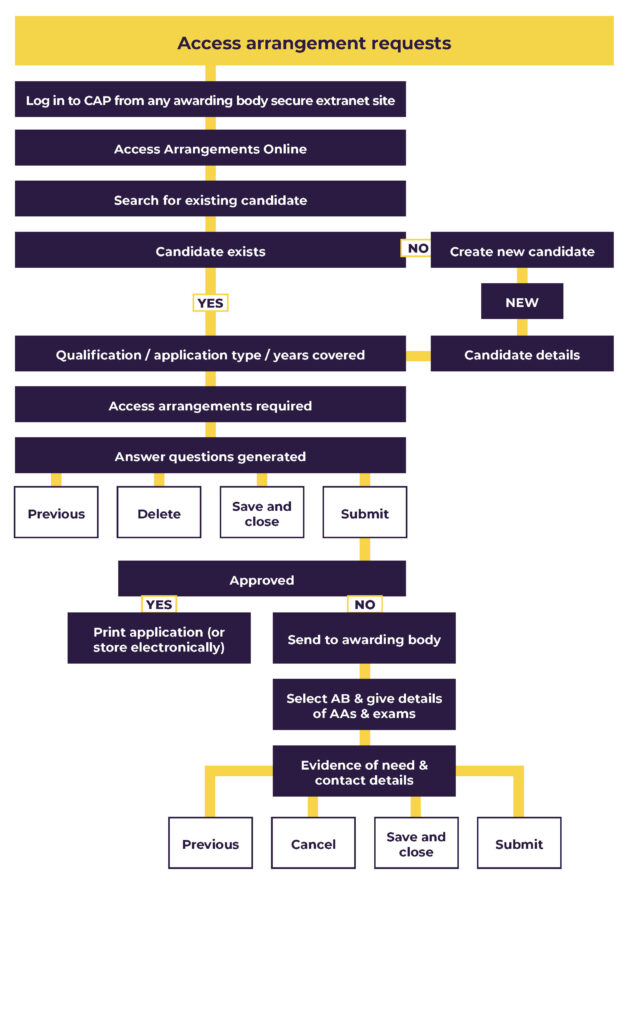
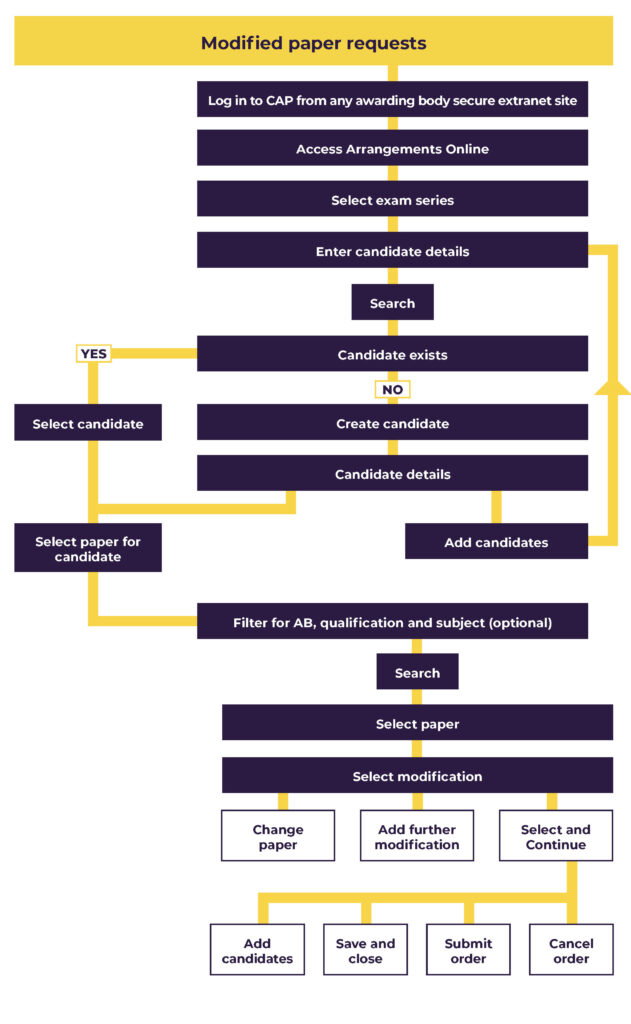
The standard formats available are:
- A4 modified 18 point bold
- A3 modified 24 point bold
- A4 modified 24 point bold
- A3 modified 36 point bold
- Tactile diagrams with print labels for use with modified enlarged papers
- Braille papers including tactile diagrams with Braille labels
- Modified language (where available)
- Non-interactive electronic (PDF) question paper
- Transcript of listening examination/media
Centres should note that the option of an A3 modified enlarged paper, 36 point bold, may not be available in all subjects.
Access arrangements online is not linked to awarding bodies’ entries systems. Centres should check that orders for modified papers and actual entries made to an awarding body match.
The awarding bodies use the UKAAF publication General and Vocational Examinations for Candidates with Visual Impairment – Best Practice Guidance for Modifiers and Producers as a source of reference when producing Braille and modified enlarged papers. This publication may be accessed from the UKAAF website: www.ukaaf.org/sectors/#education
SENCos must ensure that candidates are familiar with the format of modified enlarged papers or Braille papers being requested for examinations. If a candidate intends to use a non-interactive electronic (PDF) question paper in their examination(s), the SENCo must ensure they are familiar with the format.
If a candidate requires access to a Braille paper or a modified enlarged paper that has not previously been produced by the awarding body and cannot be downloaded from its website, the awarding body must be contacted no later than three months before the paper is required.
6.2 BRAILLE PAPERS
6.2.1 Braille papers are only produced when orders are made by the deadline. They are not produced automatically. Awarding bodies do not require evidence of the candidate’s vision impairment.
6.2.2 The layout and presentation of the standard paper is modified prior to brailling by a teacher specialised in vision impairments.
6.2.3 The modified paper is then sent to a brailling agency for the content to be transcribed into Grade 2 contracted Unified English Braille (UEB).
6.2.4Tactile diagrams and graphs will be provided, where appropriate, with the Braille paper. Tactile diagrams do not need to be ordered separately.
6.2.5 Centres may be required to provide models in advance for certain types of questions.
6.2.6 Videos or films used in assessments may be requested with audio description.
6.3 MODIFIED ENLARGED PAPERS
6.3.1 Modified enlarged papers are only produced when orders are made by the deadline. They are not produced automatically. As candidates’ needs are ongoing and long term, and modification of printed material reflects their normal way of working within the classroom, an assessment of the candidate is not required to determine their need for modified enlarged papers.
6.3.2 Modified enlarged papers are intended for candidates who cannot read a standard examination paper. The layout and presentation of the standard paper is modified to remove elements of visual complexity without changing the demands of the assessment. Pictures and diagrams are often redrawn to make them more visually accessible.
6.3.3 Centres should note that sometimes it may be necessary for an awarding body to produce a page in a larger format for diagrams.
6.3.4 Centres may be required to provide models in advance for certain types of questions.
6.3.5 Some candidates with a severe vision impairment may benefit from using an electronic or optical magnifier with a modified enlarged paper. (Centres do not need to process an online application for a magnifier.)
6.3.6 Where a centre requires an A4 modified 18 point bold paper in a non-interactive (PDF) electronic format, the relevant awarding body/bodies should be contacted.
For some subjects, such as Archaeology, Geology, Geography and Music, a modified enlarged paper alone may not be a reasonable adjustment for a candidate with a severe vision impairment. A practical assistant and/or a reader may also be required.
6.4 REASONABLE ADJUSTMENTS – MODIFIED ENLARGED PAPERS
6.4.1 The standard modified paper formats will, in the vast majority of cases, enable a candidate with a substantial and long-term vision impairment to access their examinations.
6.4.2 However, in rare and exceptional cases, a candidate with a substantial and long-term vision impairment may require question papers in an alternative format. The candidate will require a reasonable adjustment on account of their disability.
Alternatively, a candidate with a substantial and long-term multisensory impairment may require question papers where the language has been modified, as well as the layout and presentation of the paper to remove elements of visual complexity.
6.4.3 Where a disabled candidate requires question papers in an alternative format, the centre must discuss their requirements at the earliest opportunity with the relevant awarding body’s Modified Papers Unit, ideally at the start of the course. The SENCo must demonstrate to the awarding body that all appropriate adjustments, such as a computer reader, an examination reading pen, a magnifier and a reader, alongside the standard modified enlarged paper formats, have been considered and totally exhausted.
The application of the reasonable adjustment, i.e. question papers in an alternative format, will depend on several factors, including:
- the needs of the disabled candidate; and
- the effectiveness and cost of the adjustment.
6.4.4 An adjustment will not be approved if it involves unreasonable costs, timeframes or affects the security or integrity of the assessment. This is because the adjustment is not ‘reasonable’.
6.5 COLOURED/ENLARGED PAPER (E.G. A3 UNMODIFIED ENLARGED PAPERS)
6.5.1 Where a candidate requires a question paper on coloured paper and/or enlarged from A4 to A3, it is strongly recommended that a PDF copy of the standard question paper is used. The use of a PDF copy of the standard question paper will ensure better print quality and reduce the possibility of human error when collating and stapling.
For AQA, NCFE, Pearson and WJEC centres, a PDF copy of the standard question paper is downloaded from AQA Centre Services, NCFE Portal, Pearson Edexcel Online (SDS) or WJEC Portal up to 60 minutes before the awarding body’s published starting time for the examination.
For CCEA and OCR centres, a non-interactive electronic (PDF) question paper must be ordered using Access arrangements online. A PDF copy of the standard question paper can then be downloaded up to 60 minutes before the awarding body’s published starting time for the examination.
Where a centre requires access to a PDF copy of the standard question paper for this purpose, the 60 minute release time should be considered. An awarding body will not vary the release time for a PDF copy of the standard question paper to accommodate a centre’s earlier starting time for the examination.
For City & Guilds centres, a non-interactive electronic (PDF) question paper cannot be requested where a candidate requires a question paper on coloured paper and/ or enlarged from A4 to A3. For multiple choice examinations, the answer sheet can be photocopied onto coloured paper, but the candidate’s answers must be transcribed onto the original answer sheet for marking.
Only the following actions are permissible:
- copying and enlarging the standard question paper from A4 to A3; and/or
- copying a question paper onto coloured paper; and/or
- producing a question paper with single-sided print.
No further modification is permissible, such as re-typing the question paper. Such actions may constitute malpractice.
6.5.2 Centres should be aware that enlarging an examination question paper may affect questions relating to scale. This must be considered in the centre’s production process. It is the responsibility of the centre to ensure that the examination question paper is photocopied to a high standard.
6.5.3 Given the logistical challenges on exam days where question papers need to be photocopied onto coloured paper, the SENCo must ensure that a question paper on coloured paper is appropriate to the candidate’s needs. Alternative ways of working should be explored, such as the use of a coloured overlay or the candidate wearing coloured glasses.
The SENCo may wish to consider the provision of a single colour, such as buff or grey.
6.6 MODIFIED LANGUAGE PAPERS AND TRANSCRIPT OF LISTENING EXAMINATION/MEDIA
Modified language papers
6.6.1 Where a question paper has not been modified at source (see 6.6.4), awarding bodies will accept an order for a modified language paper for a candidate who is deemed to have persistent and significant difficulties when accessing and processing information.
Awarding bodies do not require evidence of the candidate’s difficulties.
6.6.2 Modified language papers are only produced for some specifications when orders are made by the deadline. They are not produced automatically.
6.6.3 Only the instructions/rubric is modified. The meaning of the questions remains the same and will require the same answers as the standard paper. Any technical and subject-specific language will remain unchanged.
6.6.4 Many question papers are already language modified since language specialists have been involved in the question paper setting process. All awarding bodies have processes in place to ensure their assessments are fit for purpose and accessible and will either use BATOD modifiers or BATOD guidance.
In such circumstances the standard question paper is accessible: a modified language paper is not required and cannot be ordered. (‘Modified language’ will not appear in the drop-down list within Access arrangements online.)
Transcript of Listening examination/media
6.6.5 In Modern Foreign Language Listening examinations, a transcript of the recording can be requested and read to the candidate, who speech-reads from a live speaker.
A transcript of the Listening track may also benefit those candidates who have persistent and significant difficulties in following speech at normal speed. The live speaker will read to the candidate separately at a pace which enables them to process the information more easily.
(Please see Chapter 5, section 5.12 on the use of a live speaker in pre-recorded examination components.)
6.6.6 Media used in assessments should be requested with subtitles for deaf and/or hard of hearing candidates. Advice should be sought from the relevant awarding body.
6.7 NON-INTERACTIVE ELECTRONIC (PDF) QUESTION PAPERS
6.7.1 Non-interactive electronic question papers are in PDF format. They can be read on-screen but cannot be typed into. A candidate may require a non-interactive electronic question paper where they:
- require a computer reader (an approved application for a computer reader being in place); or
- have a substantial and long-term vision impairment and prefer to read on-screen, rather than on paper, as part of their normal way of working. This may additionally be in conjunction with an on-screen/virtual coloured overlay.
By ordering a non-interactive electronic (PDF) question paper there is no need for the centre to scan in a question paper for computer reading purposes.
Where several candidates will require a non-interactive electronic (PDF) question paper for the same examination, the centre only needs to make one order online.
The centre must:
- maintain the integrity and security of non-interactive electronic (PDF) question papers;
- ensure only authorised members of centre staff have access to non-interactive electronic (PDF) question papers.
The centre must not:
- undertake further modification to a non-interactive (PDF) electronic question paper, for example, converting the paper from PDF to Word;
- use software to convert a non-interactive (PDF) electronic question paper into an interactive format;
- use software to completely reformat the text and remove diagrams.
Such actions may constitute malpractice.
It is the responsibility of the centre to ensure that the PDF is fully compatible with their chosen software package.
Standard print-ready PDFs that were used in previous examination series, and currently available to use as past papers, can be downloaded from awarding body websites.
6.8 ORDERING MODIFIED PAPERS
6.8.1 For the following qualifications (timetabled written components) orders must
be made using Access arrangements online:
- AQA Applied General qualifications
- AQA Level 2 Certificate in Further Maths
- AQA Level 3 Certificate in Mathematical Studies
- BTEC Firsts
- BTEC Level 2 Technicals
- BTEC Nationals
- BTEC Tech Awards
- Cambridge Advanced Nationals
- Cambridge Nationals
- Cambridge Technicals
- ELC
- FSMQ
- GCE (AS and A level)
- GCSE
- OCR Level 3 Certificates
- T Levels (Pearson and WJEC specifications)
- WJEC Level 1 and Level 2 General qualifications
- WJEC Level 1 and Level 2 Vocational Awards (Technical Awards)
- WJEC Level 1 and Level 2 Vocational qualifications
- WJEC Level 3 Applied Certificates, Diplomas and Extended Diplomas (including Alternative Academic Qualifications).
6.8.2 Orders must be made for each examination series.
6.8.3 Modified papers must be ordered by component code for each subject.
6.8.4 The SENCo must work with teaching staff to identify the most appropriate published format of modified papers so the candidate(s) can access their examinations.
6.8.5 Where FE colleges operate as part of a group with several centre numbers, modified paper orders must be processed using the centre number of the site where the candidate(s) will sit their examinations.
6.9 FINAL DEADLINES FOR SUBMITTING ORDERS FOR MODIFIED PAPERS
| EXAM SERIES | LAST DATE BY WHICH ORDERS MUST BE MADE |
| November 2025 | 20 September 2025 |
| January 2026 | 4 October 2025 |
| June 2026 | 31 January 2026 |
GCSE January 2026 examination series – GCSE specifications are not available to centres in England.
For those candidates who decide to resit GCSE units in June 2026, following the publication of January 2026 GCSE examination results, orders for modified papers must be received no later than 21 March 2026.
(For unitised GCSE qualifications in Northern Ireland in March 2026, please see CCEA’s website for information.)
Timely orders for modified papers are essential. Late orders will not be readily accepted, as delivery cannot be guaranteed.
Late requests may not be fulfilled.
The production window, from an awarding body receiving an order for modified papers through to those papers being despatched, is extremely limited. The quality assurance process is even more rigorous for modified papers; there are many more quality checks to undertake.
CHAPTER 7 – LEARNING DIFFICULTIES
The range of learning difficulties is extensive: some of the implications for assessment are not always obvious. Candidates must, therefore be assessed by an assessor (see paragraphs 7.3.3 and 7.3.4). This ensures that the approved access arrangements/reasonable adjustments allow the candidate to access the assessment but do not result in an unfair advantage.
Where assessment objectives (Chapter 3) would be compromised by an access arrangement/ reasonable adjustment, the assessment objectives will take precedence and will not be waived. This includes the demonstration of knowledge, understanding and skills required by the specification. The arrangement must not affect the integrity of the assessment.
7.1 ACCOUNTABILITIES
7.1.1 The SENCo must:
7.1.2 The centre’s appointed assessor must:
- provide the centre with evidence of their qualification(s) before assessing any candidate (see paragraph 7.3.3).
7.2 APPROPRIATE ADJUSTMENTS FOR CANDIDATES WITH LEARNING DIFFICULTIES WHICH HAVE A SUBSTANTIAL AND LONG-TERM ADVERSE EFFECT
Access arrangements/reasonable adjustments are based on an individual candidate’s needs. Consideration must be given as to whether the proposed adjustment is effective and suitable for the candidate’s learning difficulty. For example, if a candidate can complete a paper in the normal length of time and never uses the 25% extra time which has been made available, then it is not an effective adjustment. It would not be appropriate to process an application for 25% extra time. Similarly, if a candidate requests the use of a word processor but cannot type comprehensible prose, it is not an effective adjustment for their examinations. However, a scribe may be required.
7.3 APPOINTMENT OF ASSESSORS
7.3.1 The head of centre is responsible for:
- the appointment of assessors, checking the qualifications of those assessing candidates (e.g. photocopy of certificate or printout of screenshot of HCPC or SASC registration).
The JCQ cannot approve an assessor’s qualification(s) and does not maintain a list of appropriate qualifications for assessors.
7.3.2 Heads of centre must satisfy themselves that a professional does have the required level of competence and training.
The professional must present evidence of successful completion of a post-graduate course in individual specialist assessment at or equivalent to Level 7 or a printout of a screenshot of HCPC or SASC registration.
7.3.3 A head of centre will appoint:
- an access arrangements assessor who has successfully completed a post-graduate course at or equivalent to Level 7, including at least 100 hours relating to individual specialist assessment14. An access arrangements assessor may conduct assessments to be recorded within Part 2 of Form 8; and/or
- a specialist teacher assessor with a current SpLD Assessment Practising Certificate, as awarded by BDA, the Dyslexia Guild or Patoss and listed on the SASC website. A specialist teacher assessor may conduct assessments to be recorded within Part 2 of Form 8 and, where necessary, undertake full diagnostic assessments; and/or
- an appropriately qualified psychologist registered with the Health & Care Professions Council who may conduct assessments to be recorded within Part 2 of Form 8 and, where necessary, undertake a full diagnostic assessment.
7.3.4 An access arrangements assessor must have successfully completed a post-graduate course at or equivalent to Level 7, including at least 100 hours relating to individual specialist assessment, which must include training in all of the following:
- the theoretical basis underlying psychometric tests, such as the concepts of validity and reliability; standard deviations and the normal curve; raw scores, standard scores, quotients, percentiles and age equivalent scores; the concept of statistically significant discrepancies between scores; standard error of measurement and confidence intervals;
- the appropriate use of nationally standardised tests for the age group being tested;
- the objective administration of attainment tests which can be administered individually. This must include tests of reading accuracy, reading comprehension, reading speed and spelling;
- appropriate methods of assessing writing skills, including speed, must also be covered;
- the appropriate selection and objective use of tests of cognitive skills (see paragraph 7.5.12);
- the ethical administration of testing, including the ability to understand the limitation of their own skills and experience and to determine when it is necessary to refer the candidate to an alternative professional.
All assessors must:
- have a thorough understanding of the current edition of the JCQ document Access Arrangements and Reasonable Adjustments and the principles, procedures and accountabilities involved;
- be familiar with the Equality Act 2010 (although it is not their role to determine what is a ‘reasonable adjustment’, this will help identify access arrangements that might assist the candidate in examinations and assessments and are thus potentially reasonable adjustments);
- either hold an appropriate qualification to teach and make recommendations for secondary aged or adult learners who have learning difficulties or be an HCPC registered psychologist.
The head of centre must ensure that evidence of the assessor’s qualification(s) is obtained at the point of engagement/employment and prior to the assessor undertaking any assessment of a candidate.
Evidence of the assessor’s qualification(s) must be held on file for inspection purposes and be presented to the JCQ Centre Inspector by the SENCo.
7.3.5 The assessor should be employed or contracted by the centre.
Alternatively, the assessor is:
- employed at another centre, e.g. within an academy chain; or
- employed by the local authority; or
- an external assessor who has contacted the centre prior to any candidate assessment, liaises with the centre and is approved by the head of centre. Before assessing the candidate, the assessor will receive a completed Part 1 of Form 8 from the SENCo.
7.3.6 A privately commissioned assessment, where the centre has not been involved, cannot be used to award access arrangements and cannot be used to process an application using Access arrangements online. This would be where the assessor has not contacted the centre, has not liaised with the centre, has not been approved by the head of centre and has not received a completed Part 1 of Form 8 from the SENCo.
(Where a learning difficulty specifically arises as a result of a medical condition, please see paragraph 5.2.3 and section 5.7 – 25% extra time and/or a scribe.)
As a privately commissioned report, or an assessment from an external professional, cannot be used to award access arrangements, the head of centre or a member of the senior leadership team should provide a written rationale supporting their decision to the parent/carer.
SENCos and assessors working within the centre should always carefully consider any privately commissioned assessment to see whether the process of gathering a picture of need, demonstrating normal way of working within the centre and, ultimately, assessing the candidate themselves should be instigated.
7.4 REPORTING THE APPOINTMENT OF ASSESSORS
7.4.1 SENCos must hold on file, for inspection purposes, evidence that the assessor(s) is/ are suitably qualified. This can be drawn, for example, from the following sources:
- copy of current Assessment Practising Certificate (APC) issued by Patoss, Dyslexia Guild or British Dyslexia Association;
- copy of Level 7 assessment qualification certificate;
- screenshot of HCPC registration showing the Unique Registration Number;
- screenshot of SASC listing showing the APC code number and expiry date;
- screenshot of listing for PAPAA Graduates showing the certificate number;
- screenshot of listing for CPT3A Certificate Holders showing the certificate number;
- screenshot of listing for ETAAC Certificate Holders showing the certificate number; or
- screenshot of listing for Patoss AAA Certificate Holders showing the certificate number.
7.4.2 In the case of appropriately qualified psychologists (registered with the Health & Care Professions Council), or specialist teacher assessors holding a current SpLD Assessment Practising Certificate, who are directly employed within the centre, there is no need to record the names of these individuals within Access arrangements online.
7.4.3 The names of all other assessors, who are assessing candidates studying qualifications as listed within the Deadlines section, must be entered into Access arrangements online to confirm their status.
7.5 GUIDELINES FOR THE ASSESSMENT OF THE CANDIDATE’S LEARNING DIFFICULTIES BY AN ASSESSOR
7.5.1 The SENCo must arrange for the candidate to be assessed by the centre’s appointed assessor.
7.5.2 Before the candidate’s assessment, the SENCo must provide the assessor with background information, i.e. a picture of need has been painted, as required in Part 1 of Form 8. The SENCo and the assessor must work together to ensure a joined-up and consistent process.
7.5.3 The assessor is required to establish if the results of tests in literacy and/or cognitive abilities present evidence that the candidate has an impairment which substantially affects their performance.
7.5.4 Assessors must personally conduct the assessments. They must not sign off assessments carried out by another professional.
7.5.5 The assessor must carry out tests which are relevant to support the application.
7.5.6 Current editions of nationally standardised tests which produce standardised scores must be used, where published.
7.5.7 Where a computer-based assessment tool is used to gather assessment evidence for Part 2 of Form 8, a suitably qualified assessor (see paragraph 7.3.4) must be present to oversee the test’s computerised administration, actively observe the candidate and monitor the candidate’s engagement with the assessment.
7.5.8 The candidate’s chronological age must be less than the ‘ceiling’ of the test, unless there is no published test for the candidate’s age.
7.5.9 Results must be given as standardised scores which use a mean of 100 and a standard deviation of 15. (These are standard scores.) Standardised scores of 84 or less are described as ‘below average’. Standardised scores of 85–89 are described as ‘low average’. Test results for Part 2 of Form 8 must not be reported as percentiles, scaled scores, T-scores or age-equivalent scores. Such scores must be converted into standard scores.
Reading skills
7.5.10 Reading comprehension: for candidates potentially requiring a Language Modifier (see section 5.11), reading comprehension must be assessed using a recognised test of text or sentence comprehension.
Reading speed: a candidate with a history of reading difficulties, whose reading accuracy (at single word level) or reading comprehension is within normal limits for their age, may read slowly because they:
- take longer than expected to decode the words, leading to slow reading (slow reading speed);
- need to re-read text many times to absorb its meaning (slow reading comprehension speed).
There are various ways of assessing text level reading speed:
- a test which assesses speed at text level (known as reading rate or reading speed);
- a test which combines text level speed and accuracy (sometimes known as reading fluency);
- a test that assesses the time taken to both read the text and to answer questions on what has been read. The test must provide a score for reading comprehension speed, not just for reading comprehension.
Where a candidate reads for themselves, a measure of text reading speed may be used as one of the two required scores for 25% extra time. The results will be recorded within Part 2 of Form 8 under ‘Reading Speed’.
Where the candidate uses a computer reader/reader or an examination reading pen, a measure of reading speed cannot be used as evidence for 25% extra time.
Tests which measure single word reading speed and efficiency are not appropriate in this context. However, they may contribute to cognitive processing/fluency measures for extra time, as recorded within Part 2 of Form 8 under cognitive processing/fluency or in ‘Other relevant information’.
7.5.11 Writing skills
A scribe, a word processor, with the spellcheck switched on15, or speech recognition technology will be allowed in certain subjects when a candidate’s impairment has a substantial and long-term adverse effect.
For examination purposes, a substantial impairment will be shown by the candidate having:
- a below average standardised spelling accuracy score (a standardised score of 84 or less) with unrecognisable spelling attempts; or
- a below average standardised score for writing speed (a standardised score of 84 or less).
In some cases, the candidate’s writing is illegible or grammatically incomprehensible but improves significantly when a scribe is used. If these difficulties are not evidenced by a below average standardised spelling accuracy score or a below average standardised score for writing speed, Access arrangements online will not approve the application. The SENCo may then decide to refer the application to the awarding body/bodies.
Where the candidate writes by hand, an assessment of writing speed may be used as one of the two required measures for 25% extra time. The result will be recorded within Part 2 of Form 8 under ‘Writing Speed’.
Where the candidate uses a scribe, speech recognition technology or a word processor, a measure of writing speed cannot be used as evidence for 25% extra time.
Where a candidate uses a word processor, with the spellcheck enabled, or predictive text, a subject-specific bank of words is not permitted.
Cognitive processing/fluency
7.5.12 For the purposes of Form 8 Part 2, the different areas of cognitive processing/ fluency assessments are:
- short-term/working visual memory (short-term/working verbal and visual memory may be combined within a composite score)
- delayed memory
- phonological awareness
- phonological memory
- phonological processing speed/rapid naming
- visual processing speed
- visual/motor processing
- word reading fluency/sight word efficiency
- decoding fluency/non-word reading efficiency
- associational/oral fluency
- orthographic fluency
- mathematical fluency
A timed or untimed test of spelling accuracy or attainment is not acceptable as evidence for extra time.
Where a candidate has cognitive processing/fluency difficulties which have a substantial and long-term adverse impact on their speed of working, 25% extra time may be awarded. (See Chapter 5, paragraph 5.2.2.) These difficulties will be demonstrated by tests which result in at least:
- two below average standardised scores of 84 or less; or
- one below average standardised score of 84 or less and one low average standardised score (85-89);
which relate to two different areas of speed of working. This may include two different areas of cognitive processing.
In rare and exceptional circumstances an awarding body may grant 25% extra time where a candidate has at least two low average standardised scores (85-89) relating to two different areas of speed of working. This may include two different areas of cognitive processing.
An awarding body may grant extra time of up to 50% in very exceptional circumstances – see Chapter 5, paragraph 5.3.2.
7.6 COMPLETING FORM 8 – JCQ/AA/LD, PROFILE OF LEARNING DIFFICULTIES
Form 8 – JCQ/AA/LD must be used to record information about a candidate’s access arrangements/reasonable adjustments and be presented by the SENCo for inspection. The form must only be used for candidates with learning difficulties or where a Language Modifier is required.
Where the SENCo is also the centre’s appointed assessor, the online version of Form 8 may be completed using the Centre Admin Portal (CAP). CAP can be accessed using any of the awarding bodies’ secure extranet sites.
Where the centre’s appointed assessor, working within the centre, will complete all parts of Form 8, the online version of Form 8 may be completed using the Centre Admin Portal (CAP). CAP can be accessed using any of the awarding bodies’ secure extranet sites.
Alternatively, the PDF version of Form 8 on the JCQ website:
jcq.org.uk/exams-office/access-arrangements-and-special-consideration/forms may be used.
Only Form 8 is acceptable.
The following cannot be used for processing and inspection purposes:
- spreadsheets;
- email messages;
- centre-devised equivalents of Form 8;
- educational psychologists’ reports;
- a diagnosis of Dyslexia;
- diagnostic assessment reports.
7.6.1 A fully completed Form 8 – JCQ/AA/LD may roll forward where the candidate progresses from GCSE to GCE AS, A level and/or other Level 3 qualifications, whether at the same centre or at a different centre.
A Form 8, with Part 2 completed no earlier than the start of Year 9 for GCSE qualifications, may roll forward to GCE AS, A level and/or other Level 3 qualifications where a candidate requires:
- 25% extra time; and/or
- a scribe.
Where the candidate changes centre, the original or a PDF of a fully completed Form 8, together with evidence of the assessor’s qualification, must be provided. SENCos must provide this evidence to assist their counterparts in FE and Sixth Form colleges.
The Form 8 should be perceived as a ‘passport to access arrangements’ which travels with the candidate.
The SENCo must thoroughly check the Form 8 before forwarding it to another centre, ensuring it has been fully completed, signed and dated.
The SENCo at the receiving centre must not use an incomplete Form 8. The Form 8 must be checked to ensure that all parts of the form have been completed and that it has been signed and dated.
The form cannot be amended retrospectively. Where an incomplete Form 8 has been provided, the candidate must be reassessed to determine the need for 25% extra time and/or a scribe.
The SENCo, or an equivalent member of staff within an FE college, must ensure:
- that 25% extra time and/or a scribe remains appropriate, practicable and reasonable;
- the candidate meets the current published criteria for 25% extra time and/or a scribe, i.e. the 2025/26 JCQ regulations, before a new online application for 25% extra time and/or a scribe is processed.
Part 1 of Form 8 must be completed prior to the assessment. The SENCo or the assessor working within the centre must detail the candidate’s current difficulties in the classroom, internal tests and/or mock examinations and their normal way of working. The statements within Part 1 of Form 8 must be addressed prior to the assessment.
A ‘skeleton’ Part 1 of Form 8 being completed prior to the assessment is no longer acceptable.
Part 1 of Form 8 is a pen portrait of the candidate’s needs. It allows the SENCo to ‘paint a holistic picture of need’, confirming normal way of working and bringing together:
- any previously granted access arrangements;
- comments and observations across relevant subjects from teaching staff and support staff (i.e. Learning Support Assistants, Teaching Assistants and Communication Support Workers);
- intervention strategies (e.g. individual education/learning plans) in place for the candidate;
- pupil premium indicators;
- screening test results;
- use of pupil baseline and tracking data;
- information about any differentiation in the classroom;
- observing the candidate in the classroom to see their style of learning;
- normal way of working in the classroom (where appropriate);
- arrangements made for end of year internal school examinations/mock examinations;
- review of the candidate’s workbooks, checking their spellings, legibility of writing and whether classroom tasks have been completed.
Effective screening and monitoring systems during Years 7 to 9 will enable the SENCo to provide sufficiently robust evidence of need. School tests might identify those candidates who need to be assessed for access arrangements/reasonable adjustments.
If very little information is available, a selection from the following can be used by the SENCo to paint a picture of need within Part 1 of Form 8, for example:
- screening test results;
- the candidate’s self reported difficulties;
- comments and observations from teaching staff and support staff (i.e. Learning Support Assistants, Teaching Assistants and Communication Support Workers) who have noted the candidate’s difficulties;
- comments in school reports and/or pupil tracking data;
- information relayed by telephone, with notes taken, or a photocopy of Form 8 where a candidate has moved, for example, from an 11 to 16 school to an FE College.
Comments from parents cannot be recorded within Part 1 of Form 8.
Part 3 of Form 8 must be completed by the SENCo once the assessor has completed their testing and confirmed that the candidate has an impairment which substantially affects their performance.
Part 3 of Form 8 must make recommendations for access arrangements/ adjustments, taking into account:
- the information from the assessment (Part 2 of Form 8);
- the requirements of the specifications; and
- the candidate’s normal way of working in the centre (Part 1 of Form 8).
7.6.2 The completion of Form 8, Parts 1, 2 and 3 will enable the JCQ Centre Inspector to see clearly and concisely the candidate’s normal way of working within the centre and the results of an assessment.
7.6.3 All assessors, appointed by the head of centre and having an established relationship with the centre, must use Form 8, Part 2 to record the results of their assessment that are relevant to the access arrangements being requested. At the same time, the assessor must sign and date Part 2.
Record forms from standardised assessments do not need to be kept on file for inspection.
7.6.4 Once Form 8 has been completed, assessors employed within the centre may process the application using Access arrangements online (see the qualifications listed within the Deadlines section). They must keep within the centre, for inspection purposes, a fully completed Form 8 (Parts 1, 2 and 3), signed and dated. This may be a hard copy paper version or an electronic version.
7.6.5 The assessor must:
- sign and date Form 8, Part 2;
- have administered each assessment themselves.
The assessor must not sign off assessments carried out by a teacher or another professional.
Unsigned and undated assessments cannot be accepted as appropriate evidence.
The signature acts as confirmation that the assessor has completed the assessments and supports the recommendation made.
An electronic or typed signature is permissible.
Chapter 8 Processing applications for access arrangements and adjustments
8.1 GENERAL INFORMATION
For those qualifications listed within the Deadlines section, Access arrangements online enables centres to make a single online application for a candidate requiring access arrangements/reasonable adjustments using any of the awarding bodies’ secure extranet sites. Access arrangements online will provide an instant response and will only allow a maximum of 26 months for any arrangement.
Online applications must only be processed where they are supported by the centre and the candidate meets the published criteria for the arrangement(s) with the full supporting evidence in place.
Extra time of more than 25% (26% to 50%) and/or a Language Modifier must have tests recorded within Part 2 of Form 8 dated within 26 months of the final examination(s).
A Form 8 cannot roll forward from GCSE qualifications to GCE AS, A level and/or other Level 3 qualifications where a candidate will continue to require extra time of more than 25% (26% to 50%) and/or a Language Modifier. A new Form 8 must be completed and the candidate must be reassessed.
A Form 9 cannot roll forward from GCSE qualifications to GCE AS, A level and/or other Level 3 qualifications. A new Form 9 must be completed and a new online application processed for GCE and/or other Level 3 qualifications.
8.2 JCQ REGULATIONS AND ACCESS ARRANGEMENTS ONLINE
Access arrangements online does not give details of the JCQ regulations or how the JCQ regulations are to be applied. Centres must use the JCQ regulations in conjunction with Access arrangements online. Once an arrangement has been approved online, it must be put into effect in accordance with these regulations and without affecting the integrity of the qualification.
8.3 LATE DIAGNOSIS OF A DISABILITY, LATE MANIFESTATION OF AN IMPAIRMENT OR A TEMPORARY INJURY/IMPAIRMENT
Arrangements for a late diagnosis of a disability (a medical condition, a sensory impairment, social, emotional and mental health needs) or late manifestation of an impairment may be processed as the need arises even where this is after the published deadline. Evidence of need is still required to the same standard as if it was an application being processed by the published deadline.
Please see the definition of evidence of need within the Definitions section and the relevant section(s) of Chapter 5 for full details as to what constitutes the core evidence/ evidence of need for each arrangement. It is important that the appropriate evidence is produced and processed with the application. Appropriate documentation, where required and as set out in Chapter 5, must be kept on file to support the arrangement(s) and to be available for inspection.
Access arrangements online must also be used for those qualifications listed within the Deadlines section for candidates with a temporary injury or temporary impairment, such as a broken arm. These arrangements can be processed as the need arises. Appropriate documentation (where required) must be held on file to support any temporary access arrangement made.
Examples of temporary access arrangements
Example 1
A Year 11 GCSE candidate fell off her bike and injured her writing hand a few days before her first GCSE examination. The candidate is unable to write or type. The SENCo processes a temporary application for the use of a scribe using Access arrangements online (AAO). As the use of a scribe is not her normal way of working and she is not entirely comfortable or conversant in dictating her responses to another person, 25% extra time is granted.
The SENCo types a note to support the application for a scribe and 25% extra time and, with the approval sheet from AAO, retains on file for inspection purposes. Two days later, the candidate brings a note from her GP which confirms the injury to her hand and this is added to the SENCo’s file.
On the day of her first GCSE examination the candidate becomes highly anxious and stressed, as the use of a scribe is not her normal way of working. In view of this, the exams officer processes an application for special consideration.
Example 2
A Year 13 GCE A level candidate has suffered a back injury playing rugby. He cannot come to school to sit his examinations. The SENCo liaises with the exams officer about him sitting his examinations at home through an alternative site arrangement. (See section 11 of the JCQ document Instructions for conducting examinations.) In addition, the SENCo allows the candidate supervised rest breaks as sitting for an extended period of time causes him significant discomfort.
The invigilator takes the question paper in a sealed non-transparent secure transit envelope to the candidate’s home and conducts the examination as per the JCQ document Instructions for conducting examinations. However, during the examination, the candidate is in severe pain and the invigilator makes a note of this. Having received the invigilator’s incident log, the exams officer then submits an online application for special consideration to the respective awarding body.
Example 3
A Year 11 GCSE candidate arrives in school on the first morning after the Whitsun half term break. She has had chicken pox. The candidate is clearly unwell and possibly contagious, so she is sent home. The centre decides that it will arrange for her examinations to be sat at home.
In addition, the SENCo grants supervised rest breaks, as sitting for an extended period of time whilst feeling unwell may not be conducive to the candidate demonstrating her full potential.
As the candidate has had a contagious disease, the exams officer seeks medical guidance from a local GP surgery, primarily regarding the risk to others – in this case, the invigilator. The exams officer also reads the advice in section 11 of the JCQ document Instructions for conducting examinations.
The risks are deemed to be minimal. The invigilator takes the question paper in a sealed non-transparent secure transit envelope to the candidate’s home and conducts the examination as per the JCQ document Instructions for conducting examinations.
However, during the examination, the candidate begins to feel unwell and cannot continue with the examination for the remaining 45 minutes.
The invigilator makes a note of the fact that the candidate was only able to complete the first hour of the examination.
The exams officer, using the invigilator’s incident log, submits an online application for special consideration to the awarding body. The awarding body is informed that the candidate did not complete the examination.
The candidate is unable to sit any more examinations that week. The exams officer submits further applications for special consideration.
Whilst the awarding bodies will try to accommodate any arrangements for a late diagnosis or late manifestation, there may be occasions where otherwise reasonable adjustments cannot be made due to the limited time available.
8.4 CASES THAT DO NOT GAIN APPROVAL
Access arrangements online approves around 90% of all applications made by centres in the United Kingdom, providing a single automated response.
It is inevitable that some individual needs will not be accommodated by a computer system, which cannot deal with every reasonable adjustment which may be required in specific cases. For example:
- a candidate with a brain injury who may need access to eye gaze technology; or
- a candidate who cannot use a pen and must use a pencil due to sensory processing difficulties.
If a candidate has very substantial needs which are not accommodated by the online system, it may be because they relate to reasonable adjustments which are not listed. Alternatively, the arrangement(s) may require further exploration in relation to the competence being tested in the specification(s). These cases should be discussed with the relevant awarding body. SENCos should keep a written record of such discussions. Additional paperwork may be required to justify the request being made.
If an application is not approved, the SENCo or the assessor working within the centre must consider whether this is because the candidate does not meet the published criteria for one of the arrangements requested and does not have a substantial and long-term impairment for the required arrangement.
Example 1
A candidate with learning difficulties has used a reader and a word processor with the spelling and grammar check switched on throughout her course and has requested these in her examinations. In a spelling test she achieves a below average standardised score of 77. Using Access arrangements online, the SENCo keys in the score of 77 for spelling. However, her spelling attempts are phonetically plausible and readable. They are not unrecognisable. The application is not approved. The SENCo makes a new online application for the candidate, this time only for a reader. The application is approved.
Example 2
A candidate with dyslexia has persistent difficulties with writing. His subject teachers report that his verbal contributions in class show good understanding of the subject matter. However, his written responses both in class and in internal school tests are at a level expected of a much younger student and largely grammatically incomprehensible. When he dictates to a scribe the quality of his work improves substantially and is age appropriate.
The candidate is assessed and achieves low average standardised scores (85-89) on assessments of spelling and writing speed. The SENCo applies for a scribe but the application is not approved, as none of the scores are below average. The SENCo decides to make an online referral to the awarding bodies using Access arrangements online. As she can show that the candidate’s incomprehensible writing improves substantially when he dictates to a scribe, the awarding bodies approve the use of a scribe.
8.5 QUALIFICATIONS AND ARRANGEMENTS COVERED BY ACCESS ARRANGEMENTS ONLINE
Access arrangements online must be used for the following qualifications:
- AQA Applied General qualifications
- AQA Level 2 Certificate in Further Maths
- AQA Level 3 Certificate in Mathematical Studies
- BTEC Firsts
- BTEC Level 2 Technicals
- BTEC Nationals
- BTEC Tech Awards
- Cambridge Advanced Nationals
- Cambridge Nationals
- Cambridge Technicals
- Essential Skills
- FSMQ
- Functional Skills (Pearson specifications)
- GCE (AS and A level)
- GCSE
- OCR Level 3 Certificates
- T Levels (Pearson and WJEC specifications)
- Welsh Baccalaureate qualification (WBQ)
- WJEC Level 1 and Level 2 General qualifications
- WJEC Level 1 and Level 2 Vocational qualifications
- WJEC Level 1 and Level 2 Vocational Awards (Technical Awards)
- WJEC Level 3 Applied Certificates, Diplomas, Extended Diplomas (including Alternative Academic Qualifications).
Qualification types other than GCE or GCSE can be selected by clicking ‘Other’ Qualification Type when processing an online application.
Online applications must only be processed where they are supported by the centre and the candidate meets the published criteria for the arrangement(s) with the full supporting evidence in place.
The following arrangements must be applied for online:
- Access to a mobile phone for medical purposes
- Bilingual dictionary with 25% extra time (solely for those qualifications listed within Chapter 5, paragraph 5.18.2)
- Computer reader/reader
- 25% extra time
- Extra time over 25%18
- Exemption19
- Listening to music/white noise due to a substantial impairment
- Practical Assistant20
- Remote invigilation21
- Scribe/speech recognition technology
- Timetable variation on the day of the exam for a candidate with a disability
- Timetable variation requiring overnight supervision for a candidate with a disability
The following arrangements do not need to be processed online:
(Please do not select ‘Other’ when using Access arrangements online.)
- Alternative rooming arrangements – sitting the examination outside of the main examination hall/room, e.g. a room for a smaller group of candidates
- Amplification equipment
- Bilingual dictionary
- Blank sheet of paper for doodling, where a candidate has persistent and significant concentration difficulties (This must be included with the candidate’s completed answer booklet.)
- Braille transcript
- Braillers
- Colour naming by the invigilator for candidates who are colour blind
- Coloured overlays
- Examination question paper on coloured paper and/or enlarged from A4 to A3
- Fidget toys and stress balls
- Live speaker for pre-recorded examination components
- Low vision aid/magnifier
- Non-electronic ear defenders/ear plugs
- Non-electronic headphones
- Optical Character Reader (OCR) scanners
- Prompter
- Read aloud (which can include an examination reading pen)
- Sign Language Professional
- Squared paper for a candidate with visual-spatial difficulties
- Supervised rest breaks
- Timer on a candidate’s desk – a small countdown clock, a small analogue or digital clock, digital timer, sand timer, stopwatch (The candidate must have an established difficulty and control the device themselves.)
- Word processor.
How to access the Access arrangements online system:
http://qualifications.pearson.com
Access arrangements online has been specifically designed to provide centres with a user-friendly experience across a wide range of the latest versions of internet browsers via PCs and tablets. Centres must always use the most up-to-date/modern version of their chosen browser and ensure that their internet browser is not set in compatibility view mode. Centres must use Microsoft Edge or a current version of Chrome, Safari or Firefox.
Please note that the latest version of TLS must be enabled.
8.6 HOW TO USE ACCESS ARRANGEMENTS ONLINE
Getting started
Before logging in to Access arrangements online using one of the awarding bodies’ secure extranet sites, centres will need:
- paperwork determining the candidate’s needs;
- login details for an awarding body’s secure extranet site, e.g. AQA Centre Services.
Candidates must be informed that an application for access arrangements will be processed using Access arrangements online, complying with the UK GDPR and the Data Protection Act 2018.
A signed candidate personal data consent form and Data protection confirmation by the examinations officer or SENCo form are no longer required.
The SENCo must keep detailed records for inspection purposes, whether electronically or in hard copy paper format, of all the essential information on file. This includes:
- a copy of the candidate’s approved application;
- appropriate evidence of need (where required);
- evidence of the assessor’s qualification (where required).
Quick guide to applying for access arrangements/reasonable adjustments using Access arrangements online:
Step 1 Login
Log in to an awarding body’s secure extranet site, e.g. AQA Centre Services and navigate to Access arrangements online. Select the option Create application from the home page.
Step 2 Candidate details
Enter the candidate’s details (* denotes that input is mandatory).
Step 3 Qualification type and application duration
Select the qualification type(s) which is/are relevant to the candidate’s application and select either:
- Long-term condition = lasts duration of a two-year course; or
- Temporary condition = lasts duration of a single exam series.
Step 4 The academic year
Select the academic year(s) in which the access arrangement/reasonable adjustment(s) will be used.
Step 5 Access arrangements/reasonable adjustments
Choose the access arrangement/reasonable adjustment(s) required for the candidate from the list shown. More than one arrangement can be selected but each one selected must have supporting evidence, where required, to secure approval.
Step 6 Evidence of need
Answer all the questions about the evidence available on file to support the application.
Step 7 Part 2 of Form 8
Some applications for a scribe will require details from Part 2 of Form 8 to be entered to substantiate the evidence of need. Centres must specify who carried out the assessment and when.
Step 8 Confirmation
The submission is now complete. Tick the Confirmation box to state that the legal statements have been read and accepted and click SUBMIT.
Step 9 Outcome
The application outcome will now be displayed, along with the details of the application.
If the application has not been approved, it can be referred online to the relevant awarding body for consideration using the awarding body referral section. However, centres must always recheck the JCQ regulations to see if the candidate does meet the published criteria for the arrangement(s).
Step 10 Save & Close
The application has been saved and can be found at any time using the search facility. Click SAVE & CLOSE to return to the Home page.
A flow diagram of the process can be found within Chapter 6.
8.7 PLANNING IN ADVANCE OF EXAMINATION SERIES
Applications processed and approved online can be recorded as a CSV file. By using Excel, an instant list of candidates who have access arrangements/reasonable adjustments can be produced. This information will be invaluable for centres. It will enable exams officers, prior to the start of each exam series, to plan and identify:
- the number of additional rooms required within the centre to accommodate candidates with access arrangements;
- invigilation resources; and
- the number of computer readers, readers and scribes that will be needed.
Access arrangements online will also enable centres to generate populated cover sheets for a practical assistant and a scribe.
8.8 ENTRY LEVEL CERTIFICATE (ELC) QUALIFICATIONS
Where permitted by the specification, the following arrangements may be granted by the centre and do not need to be recorded. Evidence of need is not required to be held on file:
- Alternative rooming arrangements – sitting the examination outside of the main examination hall/room, e.g. a room for a smaller group of candidates
- Amplification equipment, taped questions and responses
- Bilingual dictionary
- Blank sheet of paper for doodling, where a candidate has persistent and significant concentration difficulties (This must be included with the candidate’s completed answer booklet.)
- Braille transcript
- Braillers
- Brailling of non-secure assessment material
- Colour naming by the invigilator for candidates who are colour blind
- Coloured overlays
- Enlarge or photocopy the question paper onto coloured paper
- Fidget toys and stress balls
- Live speaker for pre-recorded examination components
- Low vision aid/magnifier
- Non-electronic ear defenders/ear plugs
- Non-electronic headphones
- Optical Character Reader (OCR) scanners
- Prompter
- Read aloud (which can include an examination reading pen)
- Sign Language Professional for written questions and responses (but not in MFL Speaking assessments)
- Squared paper for a candidate with visual-spatial difficulties
- Supervised rest breaks
- Timer on a candidate’s desk – a small countdown clock, a small analogue or digital clock, digital timer, sand timer, stopwatch (The candidate must have an established difficulty and control the device themselves.)
- Word processor
Where permitted by the specification, the following arrangements may be granted by the centre without prior approval from an awarding body:
- Bilingual dictionary with 25% extra time (for the use of the dictionary)
- Computer reader/reader
- Extra time in timed components
- Practical Assistant
- Scribe.
However, Form 11 – JCQ/EL/NF must be completed online.
Form 11 can be assessed online through the Centre Admin Portal (CAP). CAP can be accessed via any of the awarding bodies’ secure extranet sites.
SENCos must liaise with teaching staff to establish whether any restrictions on the use of specific access arrangements exist.
In Entry Level Certificate English, a reader is not permitted in the Reading component. A computer reader may be used in the Reading component of Entry Level Certificate English where it is the candidate’s normal way of working within the centre.
For the AQA Entry Level Certificate (ELC) English qualification, a scribe is not permitted in the writing tasks.
8.9 OTHER ADJUSTMENTS
Where a candidate’s disability has a substantial and long-term adverse effect, other adjustments, which are not listed, may be required. The centre should, in the first instance, contact the relevant awarding body at the earliest opportunity to discuss the candidate’s needs.
8.10 INTERNALLY-ASSESSED CAMBRIDGE TECHNICALS AND PROJECT QUALIFICATIONS
For internally-assessed Cambridge Technicals and Project qualifications (including the Extended Project), centres do not need to apply to the individual awarding body.
Access arrangements/reasonable adjustments must not, however, affect the reliability or validity of assessment outcomes. They must not give the learner an advantage over other learners undertaking the same or similar assessments.
Centres should discuss the application of access arrangements/reasonable adjustments to internally-assessed units with the awarding body.
Section C
Appendix 1
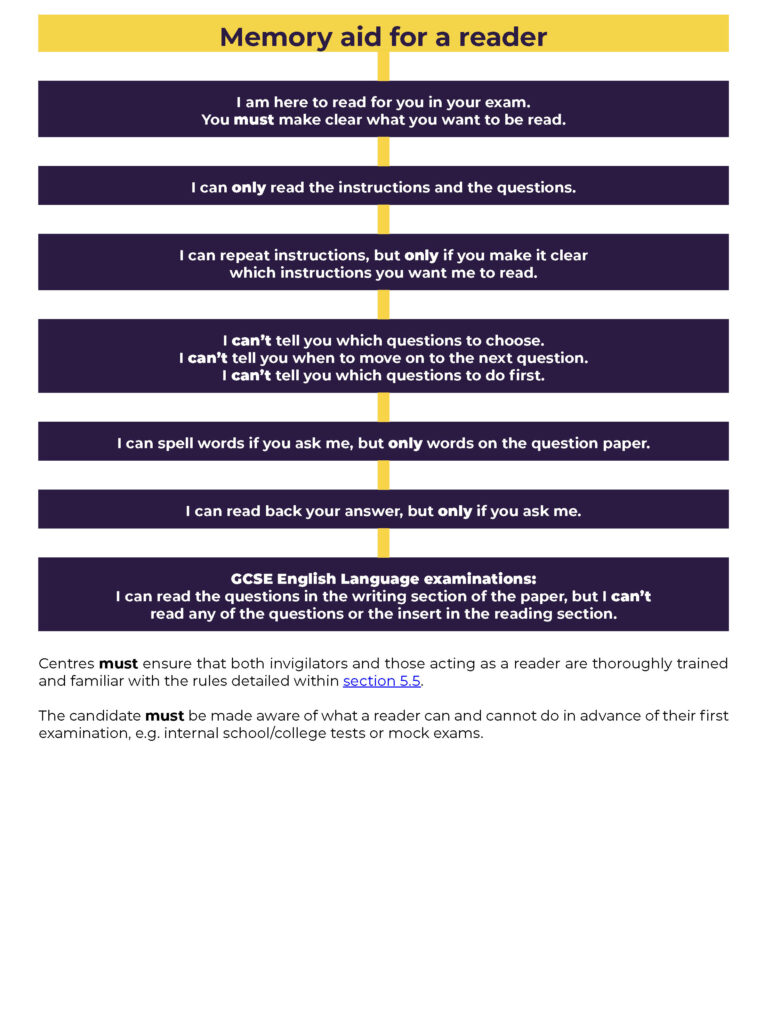
Appendix 2
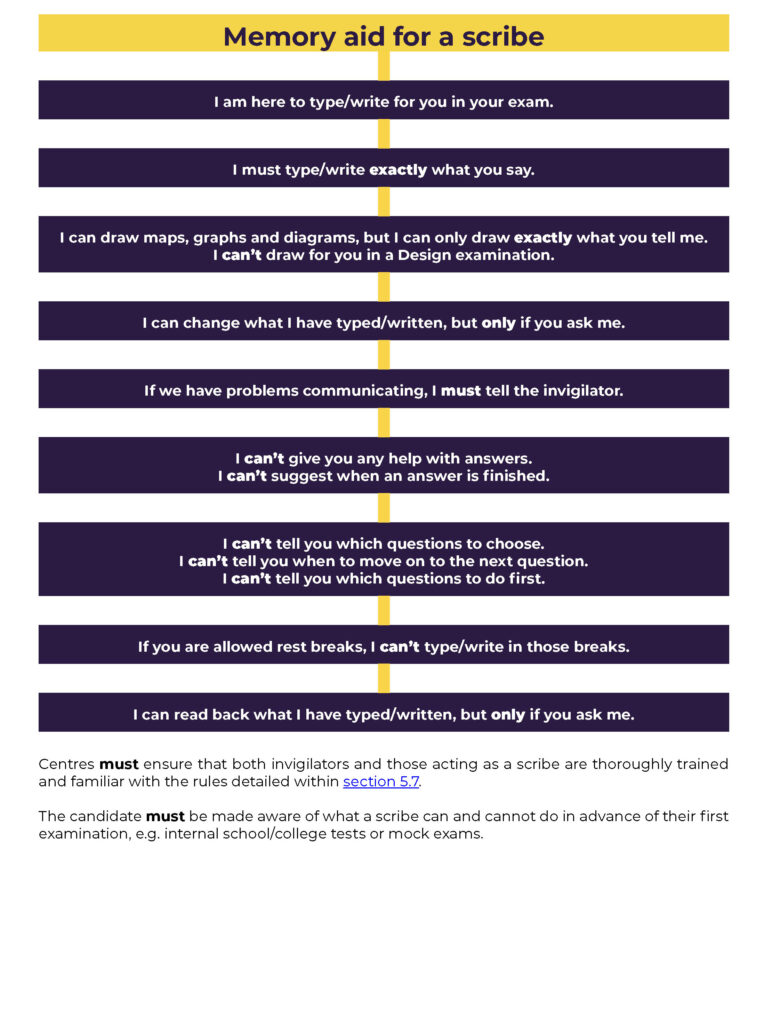
Appendix 3
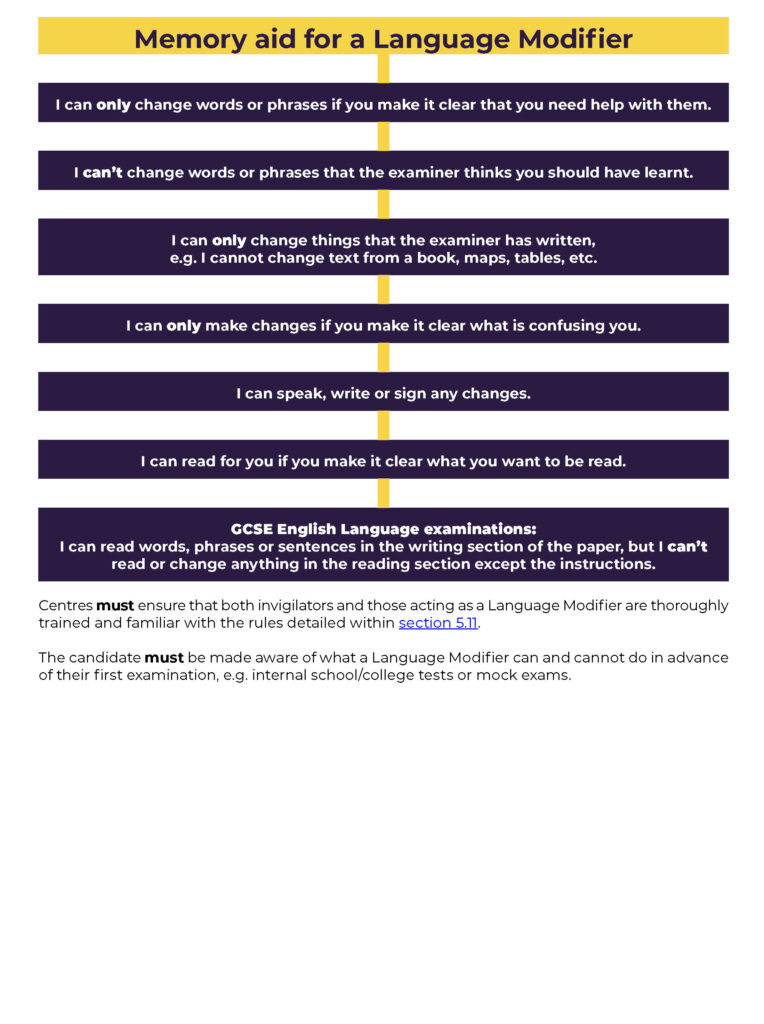
Appendix 4
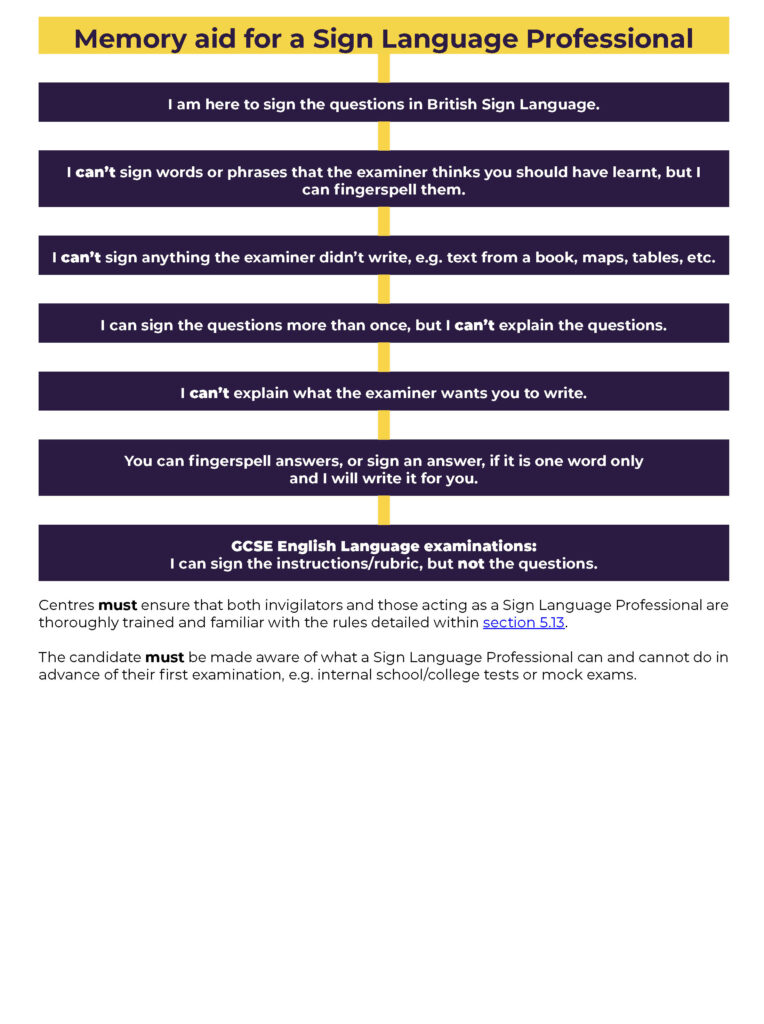
Contacts
AQA
Devas Street
Manchester
M15 6EX
City & Guilds
Giltspur House
5-6 Giltspur Street
London
EC1A 9DE
CCEA
29 Clarendon Road
Clarendon Dock
Belfast
BT1 3BG
NCFE
Q6 Quorum Business Park
Benton Lane
Newcastle upon Tyne
NE12 8BT
OCR
The Triangle Building
Shaftesbury Road
Cambridge
CB2 8EA
Pearson
80 Strand
London
WC2R 0RL
TQUK
Crossgate House
Cross Street
Sale
M33 7FT
WJEC
245 Western Avenue
Cardiff
CF5 2YX
- An assessor is defined in Chapter 7, paragraph 7.3.3. ↩︎
- The candidate must have an impairment in their first language which has a substantial and long-term adverse effect. A candidate does not have a learning difficulty simply because their first language is not English, Irish or Welsh. ↩︎
- The candidate must have an impairment in their first language which has a substantial and long-term adverse effect. A candidate does not have a learning difficulty simply because their first language is not English, Irish or Welsh. ↩︎
- The candidate must have an impairment in their first language which has a substantial and long-term adverse effect. A candidate does not have a learning difficulty simply because their first language is not English, Irish or Welsh. ↩︎
- The only exception to this is where an arrangement is put in place due to a temporary injury or impairment (see section 8.3). ↩︎
- The rolling forward of a Form 8 from GCSE to GCE AS, A level and/or other Level 3 qualifications can apply where the candidate remains within the same centre or moves to a different centre. ↩︎
- A referral to the relevant awarding body using Access arrangements online will be required ↩︎
- For example, an Occupational Therapist specialising in Children and Young People Services, learning disability, mental health. ↩︎
- For example, an Occupational Therapist specialising in Children and Young People Services, learning disability or mental health. ↩︎
- For the use of a word processor with the spelling and grammar check switched on, Form 8 ↩︎
- For example, an Occupational Therapist specialising in Children and Young People Services, learning disability or mental health. ↩︎
- The rolling forward of a Form 8 from GCSE to GCE AS, A level and/or other Level 3 qualifications can apply where the candidate remains within the same centre or moves to a different centre. ↩︎
- A candidate with no prior knowledge of the English Language who has been placed in a foster home upon arriving in the United Kingdom would not be considered living in their family home. ↩︎
- The reference to at least 100 hours relating to individual specialist assessment would include lecture, seminar and tutorial time, study time, assessment time and time spent completing assignments. Courses which are accredited at AMBDA or APC Level would meet this requirement, as would post-graduate courses at or equivalent to Level 7 which provide a qualification in access arrangements assessment. ↩︎
- For the use of a word processor with the spelling and grammar check switched on, Part 2 of Form 8 must show a below average spelling accuracy score with unrecognisable spellings. ↩︎
- The arrangement will be automatically rejected. Applications should then be referred online to the relevant awarding body. ↩︎
- The arrangement will be automatically rejected. Applications should then be referred online to the relevant awarding body. ↩︎
- The arrangement will be automatically rejected. Applications should then be referred online to the relevant awarding body. ↩︎
- The arrangement will be automatically rejected. Applications should then be referred online to the relevant awarding body. ↩︎